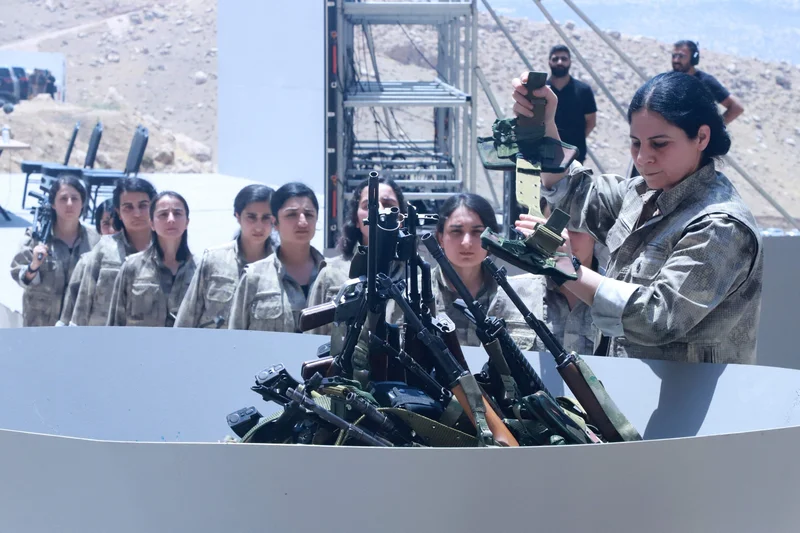
The ruling Justice and Development Party (AK Party) presented a draft bill to Parliament on Wednesday as the next stage of the landmark terror-free Türkiye initiative, aimed at dissolving the PKK through the reintegration of former members of the terrorist group.
Two years after it informally began, the terror-free Türkiye initiative took a new turn on Wednesday. The ruling Justice and Development Party (AK Party) submitted a bill to Parliament that is expected to further advance the process. The party began collecting signatures from political parties on Tuesday, and the bill will likely be brought before Parliament for further discussion and an eventual vote. Most parties support the plan. Some 360 signatures were collected from the lawmakers.
Although the contents of the bill, titled the Law on National Solidarity and Social Integration, have not yet been fully unveiled, media reports say it primarily focuses on the return of PKK members from abroad, particularly from northern Iraq, where the group's senior cadres are based. Those senior cadres, however, are expected to be exempt from the planned sentencing leniency for returnees. The law will serve as a framework for processing returning PKK members through the judicial system and facilitating their reintegration into society.
Parliament will postpone the start of its summer recess in order to pass the law, which would mark the culmination of lengthy parliamentary debates, messages delivered by the PKK's jailed ringleader Abdullah Öcalan calling on the group to dissolve itself, and the PKK's moves to lay down its arms, which began last year. The dissolution process is being monitored by Turkish intelligence, and authorities have repeatedly said the temporary law will only be implemented once the group's disarmament is fully completed.
PKK members involved in acts of terrorism will not be covered by the new law. However, it is expected to reduce the sentences of those already convicted and incarcerated, as the group's dissolution would also mean the removal of its designation as a terrorist organization under Turkish law. Since the 1980s, the PKK has waged a violent campaign that has killed tens of thousands of people. The group's campaign, aimed at establishing a so-called Kurdish state in southeastern Türkiye, posed the country's greatest security threat for decades. Türkiye has significantly weakened the PKK's influence across the region through cross-border operations in Iraq and Syria, while strict counterterrorism measures, particularly in the southeast where PKK militants operated from mountainous terrain, have substantially reduced the group's presence.
Almost all parties in Parliament support the bill, with the exception of the Good Party (IP), while critics argue that it amounts to a concession to the PKK.
AK Party Deputy Chair Efkan Ala told Anadolu Agency (AA) on Wednesday that the law would not be delayed under any circumstances.
"Everything is proceeding as we expected. We plan to have the law approved before the recess," said Ala, who served as interior minister toward the end of the "reconciliation process" launched more than a decade ago to resolve the PKK issue. That process failed after the PKK ended a brief lull in its activities and resumed attacks in southeastern Türkiye.
"By resolving this issue once and for all, Türkiye will move steadily toward its goals. The atmosphere and overall assessments are positive. There is strong political and public support. As a result of these efforts, Türkiye will break free from its shackles," Ala said.
Devlet Bahçeli, chairman of the government's ally, the Nationalist Movement Party (MHP), who first proposed the initiative, was quoted by Turkish media on Wednesday as saying that lawmakers' signatures had "certified a 1,000-year-old brotherhood." Bahçeli was among the first to sign the draft law, and he has frequently portrayed the initiative as a way to "cement Turkish-Kurdish brotherhood," referring to the PKK's exploitation of disaffected members of the Kurdish community to recruit militants to its cause.
"This is a win for everyone, for the people of the Middle East, and a step toward disrupting global plots," Bahçeli said.
For the Turkish state, the PKK is also viewed as a proxy for imperialist designs in the Middle East, serving as a separatist group seeking to undermine Türkiye's sovereignty. This has been most evident in the support provided by Türkiye's NATO ally, the United States, to the PKK's Syrian wing, the YPG. Bahçeli told journalist Sinan Burhan that the terror-free Türkiye initiative was not a political move but rather "a state project."