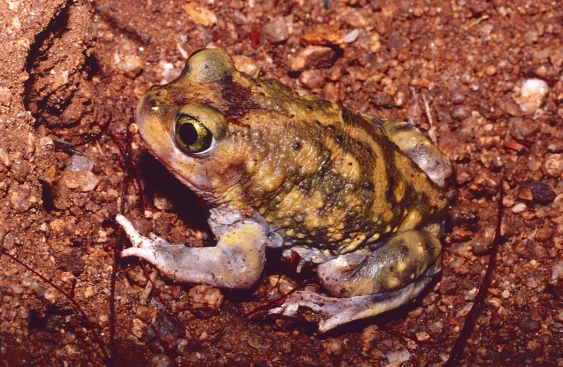
Frogs don’t preserve well in the fossil record. Their soft bodies and fragile bones are likely to just disintegrate. And so, fossils have provided only limited knowledge about their ecology. Now, though, a new study published in the Journal of Vertebrate Paleontology reports on several species of fossilized frogs, including a never-before-described spadefoot toad.
The fossils were recovered from the La Brea Tar Pits in Los Angeles. Despite their unlikely location at the center of urban sprawl, the tar pits hold a record amount of Pleistocene life from about 45,000 years ago onward. The natural asphalt—crude oil called “bitumen”—acted like a sticky trap, immobilizing animals in the pits and eventually infusing their bodies, preserving 19 species of extinct mammals and 16 extinct birds.
Headed by lead study author Alberto Cruz, now at Mexico’s SECIHTI-Centro de Investigación Paleontológica Quinametzin, paleontologists reviewed numerous different fossils from the tar pit’s Hancock Collection. At first, Cruz thought that the new toad species was deformed from illness or injury, but his comparisons with modern spadefoot toad specimens brought to light its unique features.
Read more: “Toad Orgies, Underwater AC, and Other Stories From the Storm”
“I reviewed and reviewed a lot of specimens until I was convinced,” said Cruz in a press release. “I thought, ‘Oh my gosh, this is a new species.’ This material is originally from the 1950s, but when you study it again, you can find gold in these specimens.”
While there’s no literal gold, the preserved frog—Spea labreae sp.—is an exceptional find, the first extinct amphibian species ever discovered at the tar pits. The researchers attribute the dearth of such finds in part to the dainty bones that require thorough sediment analysis, and in part to collections still meriting examination.
S. labreae is about 7 percent larger than its living spadefoot relatives, which fits with the general decrease in body size of animals starting during the Pleistocene, as the end-Pleistocene extinctions were biased against larger-bodied species. In fact, the study authors hypothesize that “Spea labreae could have went extinct because it was larger than the extant Spea species.”
Still, it clearly stood the test of time unlike any amphibian before (or after) it.
Lead image: A western spadefoot toad, common in California today. Its predecessor, the remains of which were recently uncovered from the La Brea Tar Pits in Los Angeles, would have been about 7 percent larger. Credit: Michael / Adobe Stock