A New World Record in the Greased Pole Walk Brought Extra Excitement to This Year’s World Eskimo-Indian Olympics in Alaska
A 45-year-old record fell at the annual sporting event, which celebrates Indigenous athleticism and culture with events including the knuckle hop and the Alaskan high kick
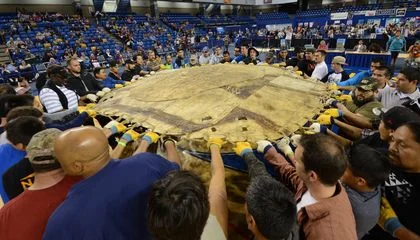
Opening ceremonies at the 2014 World Eskimo-Indian Olympics included a blanket toss.
Public Affairs Office Fort Wainwright via Wikimedia Commons under CC-BY-SA 2.0

A 45-year-old world record was shattered this month at the World Eskimo-Indian Olympics as college student Leif Richards walked 15 feet, 4.5 inches across a greased wood pole, eclipsing the old mark by nearly two feet.
The previous record, set in 1981 when Gene Andrew made it 13 feet, 6 inches, was one of the longest-standing records in the history of the games, which have taken place annually in Fairbanks, Alaska, since 1961. The event celebrates Indigenous athleticism, endurance and culture in the circumpolar north. More than a dozen sporting events, each with rich histories, are rooted in traditional practices.
The knuckle hop, for example—in which participants assume a plank position on their knuckles and toes and hop across the floor in a test of strength and pain tolerance—mimics techniques used by Arctic hunters to sneak up on seals. The Alaskan high kick—in which athletes balance on the floor on one arm and one leg before kicking a dangling target that is gradually raised higher in the air—originates from friendly competitions held inside peoples’ homes to see who could dip a toe into ash leftover from a fire and leave a sooty footprint as high as possible on the ceiling, according to the Anchorage Daily News’ Chris Bieri.
“All of our events were created by storytellers, dances, and the traditional garments from our Indigenous people,” Nicole Johnson, board member for the World Eskimo-Indian Olympics, tells Indian Country Today’s Dan Ninham. “They’re all connected. Our communities would gather to celebrate a successful hunting season. They held contests of strength and endurance, shared stories through storytelling and dance about their experiences of travel, to hunt and survive.”
The greased pole walk requires skill and balance. Competitors step barefoot onto the plank, slicked with shortening grease or animal fat, and then shuffle horizontally as long as possible without falling off.
The event “represents the treacherous task of navigating slick, wet, and highly unpredictable sea ice, glaciers or wet fish wheel logs during subsistence hunting and fishing,” according to a Facebook post celebrating Richards’ winning walk shared by the World Eskimo-Indian Olympics. “The game tests a person’s mental focus, core stability and the invaluable survival skill of keeping your composure under incredibly unstable conditions.”
Even the new record holder does not always find success in the event. “Last year I got negative-two inches in grease pole walk,” Richards, a student at the University of Alaska, Anchorage, tells KTUU’s Adrian Peterson. “I come here for the community and to help people out. Winning is just like a little fun upside.”
How to: Alaskan High Kick
The World Eskimo-Indian Olympics, open to Indigenous athletes who are at least 12 years old, are considered an important way to share history and culture with new generations of Alaska Native youth.
“I’m part of a long unbroken passage of knowledge,” decorated athlete and coach Kyle Ḵaayák’w Worl tells the Guardian’s Melissa Hellmann. “There have been many challenging points in our people’s history where things were almost taken from us: our language, our culture. It really is this generation’s responsibility to be intentional and put forth a good effort to keep it going.”
Worl, who has coached the new record-setter Richards, according to Alaska Sports Report’s Arielle Himelbloom, hopes that the World Eskimo-Indian Olympics can also reach larger audiences across the world who will appreciate the joys and intensity of Alaskan sporting.
“I don’t want our culture to be a relic of the past in museums,” Worl tells the Guardian. “It’s something alive, and it can live beyond its original context. Our own Indigenous sport, language and culture are part of the fabric of what makes us human and diverse. It’s important that our culture, our voices are recognized on that world stage as well.”