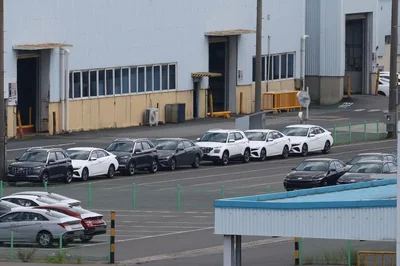
Production lines for Hyundai Motor's IONIQ 5 electric vehicle are seen at the automaker's factory in Ulsan. Courtesy of Hyundai Motor
Hyundai Motor’s artificial intelligence (AI)-sparked wage overhaul faces a critical task of redesigning a compensation system in ways that would protect workers’ income without undermining productivity, experts said Monday.
The carmaker’s management and labor union are reviewing the introduction of the so-called "complete monthly wage system," under which overtime and other variable allowances — currently paid based on hours worked — will be incorporated into production workers’ fixed monthly salaries.
The initiative will be studied through a joint labor-management task force.
Hyundai already shifted its production workers from an hourly wage system to monthly salaries in 2012. However, overtime and night-shift allowances are still paid according to actual hours worked.
The proposed reform would reduce those monthly fluctuations by converting part of the variable pay into fixed wages, so factory workers can ensure their income stability even after the carmaker’s planned deployment of humanoid robots across its major production lines here and abroad.
Hyundai Motor Group is accelerating investment in factory automation, with its robotics subsidiary, Boston Dynamics, planning to mass-produce Atlas humanoid robots beginning in 2028.
Hyundai Motor production employees leave work two hours early during a partial strike at the company's Ulsan factory, July 13. Yonhap
Experts said income stability cannot come at the expense of productivity.
"The discussion should not center on whether labor or management benefits more," said Hwang Yong-yeon, head of labor policy at the Korea Enterprises Federation.
"The fundamental question lies in how both sides can improve productivity, even after AI and robots become integrated into manufacturing."
Lee Ho-geun, a professor of automotive engineering at Daeduk University, said the auto industry differs from many other sectors because compensation has traditionally remained closely linked to measurable output.
"If workers perceive that compensation is no longer connected to performance, work motivation and production efficiency could decline, ultimately affecting corporate competitiveness," Lee said.
"Given the cyclical nature of the automotive industry, where production volumes fluctuate and overtime and weekend shifts are common, the key will be designing a framework for measuring working hours and evaluating performance. More important than the system itself is establishing a fair evaluation mechanism and safeguards to ensure productivity is maintained."
Unlike office-based industries where workloads remain relatively stable, vehicle production rises and falls in line with consumer demand, making overtime and special shifts essential operational tools.
"From the perspective of the carmaker’s management, this is far from an ideal scenario," said Kim Pil-soo, a professor of automotive technology at Daelim University.
"Automobile production fluctuates throughout the year. Once overtime-related allowances are absorbed into fixed salaries, companies lose much of the flexibility needed to respond to changing production volumes."
Boston Dynamics' Atlas humanoid robot demonstrates its movement capabilities at Hyundai Motor’s booth during CES 2026 in Las Vegas, Jan. 7. Yonhap
Some others expressed worries that the ripple effects could also extend well beyond Hyundai Motor.
Yoo Il-ho, head of the employment and labor policy team at the Korea Chamber of Commerce and Industry, cautioned that labor agreements at the country's largest automaker often become reference points for the rest of the manufacturing sector.
"If the carmaker adopts such a model, similar demands are likely to emerge at small and medium-sized manufacturers," Yoo said. "That is why the company must approach the issue with great caution."
Industry officials said another key issue to be discussed is how productivity should be measured in AI-driven factories.
“The central challenge is no longer simply how many hours employees work, but how to reward productivity when humans increasingly work alongside machines,” an auto industry official said.
Discussion on the proposed complete monthly wage system is still in its early stages, giving both management and labor ample time to narrow their differences on the matter.
“Earlier this month, both sides agreed to jointly examine and discuss measures to develop a future-oriented advanced wage system in response to the union’s proposal for a complete monthly wage system,” a Hyundai official said.
“The agreement should not be interpreted as a decision to adopt the system. Rather, labor and management will use a joint task force to study and discuss potential reforms to the company's wage structure.”