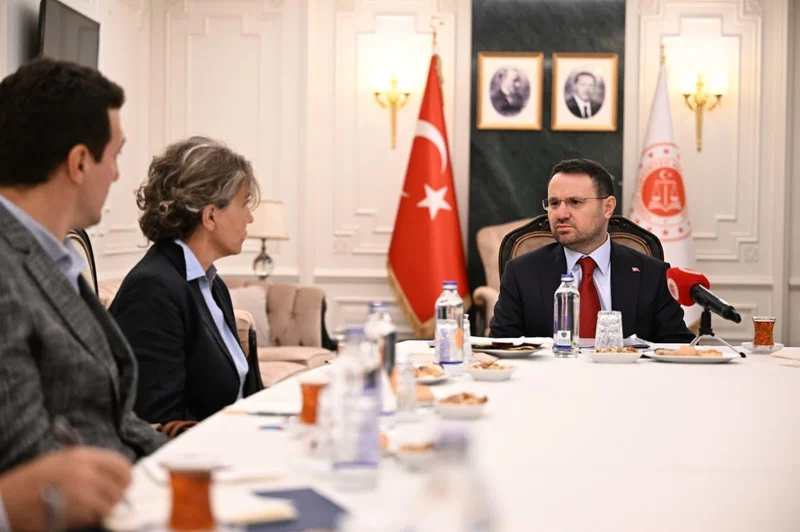
Justice Minister Akın Gürlek on Thursday hosted the families of a murdered journalist and a police chief whose death has long been considered suspicious by his relatives.
The meetings are part of the Justice Ministry's effort to shed light on unsolved murders from past decades. Since taking office in February, Gürlek has pledged to seek closure in high-profile cold cases that have remained unresolved for years.
Gürlek's first guests were the son and sister of Behçet Oktay, the former head of the Turkish National Police's elite Special Operations Department. Oktay was found dead next to his car in Ankara in 2009, and his death was officially ruled a suicide. His family rejected that conclusion, insisting that he was murdered.
The family believes the Gülenist Terror Group (FETÖ) may have been involved in his death, saying Oktay was known for opposing FETÖ loyalists who had secretly infiltrated law enforcement at the time. Gürlek echoed that point after meeting the family, saying Oktay had been "in FETÖ's crosshairs" when he died. He added that the case warranted a new investigation, including a review of the actions of the first responders at the scene.
Oktay's sister, Şule, told the minister that the police chief had been targeted by defamatory articles in pro-FETÖ media outlets before his death. She said Oktay had planned to have dinner at home but changed his plans at the last minute after being invited elsewhere.
"It was three in the morning when we were told that he had committed suicide. The case was not thoroughly investigated, and it was closed," she said.
Oktay's son, Burak, said the family had been told that his father died by suicide using his personal pistol, but the bullets recovered from his body did not match the ammunition loaded in the weapon at the time of his death.
Gürlek's next guests were Şükran Güldal Mumcu and Özgür Mumcu, the wife and son of Uğur Mumcu, respectively. Mumcu was a prominent investigative journalist and author of several nonfiction books. He was killed when a bomb planted in his car exploded outside his home in Ankara on Jan. 24, 1993.
His assassination was blamed on an Iran-linked group, and one suspect accused of planting the bomb was captured and convicted. However, the family has repeatedly called for the case to be reopened to identify the masterminds behind the assassination and apprehend a fugitive suspect who remains at large.
Speaking during his meeting with the Oktay family, Gürlek said the ministry was paying particular attention to suspicious cases from the 2007-2010 period, highlighting the murder of journalist Hrant Dink and the death of politician Muhsin Yazıcıoğlu in a helicopter crash.
"We are paying particular attention to this period to determine whether there may be any fingerprints of FETÖ. These incidents may have been part of an organized operation," Gürlek said.
Although Dink's killer was captured, the full motive behind the assassination has never been conclusively established, as earlier stages of the investigation were allegedly obstructed by police chiefs linked to FETÖ.