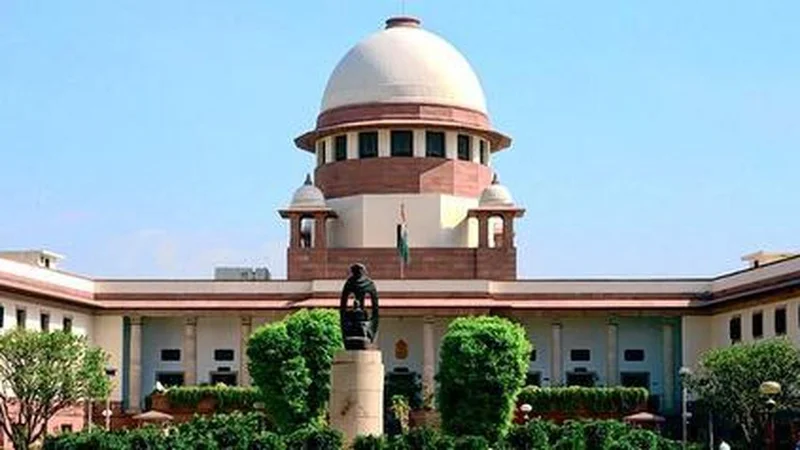
Opposing a batch of petitions in the Supreme Court of India, which seek a creamy-layer exclusion within the reserved categories of Scheduled Castes (SCs) and Scheduled Tribes (STs) as in the Other Backwards Classes (OBC), the Union government argued judicial precedents had clarified that the “principles of creamy layer do not apply to SCs and STs”.
The Union Ministry of Social Justice and Empowerment has further told the top court in an affidavit that in a “majority” of welfare and development schemes for SCs, STs, and OBCs, except reservation in educational institutes and services under the State, there is already a “means test which ensures that benefits of schemes percolate to those who actually deserve them”.
The Centre’s stand on the issue has come after the Supreme Court in February this year issued a notice on the petitions related to it. The court had also asked the Union government to file an Action Taken Report after the 2024 Supreme Court decision that paved the way for sub-categorisation among SCs and STs. No such Action Taken Report appears to have been filed with this affidavit.
In its submission to the court, the Centre said: “Modification of reservation policy, particularly to introduce income-based preferences within reserved categories, should be preceded by a holistic review and thorough empirical study, including socio-economic data of reserved category beneficiaries.”
In the affidavit, the Centre lays out the provisions related to the classification of and reservations to SCs, STs, OBCs, and Economically Weaker Section (EWS), before going on to explain that the main objective of the reservation policy for SC, ST and OBC groups was to “achieve social equality and justice, overcome historical disadvantages and discrimination, ensure economic empowerment and upliftment for marginalized communities, and promote their inclusive participation in education, public services, and decision-making processes”.
Further, the government has said that the current matter — that of seeking an income-based creamy layer for SCs/STs — neither raises a constitutional issue nor discloses the violation of any fundamental right under the Constitution.
The Social Justice Ministry went on to say that the petitioners had “not approached the court with clean hands”, adding that the petitioners had “indulged in misstatement of facts solely with the intention of misleading” the court. The government was referring to certain parts of the petitions that cited certain judgments to argue for exclusion of creamy layer in the quota for SCs and STs as well.
Responding to this aspect, the Centre said that the judgment cited in the M. Nagaraj case had merely referred to the creamy layer concept, which appeared to be a “general observation” with regards to reservations for OBCs.
The argument that a creamy layer concept for SC and ST reservations should be introduced picked up pace after the 2024 judgment by a seven-judge Bench in State of Punjab vs Davinder Singh, where Justice (Retd.) B.R. Gavai had noted in his opinion that the government “must” find a way to identify a creamy layer for SCs and STs even if the criteria for this identification was different than that for OBCs.
While the 2024 judgment had given sanction to State governments to continue with their policy of sub-categorising SC and ST quotas, the Centre has been unclear on its position on wielding this power at the national level.
In its affidavit, the Centre has stressed that only Parliament can add or remove communities from the SC and ST lists, and that this is not a domain for the court to enter. However, the Davinder Singh judgment had distinguished between Parliament’s power to add or remove communities from the lists and the Executive’s power to simply categorise within the existing lists.
Published - August 06, 2026 10:58 pm IST