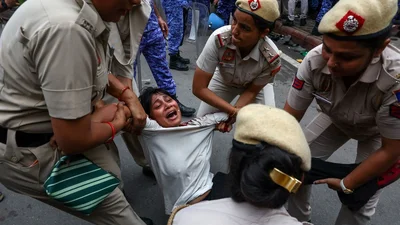
Over the past 15 years, Delhi has witnessed some of the most defining public protests. Be it the 2021 tractor rally, where protesting farmers breached security at the Red Fort, or the 2012 Nirbhaya agitation, where ordinary citizens reached the doors of Raisina Hill. Like the previous incidents, the Delhi Police seems to have misjudged the scale of Monday's Cockroach Janta Party (CJP) protest, which turned violent as thousands of youth clashed with police, who were clearly outnumbered, leaving nearly 200 injured.
That the 'Sansad Chalo' march, demanding reforms in the education system, would take place on July 20 was known. The CJP agitation was on for over a month. Yet, tens of thousands of protesters were able to reach the doorsteps of Parliament before they were lathi-charged and tear-gassed. Around 60 protesters were injured. The injury count on the police side was double the number (118). There were telltale signs that the police failed to accurately estimate how many protesters would take part in Monday's march.
Supporters of the Cockroach Janta Party scuffle with police as they attempt to march toward Parliament
HOW THE COCKROACH PROTESTS UNFOLDED?
The call for the march to Parliament was issued around three weeks ago by the CJP, a satirical movement founded by Abhijeet Dipke. On June 28, activist Sonam Wangchuk started an indefinite hunger strike demanding the resignation of Union Education Minister Dharmendra Pradhan over the NEET-UG paper leak fiasco. In the initial weeks, the protest failed to gather any steam.
The first sign of government intervention was seen on July 18, when Wangchuk was removed by cops and shifted to Safdarjung Hospital in dramatic early-morning scenes. However, instead of ending the agitation, it gave the protest a fresh impetus.
In fact, hundreds more arrived at the Jantar Mantar protest site in solidarity. By Sunday evening, the numbers swelled from 3,000 to around 5,000. According to a report in The Indian Express, the Delhi Police had intel that the turnout would be around 7,000-8,000. However, on Monday, nearly a lakh protesters gathered on the roads leading to Sansad Marg.
Delhi Police said the CJP neither sought permission nor received any nod to hold a march to the Parliament. However, it didn't deter the protesters, who came from all walks of life - students, parents, young professionals. Several were teens, aged between 12 and 17, many of whom said they came to the protest after lying to their families.
According to a report in HT, several women protesters and students travelled from nearby states to Delhi in groups or connected with other participants through WhatsApp.
While the CJP said their march would be "peaceful", what added to the intrigue was the presence of a truck carrying stones parked near Jantar Mantar. Neither the CJP nor the police claimed to know how it ended up there despite prohibitory orders in place.
In a post on X, Dipke posted a video purportedly showing a truck loaded with stones, saying it could be used to falsely implicate peaceful protesters. "What are the police authorities up to? Are they orchestrating stone-pelting on the CJP protesters?" Dipke tweeted. He also alleged that a damaged vehicle had been placed near the protest site.
DID GOVT MISJUDGE SCALE OF CJP PROTEST?
The preparations on the ground appeared to indicate that the police believed the protest march would fizzle out before noon. The area around Jantar Mantar was extensively barricaded. Initially, around 2,000 personnel were deployed.
The Home Ministry also seems to have believed that the protest would not sustain. The initial internet shutdown order was issued from 6 am to noon. However, as the situation spiralled out of control, with protesters breaking barricades and clashing with police, the internet shutdown was extended till 6 pm.
As the crowd swelled, the DMRC closed five metro stations, ostensibly to prevent more protesters from reaching the site. However, this created chaos and an unending agony for the thousands of office-goers and commuters who remained stuck for hours.
"Four (metro stations) less than those shut during 2012 Nirbhaya protests," tweeted author Rahul Pandita.
The police's primary objective was to prevent the march from reaching Parliament, where the first day of the Monsoon session was underway. The cops soon found that the use of mild force was insufficient to deter the crowd. As the day progressed, the situation only worsened.
The police and security personnel were clearly taken aback.
Seeing the intensity of the protests and as the agitators reached Parliament, the Centre deputed Union Health Minister JP Nadda to engage with CJP leaders. CJP spokespersons Saurav Das and Ashutosh Ranka met Nadda at his residence and submitted three demands.
These included release of Wangchuk, resignation of Dharmendra Pradhan, and Rs 1 crore compensation to the family of each NEET aspirant who died by suicide. However, the government did not commit to their demands.
Nadda's meeting with the CJP leaders was the first government acknowledgement of the month-long protest. The protests had already created bad optics, and the government didn't want to be seen as insensitive to the students.
Police personnel turn over a damaged vehicle during the violence on Monday (Reuters)
MISCREANTS, OUTSIDERS INVOLVED?
In the background, the standoff escalated near Parliament Street.
Viral videos on social media showed the police, some in plainclothes, repeatedly beating the protesters with batons. Some were seen severely bleeding from their heads. Several protesters alleged that they were beaten even after falling to the ground. Another protester alleged the batons had nails stuck to them.
The police suspect that miscreants might have infiltrated the protest as part of a pre-planned conspiracy. By the end of the day, around 70 protesters were detained.
However, police said those detained were not "students" and suggested that the "outsider" angle would be investigated as well. CCTVs, mobile phone recordings, and drone footage are also being scanned to find out whether those involved in the vandalism had previous criminal records.
Overall, there were clear signs that the police and the government grossly misjudged the scale of the Monday protest. It not only failed to initiate early dialogue with the protesters, but it also failed to gauge the scale of youth anger despite weeks of prior signals.
- Ends
Published By:
Abhishek De
Published On:
Jul 21, 2026 13:23 IST