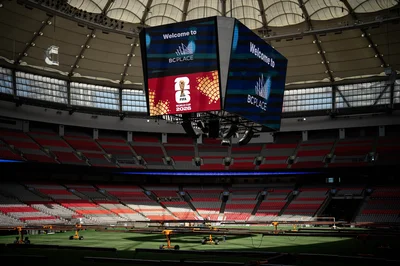

UV grow lights are seen on the grass pitch installed at BC Place ahead of the World Cup. The grass, a blend of Kentucky bluegrass and perennial ryegrass, was grown over a year at a farm in Abbotsford, B.C.Ethan Cairns/The Canadian Press
Nearly every part of Vancouver’s World Cup playing field will be given a new life, with components going to a local baseball diamond, new sports fields and research into more resilient soccer pitches.
BC Place hosted seven matches and its pitch was the setting for some of the most defining moments of the tournament in Canada. It was the stage for the first World Cup win by Canada’s men’s national team, and bore witness to Egyptian superstar Mohamed Salah leading his country to its first victory since its debut in 1934. It was also where a hard tackle snapped the leg of Canada’s Ismaël Koné, sidelining the linchpin midfielder and rallying the nation.
With the largest World Cup now over, BC Place is recycling or repurposing nearly every part of its field of play, from the grass pitch and the sand beneath it to the goal nets and frames and corner flags.
Tony Valente, senior director of infrastructure and capital projects at BC Pavilion Corp. (PavCo), which owns and operates BC Place, said the approach reflects the provincial Crown corporation’s environmental sustainability goals. The 43-year-old stadium received a Leadership in Energy and Environmental Design (LEED) Gold certification in June, following years of energy-saving retrofits and sustainability initiatives.
“I think this is what British Columbians expect, and what people in Vancouver expect,” Mr. Valente said in an interview. “This is the values of the region manifested.”
BC Place hosted seven World Cup matches and its pitch was the setting for some of the most defining moments of the tournament in Canada. Now, nearly every part of the playing field will be repurposed.
The Globe and Mail
An April Globe and Mail feature detailed the massive effort behind growing grass for the World Cup. Five years of research and US$5-million went into ensuring consistency of the playing fields, which were spread across 16 host stadiums in three countries, with different climates and elevations.
For Vancouver, a blend of Kentucky bluegrass and perennial ryegrass was chosen for its fast germination and tolerance of temperate climates. The grass was grown over a year at a sod farm in Abbotsford, B.C., using a “hybrid carpet” system, in which natural grass is grown on synthetic backing. The result is a more durable surface that is also easier to transport.

Workers patch the grass pitch installed at BC Place in May. Beneath the grass was 5,000 tonnes of sand, which will also be reused.Ethan Cairns/The Canadian Press
The 80,000-square-foot pitch at BC Place has since been returned to the sod farm for composting. It now sits in a bunker where it will spend the next year breaking down, aided by occasional turning to encourage decomposition, said Bos Sod Farms president Bert Bos.
Next summer, the farm will separate the organics and sand from the synthetic backing. The organic matter will be used to grow a new field, while the synthetic material could potentially be recycled into a new product.
The 5,000 tonnes of sand that sat beneath the grass will also be reused. Rob Maat, president of Wilco Civil Inc., the civil and landscape development company that built and removed the BC Place field of play, said some will go to the renewal of a baseball diamond at Mackin Yard in Coquitlam.
Half a field of contingency grass that wasn’t needed during the World Cup remains at the Abbotsford sod farm. PavCo is exploring opportunities to donate it.
Canada’s World Cup games are over. What’s left behind?
Wilco, a leading builder of sports fields in B.C., will use some of the contingency grass and salvaged sand to research whether a hybrid natural grass system could be a new option for community sports fields in the Lower Mainland, where heavy rainfall and reduced sunlight during the peak soccer season has led most communities to use artificial turf.
Mr. Maat said his team will build a mini soccer pitch on private property in Langley to study the construction practicality, maintenance requirements and recovery rates of the playing surface, among other factors. Youth soccer clubs will be invited to play on the pitch and provide feedback.
The interlocking plastic geocells that formed the foundation under the pitch will be auctioned off. Grow-light rigs, fans, cables and power transformers – leased for the World Cup – are being returned to their manufacturers. Goals, corner flags and players’ shelters will be repurposed.

After the last World Cup match at BC Place, the entire playing field was removed in 72 hours.DARRYL DYCK/The Canadian Press
While many footie fans have called for the natural grass pitch to remain at BC Place, it wouldn’t have been feasible in the multipurpose stadium, Mr. Valente said. Concerts, trade shows and other events would require the grass to be covered with flooring for days or more at a time, depriving it of light and ventilation.
The used pitch couldn’t easily be donated, either. Cutting the sod barely a month after installation would almost certainly compromise it, Mr. Bos said, a risk made even less worthwhile by the high cost of transporting and installing it elsewhere.
The entire playing field was removed in 72 hours, after which a new artificial turf surface was installed. The BC Lions host the Toronto Argonauts at BC Place on July 25, just 18 days after the stadium’s final World Cup match.
Cathal Kelly: When it comes to soccer, this is as good as it gets for Canada
Mr. Valente called the experience a “once-in-a-lifetime” opportunity. Adam Grossman, senior director of communications at PavCo, said the organization was proud of the role it played in a successful event that brought together the city, thousands of volunteers and the broader community.
“This was a moment of, we played a really big part in something, alongside so many others, and wow, we showed up well,” he said.
Those who helped create Vancouver’s World Cup pitch admit they were a little distracted during the games themselves. As his family focused on the action, Mr. Bos found himself scanning the field for any tufts or divots that may have formed during play.
“You don’t want to see anything that people don’t want to see on TV, right?” he said. “But it did pretty well, so I was really happy with the outcome.”
Mr. Maat, 70, said the project was a special way to round out a career that has included work for the 2010 Winter Olympics and Expo 86.
“All those projects were major milestones in my career and this was right up there – probably the tops in terms of challenges and technical ability to do it," he said. “It was a thrill.”
Mr. Maat conceded that his attention, too, was divided.
“I was watching the grass more than the guys,” he said with a laugh.