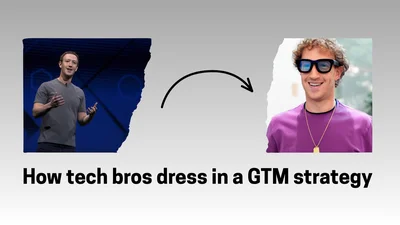
Welcome to the only industry on earth where dressing badly on purpose is a competitive advantage, where a $14 t-shirt can carry more authority than a $4,000 blazer.
Tech founders looked like
I'm Daria Strategy. I work with founders and tech teams on go-to-market and narrative, packaging a product into a story buyers understand. Reading the signal a room receives before a word is spoken is exactly what I do, shaping how founders and products get perceived so the right buyers understand them fast.
Is it about taste or go-to-market?
Daria Strategy here! Happy to explain why your wardrobe is your GTM strategy.
What you wear is the fastest positioning statement you'll ever make.
Before you open your mouth, your clothes have told the room your category, your stage, and which buyer you think you're talking to. Most people are unconsciously dressed for the wrong one.
Steve Jobs had the famous black turtleneck and New Balance sneakers.
Zuckerberg in the grey t-shirt, explaining he didn't want to waste decision-making energy on clothes. Except the man who saved all that willpower by wearing one shirt now spends it on a haircut budget and a gold chain, so I'm not convinced the energy went where he said. The message underneath was always: I'm too important to perform importance. For a decade, the richer you were, the more aggressively ordinary you dressed.
Zuckerberg's glow-up into tailored everything happened because Meta needed to stop looking like a dorm project and start looking like a company that could sell you a three-hundred-billion-dollar AI bet and a headset you wear to dinner.
The wardrobe is investor relations:
- When you're the underdog, you dress down to say don't count me out.
- Defending a trillion-dollar narrative, you dress up to say take this seriously.
Crypto founders: from meme t-shirts to tuxedos
18 months ago the founder uniform was a meme t-shirt, an ironic cap, ON Running or Nike sneakers — a look that said I'm an internet degenerate who happens to control a treasury. Walk into a crypto event now, and a lot of those same people are in jackets and loafers, looking like they're applying for a banking license, because several of them are.
Source: Google
That shift is pure go-to-market.
The meme tee was perfectly on-brand when the buyer was a twenty-four-year-old with a hardware wallet. It's malpractice when the buyer is suddenly a pension fund and a compliance officer who has never once said "gm." They changed clothes because they changed customers.
Patagonia vest diplomacy
Then there's the vest. Patagonia, or Barbour once we've gone quietly old-money. Worn indoors, worn in July, worn by men who are not cold.
Source: TikTok and Google
Patagonia reportedly got so tired of being the unofficial finance uniform that they pulled back on co-branding with those firms, which only made the existing vests more of a sacred relic.
The vest does precise work: it reads as “I have capital and I'm serious without tipping into a suit”, because a suit files you under "salesperson," which in a room full of engineers is a downgrade. It's a hedge between two buyers, the money and the builders.
Patagonia vest culture has become so memeable that I asked a friend, a fintech bro, why they wear them. He said, "because it's cold in the office". But most of them just wear vests out of habit.
How to sell fear and trust with one hoodie?
Cybersecurity runs an anti-uniform with total conviction. Black t-shirt, black hoodie, laptop fossilized under stickers, the posture of someone who could be inside your network by lunch.
In an industry that sells trust and paranoia, looking too corporate is a liability, and polish reads as the thing you're supposed to protect people from. The black hoodie says “I'm closer to the attacker than to your procurement department”, which, when you're buying security, is exactly who you want.
Tasteslop and AI crowd
And the newest tribe, the AI crowd, with their anxious obsession with taste. I made a whole article on Hackernoon about why taste is the cope for vibecoders, but the short version: a community that can optimize anything, suddenly desperate to optimize the one variable with no loss function and no A/B test.
The OpenAI new merch is the newest example that confirms this AI slop trend. Primitive design, sophisticated presentation. I don’t even know what I “like” more: socks or a bag with an ugly robot saying “building things“ and representing “AI revolution.“
Source: https://x.com/karine_hsu/status/2077442751478837326
It’s hard to find a more basic and tasteless combination than this, but it does the work: it signals that the person joined the company to build. And it’s a contrarian approach to OpenAI’s statement on “taste is the most valuable skill“. There is no taste skill, but pure utility.
Source: a screenshot from the new role at OpenAI
What can you do?
The grey tee, the loafers, the vest, the black hoodie, or the linen — each encodes the same three things:
- tech category/niche
- startup stage
- buyer (ICP)
The person who shows up over-dressed hasn't underdressed the room. They've mis-segmented themselves, optimized for a buyer who isn't there. And it lands hardest on people from cultures where formality is the language of respect. You wear your best to show you take this seriously, and a room raised on inverse signaling reads your respect as a sign you don't get the game.
So the move isn't to chase the uniform. It's to dress so the code can't use your clothes against you — neutral, deliberate, segmented for the buyer actually in the room. The real edge was never the t-shirt. It's being the one person who can read the whole positioning war while everyone else believes they got dressed this morning.
Tell me in the comments: what's the dress-code tell in your corner of tech, the thing that instantly says insider, or instantly says outsider?
💗 Liked this article? Follow me on X, LinkedIn, and Youtube.
💬 Have something to share or want to discuss the fashion trends in tech? Let me know in the comments.
👀 I also covered this topic in a video format. Check it out!