SCIENCE
Viking 1 landed on Mars 50 years ago
And would have lasted longer if some code hadn't trampled on places it shouldn't
It has been half a century since NASA landed on Mars with the Viking 1 lander.
Viking 1, one of a pair of Viking spacecraft, landed on Mars on July 20, 1976. Launched on August 20, 1975, Viking 1 arrived in orbit around Mars on June 19, 1976. The Viking program is, when adjusted for inflation, one of the most expensive robotic missions ever attempted by NASA.
The spacecraft consisted of an orbiter, which was eventually shut down on August 7 as its attitude control gas was depleted, and a lander, which became the longest-lived component of the Viking program (and even then, it was only human error that did it in).
The original plan had called for a landing on Mars on July 4, 1976, to coincide with the US Bicentennial, but a look at the potential landing site made managers postpone the descent to July 20 – the seventh anniversary of the Apollo 11 lunar landing – and a safer destination.
The lander was equipped with an ablative heat shield to withstand atmospheric entry. Parachutes slowed the lander as it descended, and retro-rockets fired just above the surface to ensure the three-legged Viking lander reached Martian soil without incident.
Viking 1 landed on Mars' Chryse Planitia. It performed the first sampling of Martian soil using its robotic arm and an onboard biological laboratory. While the official word from NASA is that no definitive signs of life were found, debate has continued over the decades that… perhaps… there was something else in the data from the robots.
NASA's take was that the "experiments discovered unexpected and enigmatic chemical activity in the Martian soil, but provided no clear evidence for the presence of living microorganisms in soil near the landing sites."
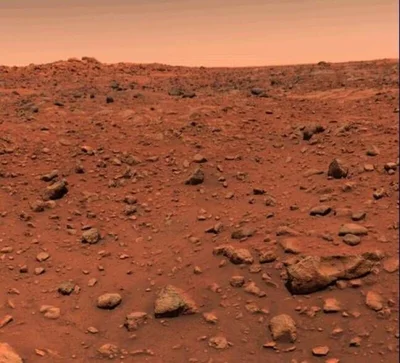
Findings from onboard experiments aside, the lander was also equipped with cameras capable of snapping breathtaking vistas of the surface, as well as antennas for communicating with the Viking 1 orbiter, which acted as a relay, and directly with Earth. Crucially, the lander was also powered by a Radioisotope Thermoelectric Generator (RTG), which uses the heat from the decay of plutonium-238 fuel to generate electricity. This played an important role in keeping the Viking 1 lander running past its 90-day prime mission all the way to when it made its final transmission on November 11, 1982.
The mission might have gone on longer if it had not been for a mistake made when engineers were devising ways [PDF] of prolonging the life of the lander's batteries. In January 1982, three of Viking 1's four nickel-cadmium batteries were showing signs of wear. Engineers attempted deep-discharge battery conditioning to bring things closer to where they had been at the start of the mission, but the results were only partially successful (with benefits being very temporary).
So, a different approach was tried. Rather than discharge the batteries for a specific time, engineers would have Viking 1 go for a known voltage. There would be a reduction in the frequency and duration of battery charging. Engineers reckoned the plan would prolong the life of the batteries and, on November 19, 1982, the changes for the battery charging sequence were uploaded… and… silence.
The expected downlink from Viking 1 did not appear, and on November 20, a spacecraft emergency was declared.
It transpired that the new battery charging sequence had been written to memory locations occupied by the lander's high-gain antenna pointing parameters. As a result, the antenna was no longer pointing at Earth.
The next four months were spent trying to contact the lander, but to no avail. In March 1983, the Viking Lander Monitor Mission (VLMM) was terminated.
Still, that was all in the future when Viking 1 landed half a century ago. Viking 1 wasn't the first spacecraft to make a soft landing on Mars – that prize goes to the Soviet Union's Mars 3 lander in 1971 (although transmissions ended 20 seconds after landing compared to the years of operation for Viking 1), but it produced spectacular imagery and a trove of science data and, coming just seven years after the first crewed lunar landing, was a triumph for the US space agency. ®