Your support helps us to tell the story
From reproductive rights to climate change to Big Tech, The Independent is on the ground when the story is developing. Whether it's investigating the financials of Elon Musk's pro-Trump PAC or producing our latest documentary, 'The A Word', which shines a light on the American women fighting for reproductive rights, we know how important it is to parse out the facts from the messaging.
At such a critical moment in US history, we need reporters on the ground. Your donation allows us to keep sending journalists to speak to both sides of the story.
The Independent is trusted by Americans across the entire political spectrum. And unlike many other quality news outlets, we choose not to lock Americans out of our reporting and analysis with paywalls. We believe quality journalism should be available to everyone, paid for by those who can afford it.
Your support makes all the difference.
Read more
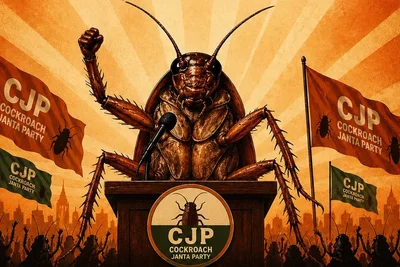
It began as a satirical movement online, embracing the humble cockroach as a way to voice the frustrations of young people in India after a series of scandals rocking the education sector.
Now, the so-called “Cockroach Janta (People’s) Party” has captured the attention of the nation, with a weeks-long sit-in protest in the capital culminating in a march on parliament that was met by tear gas and baton charges from the police.
Dubbing itself the “voice of the lazy and unemployed” as a response to criticism of Gen Z workers from India’s most senior judge, the CJP was founded on 16 May by Abhijeet Dipke, a 30-year-old public relations graduate at Boston University and former social media strategist for the Aam Aadmi party (AAP).
Within a week, it amassed nearly 20.5 million followers on Instagram, while its official X account – which was temporarily blocked in India due to a legal demand from the government – now has over 300,000 followers.
With the social media accounts came a website complete with a manifesto, membership guidelines, and a sign-up form inviting users to join “a political party for the people the system forgot to count”.
The party’s name parodies Indian prime minister Narendra Modi’s Bharatiya Janata Party (BJP), in power since 2014.
The movement traces its origins to comments from India’s chief justice Surya Kant, who said during a Supreme Court hearing on 15 May that there were “youngsters like cockroaches” who, unable to find employment or “any place in the profession”, turned to media, social media, and activism to “start attacking everyone”.
The comments, made while criticising what he described as “parasites” attacking Indian institutions, spread rapidly across Indian social media and struck a nerve among younger users.
The following day, Mr Dipke responded with a post on X asking: “What if all cockroaches come together?” alongside a Google form inviting users to join “a new platform for all the cockroaches”.
Mr Kant later clarified that he had been referring specifically to people entering professions using “fake and bogus degrees”, not unemployed young people broadly, who were “the pillars of a developed India”.
But the seed of an idea had already been sown. “Those in power think citizens are cockroaches and parasites,” Mr Dipke told Al Jazeera. “They should know that cockroaches breed in rotten places. That’s what India is today.”
Unemployment among Indians aged 15 to 29 stood at 9.9 per cent in 2025, rising to 13.6 per cent in urban areas, according to the Indian government’s Periodic Labour Force Survey. The 2026 State of Working India report by Azim Premji University also found unemployment among graduates aged 15 to 25 was close to 40 per cent.
Mr Kant’s remarks came amid nationwide anger after authorities cancelled India’s competitive medical entrance examination following a paper leak scandal. At least 2.3 million students sat the test on 3 May. The controversy followed similar scandals elsewhere, including the cancellation of Uttar Pradesh’s police recruitment exam in 2024, affecting 4.8 million applicants, and the scrapping of the UGC-NET examination the same year over leak allegations.
The controversy has since become a rallying point for the CJP, which has broadened its campaign to demand greater accountability in education, employment and governance. The group launched an indefinite sit-in protest at Delhi’s Jantar Mantar site on 20 June, making the resignation of education minister Dharmendra Pradhan its central demand.
The movement drew support from renowned activist Sonam Wangchuk, who launched a hunger strike in solidarity with the CJP’s campaign. Mr Wangchuk was later forcibly moved to hospital by police after three weeks of fasting.
Established political parties have been wary of how to handle the CJP’s sudden rise to the centre of public discourse, with few big-name politicians engaging with the group’s Delhi sit-in.
“The youth of India has largely vanished from the mainstream political discourse,” Mr Dipke told Reuters. “Nobody is talking about us. Nobody is listening to our issues or even trying to acknowledge our existence.”
That appeared to shift on 21 June when the Leader of the Opposition in parliament, Rahul Gandhi, spoke out in the CJP’s defence after protesters were tear-gassed the day before.
Other opposition politicians, including Trinamool Congress MP Mahua Moitra, Samajwadi Party chief Akhilesh Yadav, Trinamool Congress MP Kirti Azad and Aam Aadmi party leader Manish Sisodia, have voiced support for the CJP publicly.
The CJP’s manifesto channels frustration into a mix of satire and direct political demands. One proposal calls for retired chief justices to be barred from receiving seats in parliament’s upper house as a “post-retirement reward”, while another proposes a 20-year ban on politicians who defect between parties.
The manifesto also calls for 50 per cent of seats in parliament and cabinet positions to be reserved for women, and demands that media outlets owned by the billionaires Mukesh Ambani and Gautam Adani, whose business groups control Network18 and NDTVrespectively, have their licences revoked “to make way for truly independent media”.
Membership requirements listed on the website include being “unemployed, lazy, chronically online, and able to rant professionally”.
Supporters have described the CJP as a “breath of fresh air” and “completely unafraid to ask uncomfortable questions that mainstream politicians keep dodging”.
Critics have dismissed the movement as hidden arm of a major opposition party, pointing to Mr Dipke’s previous work with AAP between 2020-2023. Mr Dipke has denied allegations that the movement was coordinated by any political party, and told India’s The Printwebsitethat the idea emerged “completely impromptu”.
“I read the CJI’s comment – that everybody is a cockroach – and I tweeted from my personal account,” he said.
Others have questioned if the movement represents meaningful political organising or simply internet spectacle. “I have realised most internet folks have no clue how politics really works. Real-life political work is a ball buster,” wrote one critic on X. The Quint website argued that the movement remained “performance theatre” unless it connected to “organised power”.
Mr Dipke has stopped short of saying whether the CJP will formally enter electoral politics, cautioning against comparisons with the Gen Z-led uprisings in Bangladesh and Nepal. “Whatever we do, we will do within the rights of the constitution. We will do it in a very democratic and peaceful way,” he said.
For now, Mr Dipke says he wants to build what he describes as an “online political party” that encourages younger Indians to become more politically active. He said he wanted the platform to “mobilise youth, encourage civic engagement, and even guide supporters toward activism through steps such as filing Right To Information applications to hold governments accountable”.