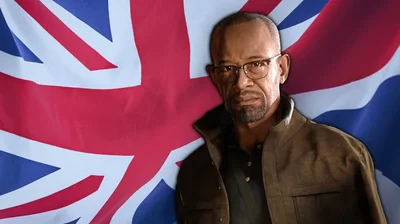
IO Interactive has shared more development insight about arguably the stand-out character in 007 First Light: James Bond's mentor figure, John Greenway. This is the character played brilliantly by Walking Dead and Line of Duty actor Lennie James - a character as welcoming as a locked door when Bond initially joins the resurrected double-O secret agent training programme at the beginning of the game, but who gradually opens up.
Beware that spoilers follow.
The idea of having a mentor figure in the game was always part of the plan, 007 First Light's main writer Michael Vogt told me at IO Interactive's office in Brighton last week. "Since it's an origin story and he's entering MI6, there always was a mentor figure," he said, "so he was always there in some shape or form. It's a classic dynamic, really, with the surly mentor, where Bond kind of represents human excellence - he's the maverick, he's the hero, he takes those odds - then Greenway is supposed to be the one who said, 'No, it's not about you, it's not about heroics, it's about doing your duty, doing what you're told.' Believing in authority."
Main writer Michael Vogt talks about the story in 007 First Light ahead of the game's release.Watch on YouTube
IO Interactive took this idea a step further with Sir Nicholas Webb, the creator of the game's AI superbrain Theia, around which the plot centres. Webb was designed as "an extreme version of Greenway". "Because again," Vogt said, "if Bond is a celebration of singular human achievement, then Webb is the guy who doesn't believe in that. He doesn't believe in the power of the individual. He doesn't believe in humanity. Actually, he thinks we're so flawed that we need a benevolent AI to govern us, so he's the extreme counterposition to that."
Over the course of the game, Greenway begrudgingly begins to soften to Bond's presence. Some of this acceptance is forced after Greenway suffers an injury, meaning he requires Bond's help, but there is also a thawing in his attitude toward Bond as time goes on. Indeed, by the end of Greenway's storyline, he openly admires his young protégé, and says that Bond is what MI6 needs. It's a touching arc, both for Bond - who sees in Greenway the father that he never had - and for Greenway, who sees a chance for redemption in Bond. Their final scene together is beautiful.
"It's the sort of moment where of course you have to get it exactly right, so it's not melodramatic or overblown" -Michael Vogt
"We had that scene fairly early on, actually," Vogt told me. "It's the sort of moment where of course you have to get it exactly right, so it's not melodramatic or overblown, where it's actually kind of scorching. The difficulty with a scene like that is that it's almost certainly expected, right? The mentor always dies. Obi-wan has to die otherwise the hero can't emerge as the master, and everybody knows subconsciously that it's coming."
In this final scene, a fatally wounded Greenway asks a panicking Bond to simply sit calmly next to him and admire the view from their high-up vantage point in a partially destroyed building. And as they do, Greenway quietly, discretely slips away. "We were always very conscious to write in a subtle way, a restrained way because Bond is a celebration of all things British," Vogt explained, "and you want not necessarily the stiff upper lip but the restrained emotion compared to maybe the American style, which is much more melodramatic, more expressive.
"It's probably in our DNA," he said, thinking more about it, "not something we had to bend over backwards to do. It's probably something that Scandinavians share with the British, that sort of tonal restraint."
Elsewhere in 007 First Light, Vogt expressed some regret that we never got to experience the AI supercomputer Theia in action before we destroyed it. "It's something we talked about," he revealed. "I think in the Iceland mission, there were originally supposed to be moments where you report something to Moneypenny, and she lightning fast has all the data and how is that even possible? Stuff like that. There's always stuff that ends up [discarded] when you reframe a level and that gets lost along the way. So we talked about it but you don't really get to experience what it's like to be Theia-powered in the field. I would like to have a section or two of that before you take it away."
Vogt also revealed that he "struggled", narratively speaking, with the killer robots - the androids - in the villain's layer in Antarctica. "That didn't come from narrative," he insisted, meaning the narrative team. "That idea came from gameplay. Everyone can see that that's a cool idea for gameplay, but I did struggle with how that would fit into the theme.
"It's such a strong trope, killer robots," he added, explaining his concern, "that I was afraid that no matter how many times characters would repeat that they are not supposed to act like this, that people would actually walk away from it thinking Webb, in the end, was all about killer robots. He was just trying to take over the world with killer robots. Which I would absolutely hate, because that goes counter to the theme. That's not the kind of villain that he is at all. He's the kind of villain who does the wrong thing for the right reason because he thinks he's saving the future or whatever. So that was a concern.
"I think we managed to massage it in, but that was a bit of a difficulty. That's part of the job, when some other department comes up with a cool idea; you have to remember that games are not like a movie, it's an ensemble piece, and you go, 'Okay! Fair enough. Let me get back to you.'"
In a separate piece published a few days ago, Vogt talked about how - when he and IO Interactive first pitched the game seven years ago - 007 First Light was envisaged as more of an ensemble piece. That group feeling you get at the beginning of the game as you train alongside the other double-O recruits: that would have continued throughout it. But by necessity of the story and of Bond's journey through it, the arc had to change.
007 First Light appears to have been a big success for the Hitman studio, having received universally positive reviews - we awarded 007 First Light four stars in our review - and selling 2.7m copies in a week on sale. But where there should be celebration there is instead commiseration, as the studio undergoes a wave of layoffs caused by the termination of a publishing deal by Xbox for the studio's online role-playing game Project Fantasy. There appears to be a future for both James Bond and Project Fantasy at the studio, but exactly what materialises, we'll have to wait and see.