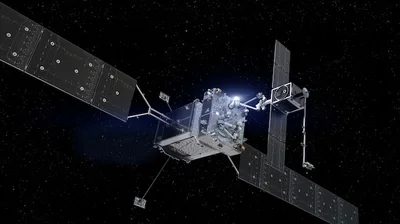
Following its launch in summer 2026, Northrop Grumman’s Mission Robotic Vehicle (left) will install Mission Extension Pod (right) jetpacks to extend the lives of client satellites in geosynchronous orbit. MRV also can perform inspection, relocation, repairs, upgrades, and other missions yet to be imagined. Illustration credit: Northrop Grumman
A SpaceX Falcon 9 rocket is scheduled to launch from Cape Canaveral Tuesday carrying Northrop Grumman’s Mission Robotic Vehicle (MRV) and three Mission Extension Pods (MEPs), a novel mission designed to prolog the lifespans of multiple satellites.
The MRV is equipped with the Robotic Servicing of Geosynchronous Satellites (RSGS) payload, a pair of robotic arms with an array of tool attachments developed at the U.S. Naval Research Laboratory with financial backing from the Defense Advanced Research Projects Agency (DARPA).
Following deployment, the MRV and MEPs will spend a year heading out to geosynchronous Earth orbit. Once there, the MRV will begin the process of installing MEPs onto clients’ spacecraft, including those owned by Australia-based company Optus and Luxembourg-based company SES.
The MEPs, which carry fresh supplies of maneuvering fuel, are designed to provide up to eight years of additional life for a satellite.
Liftoff from Space Launch Complex 40 is scheduled during a four-hour window that opens at 5:15 p.m. EDT (2115 UTC). The rocket will fly due east upon leaving the launch pad.
Spaceflight Now will have live coverage beginning about 1.5 hours prior to liftoff.
VIDEO
SpaceX will launch the mission using the Falcon 9 first stage booster B1069 which is making its 32nd and final flight. The company said this would be the boosters final mission “Due to the additional performance needed to launch these payloads to geosynchronous transfer orbit.”
In addition to 27 batches of Starlink satellites, B1069 launched the following missions:
- Dec. 21, 2021 – NASA’s CRS-24
- Oct. 15, 2022 – Eutelsat’s Hotbird 13F
- Dec. 8, 2022 – OneWeb’s OneWeb Mission 15
- Mar. 17, 2023 – SES’ SES-18 \& 19
Decades in the making
The concept behind the RSGS goes back more than 20 years when the NRL began examining the possibility of two uncrewed spacecraft performing autonomous rendezvous and docking operations. In the early 2000s, that evolved into a study called ‘RescueSat’, looking at how to recover a satellite stuck in the wrong orbit, and eventually the Spacecraft for the Universal Modification of Orbits (SUMO) program.
“The SUMO mandate was daunting. DARPA challenged us to design a robot that could dock with any satellite in space,” said Glen Henshaw, Ph.D., NRL Lead Space Roboticist for RSGS in a prelaunch statement.
“We then realized a universal truth—every satellite got to space on a rocket! By targeting the sturdy ‘launch vehicle interface plane’—the structural ring or explosive bolt holes that attach a spacecraft to a rocket for launch—we determined that a robotic arm could safely grapple almost any spacecraft without damaging delicate instruments.”
The MRV inside Northrop Grumman’s Dulles, Va., Satellite Manufacturing Facility. Image: Northrop Grumman
After proving the concept was possible, by 2005 the SUMO program shifted to the Front End Robotics Enabling Near-term Demonstration (FREND). That program would go onto develop spaceflight worthy robotic arms through a commercial vendor.
Alliance Spacesystems, Inc. (ASI), the company who built the robotic arms for NASA’s Mars Curiosity Rover, was selected and environmental testing began in 2008.
To find a good business case for these arms, a series of studies were conducted, including a joint NASA-DARPA study in 2012 called the Manned GEO Servicing study. Ultimately, DARPA moved the technology back into what the NRL called “research and hardware maturation via a spaceflight concept program called Phoenix.”
After years of studying and contemplation, DARPA decided to proceed with what was then called the RSGS payload to pursue “ultra-close inspection, orbital ‘tow truck’ relocation, mechanical anomaly repair, and upgrading satellites not originally designed to be upgraded.”
Four years later in 2019, it selected SpaceLogistics, a Northrop Grumman company to combine the RSGS with the MRV. Following initial checkouts, the RSGS program will be turned over to the U.S. Space Force in support of its Servicing, Mobility, and Logistics portfolio.
A Northrop Grumman employee at the company’s manufacturing facility in Gilbert, Arizona, performs final inspections of one Mission Extension Pod (MEP). Image: Northrop Grumman