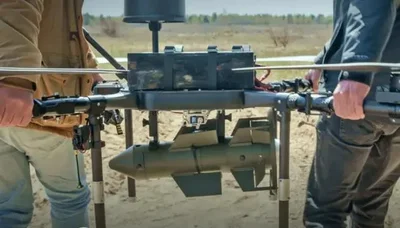
A Ukrainian drone bomber with the new Firefly munition
Brave1
This week Ukraine’s Department of Defense announced that it has codified a new series of guided drone bombs known as Firefly. The weapon, which has already been used in action, is now cleared for general use and is ready for mass production.
This is a powerful new capability for Ukraine’s fleet of heavy bomber drones. It is described as an add-on kit suitable for bombs from 2 to 20 pounds. Crucially, the simple, low-cost design can easily be rolled out at scale, with the makers saying they can make 10,000 units a month and are ready to ramp up as needed. An early look at video of Firefly in action suggests huge potential.
The “Baba Yaga” Bomber: Ukraine’s Ace Of Drones
Ukraine operates a wide variety of heavy multicopter bombers, including the Vampire. Kazhan, Heavy Shot, Perun, Nemesis and others. The Vampire, the most common type, delivers a 33-pound bombload some 20 miles; Kazhan bombers carry up to 66 pounds of munitions. Unlike single-use FPVs, the bombers return to base, reload and attack again and again.
The Kazhan series are popular Ukrainian heavy bomber drones
Reactive Drone
Operations are often at night, as the bombers are highly visible and can be heard for miles. They are greatly feared by Russian troops who call them “Baba Yaga” after a fearsome child-eating witch in Slavic folklore who flies at night. Some analysts suggest the bombers may cause more casualties than the far more numerous FPVs.
Artem Kolesnyk, CTO of Reactive Drone, claims heavy bombers are the most cost-effective weapon in the Ukrainian arsenal, because the only cost is the munitions they drop. He claims that his company’s Kazhan bombers typically perform 100 missions each before being lost or shot down.
Interestingly, the Russians have had trouble producing their own version. Russian makers have launched various products, but none seems to have made it through procurement bureaucracy and into widespread use.
The bombers already have sophisticated aiming systems that allow the operator to lock on to a target. These adjust automatically altitude, windage and movement, and achieve impressive accuracy. But Firefly takes things a step further.
Firefly Guided Bombing System
The Firefly system consists of a bolt-on guidance unit with steering fins which attaches to a munition, and a unit on the drone. The operator locks on to the target via the drone’s camera. The system tracks the bomb as it falls, adjusting its position so it coincides with the target.
Video of Firefly test drops show the interface displaying a flag showing the direction and speed of the bomb, which is adjusted moment by moment.
According to the unnamed makers, Firefly hit targets day or night from altitudes between 600 and 1,600 feet with an accuracy of from 2 to 7 feet depending on conditions. That should more or less guarantee a hit on a vehicle, or ensure that targeted personnel are within the lethal radius of a fragmentation bomb.
Bomb with Firefly guidance kit
Brave1
Although the video shows precision hits from 1,000 feet, the MoD release suggests the systems is accurate at 2,400 feet. Subsequent versions may be even more effecitve,
Accurate weapons delivery from these altitudes puts the bombers well out of the range of small arms fire,. It also greatly reduces the effectiveness of jamming which is often limited to a few hundred feet.
In addition, higher altitude drops increase the effectiveness of bunker-busting drone bombs like the “fence post” penetrator weapon revealed last month. Such weapons have a delayed-action fuse and explode after they have travelled through several feet of earth to reach a bunker or dugout.
One source suggests the unit cost for Firefly munitions is just 10,500 UAH or $240. This is key because such munitions will be needed in large volumes. Western style “exquisite” guided munitions are not affordable. Even the APKWS, a simple rocket upgraded with the addition of with a laser guidance unit and touted as a low-cost alternative to traditional missiles, costs over $80,000 a shot—more than a bomber drone.
Firefly guidance modules are already being produced in significant numbers
Brave1
Two years ago, Ukraine experimented with arming heavy bombers with laser-guided munitions. These seem to have vanished, likely due to high costs associated with laser designators and laser seekers. But a $240 munition is likely to be in high demand.
Firefly technology is being made available under license via Ukraine’s Brave1 technology accelerator for other companies to integrate into their own products.
Next Up: Guided Glide Bombs
The demonstrations, like most bombing videos, show attacks from vertically above the targets. But, as Kolesnyk notes, what bomber operators really want is a weapon that provides stand-off so they can attack from outside the range of interceptors and other defenses. Hence experiments with using bombers as FPV carriers.
Jet aircraft show how guided bombs can be delivered from a distance. The U.S. Air Force’s JDAM series, used by Ukraine, have a range of up to 15 miles; the Extended Range variant of JDAM with pop-put wings triples this to 45 miles. The Russians routinely use guide bombs as heavy artillery, releasing them a safe distance from the front line to hit tree lines and buildings occupied by Ukrainian forces
However, these ranges are only possible from an aircraft flying several hundred miles an hour. For a multicopter flying at perhaps 40 mph , ranges will be more modest, but could still be a multiple of the altitude. Attack from more than a mile away should be feasible with a suitable wing design.
US Air Force JDAM-ER, is a guided winged glide bomb with a range of 45 miles.
USAF/AFP via Getty Images
Meanwhile Ukrainian developers are also working on a small drone munition with its own camera which locks on to the target and glides to impact.
Firefly shows how the Ukrainian defense sector is capable of rapidly producing new weapons when there is no international equivalent. And they are doing it at extremely low cost.
Ubiquitous small, guided weapons add another twist to drone warfare and make countering drones just a little bit harder. And the evolution continues.