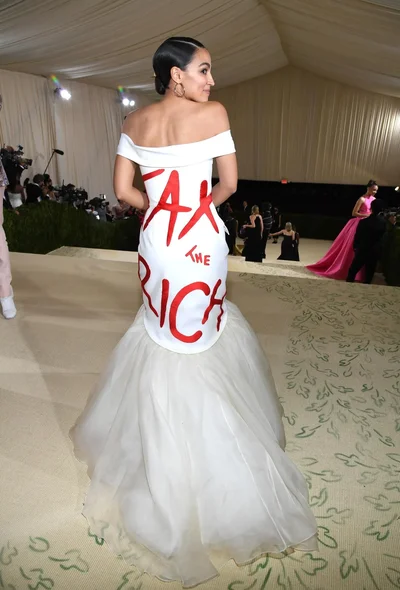
AOC Tax The Rich
Getty Images For The Met Museum/Vogue
This year’s midterm elections will offer a barometer for how Americans feel about the direction of the country — including how they feel about taxing the rich. Approximately 14% of Americans across California and Washington will vote on different tax measures imposed entirely on the wealthy. The outcome of these two ballot measures might provide the clearest indications of how Americans — as opposed to politicians or economists — truly feel about taxing extreme wealth.
California’s Proposed Billionaire Tax
California’s 2026 Billionaire Tax Act would impose a 5% tax on the wealth of California residents who have over $1 billion in total net worth. Unlike a tax on income, billionaires’ total wealth, whether realized or not, would be subject to the tax. The proposal is expected to raise $100 billion in incremental tax revenues from the state’s 200-plus billionaires, with no incremental tax revenues being collected by those who are not billionaires.
ForbesCan A 5% Wealth Tax On 200 Billionaires Save—Or Sink—California?By Nathan Goldman
While some billionaires, like Jensen Huang of Nvidia, have voiced support for this proposal, many others have already threatened to or have already fled the state. The reason is that some billionaires like Tony Xu (founder of DoorDash), Sergey Brin, and Larry Page (both founders of Alphabet) would owe far more than the 5% tax on their net wealth because of how the proposal defines net worth, according to the Tax Foundation.
ForbesCalifornia’s Billionaire Tax Battle: Inside The 2026 ShowdownBy Nathan Goldman
Despite the promise for this tax to address critical housing, education, and healthcare needs, independent analyses have diverged sharply on the incremental tax revenues that California will actually collect. For instance, the analysis provided by the original proposal was the basis for the $100 billion incremental tax revenue figure. Yet another independent analysis estimates that California will lose $24.7 billion due to behavioral responses to capital flight -- individuals and companies leaving a jurisdiction – as well as updated definitions of which assets will be subject to the wealth tax. This analysis also suggests there could be costs associated with the tax’s constitutionality. Other commentary provided by Promarketsuggests that the tax could create inequities and adverse incentives. Additionally, California’s Governor Gavin Newsom has voiced his opposition to this measure due to concerns for the California economy. These differing opinions have put California in a pickle when voting in November, as they must effectively decide which model is correct and whether they want to gamble on the state’s future in this way.
ForbesWill California's Billionaire Tax Be Paid By Non-Billionaires Too?By Nathan Goldman
What A Yes — Or A No — Would Mean Nationally For A Tax On The Rich
If California’s Prop 40 passes, it would be the first voter-approved wealth tax in the U.S. This could send a signal to the rest of the country that even though California is known for high taxes, voters are willing to levy even more on its ultra-wealthy. Similarly, if Washington votes to keep the millionaire income tax in place, it would confirm that a state with no income tax in its history is able to enact one.
Either outcome, or both together, would provide significant fuel for tax fights that are emerging all over the country. For example, states like New York, Massachusetts, and Illinois are already proposing wealth taxes. Oregon has also proposed a billionaire tax, and it could use California’s strategy as a blueprint for seeing it come to reality.
Despite this momentum, it is important to note that many Republican-led states are nowhere close to doing something of this nature. States like Texas and Tennessee have no current intentions of raising taxes on the ultrawealthy, and they appear to be relishing the opportunity to attract out-of-state taxpayers and businesses to their lower tax jurisdictions. Florida, which also does not tax individuals’ income, is taking steps to go in the opposite direction by significantly reducing property tax collections.
If both ballot measures fail, it could be just as telling about the current appetite for raising taxes on the rich. California and Washington are two very heavy Democrat-leaning states. If voters turn down these taxes due to revenue volatility concerns, capital flight risk, constitutional risk, or even just discomfort with the notion of taxing wealth (as opposed to income), then it could provide ammunition to those who oppose these taxes. Put differently, if policymakers believe that “taxing the rich” is the desire of American taxpayers, and the measures cannot pass in states like California and Washington, then it could send a strong signal that the ideas and movements are out of touch with how taxpayers really feel.
Ultimately, these two ballot measures represent more than isolated state tax policy debates — they are a live test of whether the “taxing the rich” movement can survive when placed in the hands of actual voters. Only two states are voting, but together they represent almost 14% of the U.S. population. Both are also ideal proving grounds for the movement as they are Democratic-leaning states where progressive tax policy should have its best shot at success. However, both states have already seen early signs of capital flight and business relocations, suggesting that there is reason for even the most progressive voters to heed caution when heading to their polling sites come November. Regardless of the outcomes, both measures now officially being placed on their state’s ballots have the potential to shape how other states (and even the federal government) pursue similar taxes in years to come. Thus, Californians and Washingtonians may not just be deciding their own tax fates, and these outcomes could be casting an early verdict that has nationwide tax implications.