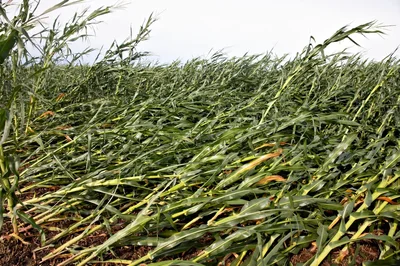
POLO, IL - AUGUST 10: Corn plants lie on the ground following a derecho storm, a widespread wind storm associated with a band of rapidly moving showers or thunderstorms, on August 10, 2020 near Polo, Illinois. The storm moved across the Midwest with winds recorded near 100 mph in Iowa and Illinois. (Photo by Daniel Acker/Getty Images)
Getty Images
From historic droughts in the West to record freezes in the Southeast and severe storms across the country, American farmers are facing increasingly unpredictable growing conditions. Weather-related events cause approximately 20 billion dollars of annual losses for U.S. agriculture. To mitigate those losses, scientists are developing a wide range of tools—combining advances in genetics, breeding, and crop physiology—to make agriculture more resilient to climate risks.
Climate uncertainty is one of the biggest challenges in agriculture today. The Green Revolution of the 1960s focused on improving yields under normal conditions. Now the focus is shifting to risk management: maintaining reliable harvests despite erratic weather. For farmers, avoiding catastrophic losses during bad years can mean a difference between surviving or losing their business.
The Farmer’s Quandary
At the start of each growing season, farmers have to decide what crop varieties to plant and when exactly to plant them months before they know whether that year will bring droughts, floods, heat waves or powerful winds.
“It's difficult to predict what the best variety is going to be from year to year,” says Peter Innes, a postdoctoral researcher in the Ecology and Evolutionary Biology Department at the University of Colorado Boulder. “Do you base that decision on what performed best the year before, or is there a more complex algorithm that we could develop to help farmers?”
To answer that question, Innes’s colleagues at the University of Colorado have analyzed decades of field data on the performance of different sunflower varieties collected since 1978 across the Great Plains of North America. The data point to the importance of flowering time as a predictor of yield: if sunflowers bloom too early, the plant may not have enough resources to support seed production; late bloomers, on the other hand, risk facing heat and drought stress.
Flowering time is controlled by genetic mechanisms that translate environmental cues like temperature and day length into developmental signals. Rigid varieties have tightly controlled gene networks that make them flower within a narrow window each year. In warmer years, however, flowering earlier may help plants avoid heat or water stress during critical seed production stages. While we cannot influence when warm weather arrives, we can make plants more adaptable by developing crop varieties that have a more flexible flowering window.
This shift is reflected in broader recommendations for climate adaptation. This year’s Extreme Heat and Agriculture report published by the Food and Agriculture Organization (FAO) of the United Nations emphasized the importance of adjusting planting windows, as well as selecting more resilient crop varieties, to reduce heat-related losses. FAO’s recent Green Climate Fund project showed that investing in climate-smart agriculture solutions generated up to $8 of returns for every $1 spent.
Hot Research Topic
Genetic interventions like making the flowering time window more flexible could help avoid billions of dollars in losses due to heat stress. Wheat, in particular, is highly sensitive to heat waves: even a few hours of temperatures above 82 degrees Fahrenheit during the pre-flowering stage can reduce the number of grains per plant, while post-flowering temperatures above 90 degrees can lead to approximately a 2% reduction in grain weight for every two degrees Fahrenheit.
Scientists are exploring multiple strategies to make wheat less sensitive to heat stress: for example, by using gene editing tools such as CRISPR to stimulate heat-shock proteins that can help plants recover after short heat waves. But editing one or even several genes is unlikely to completely solve this problem.
“Traits such as heat tolerance or other aspects of climate resilience, like the flowering time, have a more complex genetic basis,” explains Innes. “It is not just a single gene that controls the trait, and so that makes the gene editing approach more challenging.”
This is why many crop breeders perform controlled heat-stress tests to screen for wheat varieties that are more robust. This approach builds on traditional selection and breeding methods that have been used in agriculture for thousands of years. The downside, however, is that it can take 10-15 years to develop a new commercial variety.
“I think we're going to have to come at it from both sides, using all the available tools, whether that's traditional breeding or genome editing,” says Innes.
Weathering The Storm
The diverse challenges associated with the increasing prevalence of extreme weather events require an equally diverse repertoire of solutions. In 2020, a massive storm called a derecho struck Iowa, producing hurricane-force winds and flattening over 10 million acres of corn and soybean fields. This problem is known as crop lodging—the bending or breaking of plants at the stem or root. But because it affects crops that under normal circumstances would have produced great yield, the problem is often disregarded.
Erin Sparks studies how we can prevent crop losses due to lodging in her role as a Bond Life Sciences Investigator at the University of Missouri and a Principal Investigator at the Donald Danforth Plant Science Center.
“Lodging is often an afterthought when it comes to crop breeding,” says Sparks. “If [a new crop variety tested in the field] is still standing, we move it forward. But we've seen this happen in the past, where if you didn't have a storm that year, you've moved forward something that actually still lodges.”
Sparks comes to the field of agriculture from a background in biomedical engineering, and the way she approaches studying crop lodging reflects this kind of thinking.
“As an engineer, I want to know what the point of failure is,” says Sparks. “Agronomically, we just lump it all together: we don't know if the plant failed at the stalk or the root, and how it failed. But when you're trying to design crops rationally, it's important to identify the point of failure.”
Sparks’ research team has been working with lodging-resistant short-stature corn. The hybrid variety, which measures about seven feet (compared to the typical height of 9–12 feet), was developed by Bayer Crop Science as part of the Preceon™ Smart Corn System. This and other shortened cultivars, like Corteva’s reduced-stature corn, have been shown to withstand wind damage up to 64% better, and Sparks wanted to understand why.
What she found was that the height of the corn stalks is only part of the story. Wind-resistant plants also have stronger stalks and a more flexible root system, which enables them to absorb the shock from strong wind gusts. Now the team is looking into developing this valuable trait in other plant varieties.
“We kind of equate this to earthquake engineering. If you have a rigid base, you're fragile, but if you have a more flexible base, you can actually withstand winds better,” explains Sparks. “We saw that in the instance where if the root system in short-stature corn did not get more flexible, we still saw lodging.”
Planning For Uncertainty
As we face more frequent extreme weather events, crop adaptability becomes a defining feature of agricultural resilience. But it is unlikely that there will be a single solution to a complex problem like this. Instead, developing crops for unpredictable weather requires integrating different technologies and clever engineering approaches.
“We have to adapt the way that we approach farming in the twenty-first century,” says Sparks.
Farmers will still face uncertainty, not knowing what the season will bring when they plant their crops in the spring. But science can help reduce those risks.