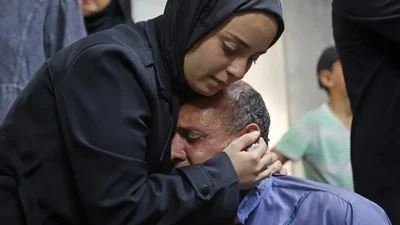
When Muhammed Abu Khammash disappeared, his family feared the worst.
The 29-year-old Palestinian father of three had lived with severe mental illness for years. Since Israel's genocide in Gaza began in October 2023, his condition had deteriorated dramatically.
Afraid he would wander into one of the enclave's increasingly dangerous areas, relatives took turns staying by his side.
One day, he slipped away.
He never returned.
New MEE newsletter: Jerusalem Dispatch
Sign up to get the latest insights and analysis on Israel-Palestine, alongside Turkey Unpacked and other MEE newsletters
"As soon as I realised he was gone, I searched everywhere for him," his father, Oda Abu Khammash, told Middle East Eye.
"I shared his photograph across social media and begged people to contact me if they found him."
Three days later, the family received devastating news.
"I was told he had gone towards the Yellow Line, where the Israeli army fired a shell at him and killed him."
Since the October ceasefire, the Gaza Strip has effectively been divided into areas with vastly different levels of access and control.
There is no ceasefire in Gaza
The so-called Yellow Line, introduced on 10 October, became the main reference point for the areas where Israeli forces remained deployed. Covering more than 60 percent of Gaza’s territory, the line has in practice confined the majority of Palestinians to a limited area where population density and humanitarian needs have intensified.
Israeli forces later installed yellow concrete markers along sections of the boundary, including in places that appeared to extend beyond the original line.
Palestinians who approach or attempt to cross the line are routinely shot by Israeli forces.
Scores have been killed along the line since the ceasefire took effect.
Because the area has been declared off limits, many families have been unable to recover relatives killed near or beyond the line, leaving bodies stranded for weeks or even months.
While families, journalists and humanitarian organisations have documented dozens of cases, the true scale remains unknown.
Muhammed was one of them, where his body remained out of reach for days.
Mental health deteriorates
According to Oda, Muhammed had lived with psychosis for years, suffering from paranoia, delusions and constant suspicion of those around him.
"Before the war, we used to take him to the Gaza Community Mental Health Centre whenever he experienced an episode," Oda said.
'He kept praying for his own death and repeatedly tried to head towards the Yellow Line'
- Oda Abu Khammash, Palestinian father
"He would stay there for between two weeks and a month, where doctors cared for him and closely monitored his condition."
After the war began, however, relentless bombardment and repeated attacks on hospitals made treatment impossible.
Instead, the family cared for Muhammed inside the displacement tents where they were living.
But keeping him safe became increasingly difficult.
He repeatedly tried to return to the family's destroyed home in eastern Deir al-Balah.
"I had to stay with him all the time, but I wasn't the only one," Oda said.
"Nine members of the family took turns watching him to stop him wandering into dangerous areas.
"Before the war, his episodes usually lasted no more than a month. This time they continued for months."
Palestinians launch #TheyLiedtoYou campaign to debunk Gaza 'ceasefire' narrative
Muhammed's condition worsened further after his younger brother, Osama, was killed in August 2025.
According to Oda, Osama had been helping secure humanitarian aid for an orphanage when he was killed in an Israeli air strike.
"After Osama was killed, Muhammed couldn't cope," he said.
"He kept praying for his own death and repeatedly tried to head towards the Yellow Line, saying he wanted to avenge his brother.
"He constantly called out Osama's name. He never accepted that his brother was gone and kept going out to look for him, as though he were still alive."
Just four months earlier, the family had suffered another devastating loss.
Muhammed's younger brother, Marwan, 20, was killed by Israeli forces while trying to collect flour for the family during Gaza's hunger crisis.
Locating the body
After learning of Muhammed's death, the family began trying to recover his body.
With access to the area heavily restricted and information scarce, they turned to people with contacts inside the Israeli-backed militias operating along the Yellow Line.
Members of the militias located the spot where Muhammed had been killed, but said they could not retrieve his body without the Israeli army's approval.
Palestinians living along the 'Yellow Line' endure daily Israeli attacks
The militias are armed groups operating in Israeli-controlled parts of Gaza with Israeli backing.
In June 2025, Israeli Prime Minister Benjamin Netanyahu publicly acknowledged that Israel had "activated" armed groups in Gaza to undermine Hamas and disrupt public order.
The militias have been accused of a wide range of abuses against Palestinians, including killing and abducting civilians, as well as looting humanitarian aid.
Some groups have also sought to portray themselves as providing assistance, occasionally helping civilians before encouraging them to post videos on social media expressing their gratitude.
According to Oda, militia members told him the Israeli army had refused to allow them to recover Muhammed's body.
"All we wanted was to bring my son's body home so we could bury him with dignity," he said.
Despite the uncertainty, relatives and neighbours dug a grave in anticipation of his burial.
"The grave remained open for days because we couldn't retrieve his body."
A mother's search
For nine days, Muhammed's body lay exposed where he had been killed.
"When every attempt failed, my wife lost all sense of fear," Oda said.
"She couldn't sleep and kept saying, 'I'll go and bring him back myself.' She entered the area, and the Israeli army almost shot her."
Holding a white flag, she walked towards the Yellow Line day after day.
'She told them, "If you want to shoot me, then shoot me. I'm not leaving until I bring back my son's body.'''
- Oda Abu Khammash
"For at least two days, she left at dawn to search for him and returned only after sunset to a relative's house near the Yellow Line," Oda said.
In a Facebook post written during the search, Oda described his wife's anguish.
"I haven't seen her for two days. Before that, I avoided seeing her so she wouldn't ask me: 'What kind of life is this that we have, and what meaning does it hold?' I am tired of being pitied."
On the final day of her search, an Israeli quadcopter flew overhead.
Through its loudspeaker, an Israeli officer ordered her to turn back, warning that soldiers would open fire if she continued.
"My wife refused," Oda said.
"She told them, 'If you want to shoot me, then shoot me. I'm not leaving until I bring back my son's body.'"
Unable to find Muhammed's remains, she eventually returned empty-handed.
Nine days after he was killed, coordination between the militias and the Israeli army finally allowed the body to be recovered.
"The militias retrieved Muhammed's remains, and we were finally able to lay him to rest," Oda said.
Photographs shared by local journalists showed Muhammed's mother clutching a black plastic bag containing what appeared to be her son's remains, which had badly decomposed after days of exposure.
Middle East Eye could not independently verify the contents of the bag.
"I don't exaggerate when I say the ordeal of recovering him was even harder than losing him," Oda said.