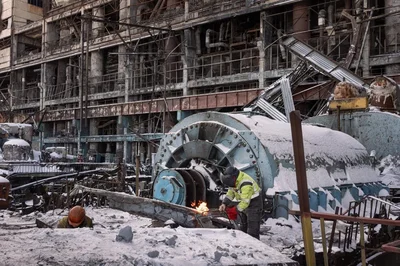
UNSPECIFIED, UKRAINE - FEBRUARY 09: (EDITOR'S NOTE: Image has been reviewed by DTEK officials prior to transmission) DTEK workers repair recent missile and drone attacks' damages at a thermal power plant on February 09, 2026 in Central Ukraine. While strikes against energy infrastructure have defined the war in Ukraine, energy repercussions will spread far beyond.
Getty Images
Russia—the petrostate that spent a decade trying to weaponize natural gas against Europe—is now rationing fuel at home as shortages spread across the country. The Crimea has declared a state of emergency, and other occupied Ukrainian territories are struggling to secure adequate supplies as civilians continue to flee the deteriorating conditions. Ukraine’s sustained drone and missile campaign against Russian refineries, depots, and logistics is inflicting real costs on Moscow's capacity to sustain both its war machine and domestic stability. The Schwerpunkt—the breaking point—has not yet been reached. However, the balance of power is shifting toward Kyiv.
Whatever the final outcome, it has been shaped heavily by the Russian military’s massive underperformance. Russia's economic trajectory is even easier to read. Vladimir Putin may hold on to power, but Russia's economic foundations are eroding beneath him. Even if Russia retains the currently occupied Ukrainian lands, there is little it can plausibly extract from them to justify the casualties, financial cost, diplomatic isolation, and industrial decline accumulated since 2022. Victory, however Moscow chooses to define it, would be stripped of the prosperity that conquest once promised.
The deeper question is not how the war will end—but what Russia will look like after the shooting stops. Prolonged instability inside one of the world's largest energy exporters will reshape investment flows, supply chains, and energy pricing from Vietnam to Ireland. Policymakers focused only on the battlefield are missing the economic transition already underway.
The Big Purchasers
Even if sanctions are lifted post-war, Russia’s reputation as a supplier will continue to give investors serious pause. Europe was long Russia's largest hydrocarbon customer and offers the clearest example. The European Union has dramatically reduced its dependence on Russian pipeline gas through conservation, diversification, and LNG imports. Russia still accounted for roughly 12% of European gas as recently as 2025, but in January 2026, the EU formally banned all Russian gas imports, with plans to phase out the last volumes by the end of 2027. No one in Brussels is eager to recreate the vulnerability that made the continent a hostage to Gazprom.
American exporters have become Europe’s largest LNG suppliers, accounting for some 63% of EU LNG in Q1 2026. Counterintuitively, Russia, not Qatar, is second, at around 13%, with Nigeria overtaking the Gulf state for third place. Qatar's position is tied to the Strait of Hormuz/ If that chokepoint becomes reliably open again, competition for European volumes will intensify. In that environment, commercial logic could create limited space for Russian gas to creep back into parts of the market,but any such return would face sanctions, infrastructure gaps, and deep political resistance that will not dissolve with a ceasefire.
China is likely to move in the opposite direction. Beijing demonstrated throughout the conflict that it could have absorbed substantially larger volumes of Russian hydrocarbons without imposing meaningful costs upon itself. Instead, it deliberately exercised restraint. The calculus was cold: a Russia with fewer alternatives becomes a Russia that depends on Beijing for financing, technology, and political cover. Russia sliding deeper into China’s gravitational pull may be the most consequential long-term outcome of the entire war.
Expanded Chinese energy purchases after a peace deal would not be charity toward Moscow. It would be a ratcheting up of leverage. The longer this imbalance persists, the greater the opportunity for Chinese economic penetration into the Russian Far East and Eastern Siberia. Short of a political upheaval, which is unlikely as long as Putin remains in office, Russia retains sovereignty on paper while quietly becoming a semi-vassal whose room for maneuver narrows by the year.
India's trajectory is different. New Delhi dramatically expanded its imports of Russian hydrocarbons because deeply discounted Russian crude created an extraordinary commercial opportunity. Those discounts were the products of wartime dislocation, not a permanent feature of the market. As prices normalize and other producers expand output, Indian refiners will diversify their purchases based on economics alone. Pre-2022 patterns will reassert themselves, with India sourcing more from the Middle East and East Africa.
New Production
A Ukraine peace deal will not freeze the competitive landscape. Russia’s damaged infrastructure, exposure to sanctions, and uncertain political future leave real space for rivals to move in. And even China—Russia's most likely large-volume buyer—has every interest in keeping its options open, both to hold down prices and to retain political leverage over Moscow.
Namibia continues advancing offshore developments with considerable international interest. Mozambique remains positioned to expand LNG exports despite persistent security challenges. Kazakhstan is strengthening its role as a reliable Eurasian supplier while seeking transit routes that bypass Russia. Guyana has become one of the world's most consequential new petroleum producers. Venezuela may continue its recovery following the U.S. military capture of Nicolás Maduro on January 3, 2026, and Delcy Rodríguez's subsequent assumption of the presidency.
Who Goes Back to Russia
The companies most likely to re-enter Russia—if peace and sanctions relief make this feasible—are those with the largest stranded claims. BP never sold its 19.75% stake in Rosneft. Russian law prevented any transfer, leaving the British major holding a position with a written-off book value of roughly $25 billion. The financial logic of returning, once sanctions permit, is overwhelming. ExxonMobil wrote off $4.6 billion when it was effectively expelled from Sakhalin-1. Putin signed a decree in 2025 allowing foreign companies to reacquire equity in the operating entity, and Exxon has already engaged in quiet talks with Rosneft about re-entry.
TotalEnergies of France is another strong candidate. The company held 19.4% of Novatek and a 10% stake in Arctic LNG 2; while it finally exited the latter in June 2026, it retains other Russian upstream interests. The French government has historically been far more accommodating toward Moscow than either London or Washington, and the TotalEnergies leadership was visibly reluctant to sever ties with Russia ties throughout the conflict.
Shell, forced out of its 27.5% share in Sakhalin-2 in 2022, wrote off roughly $5 billion on a project it had helped build since the 1990s. Norway’s Equinor, which held a 1.5% stake in Rosneft and multiple Arctic exploration blocks, wrote off $1.08 billion. Given Norway's geographic proximity and its decades of Arctic energy cooperation, some form of re-engagement is plausible.
Oilfield services companies face fewer political barriers and would likely move first. SLB (formerly Schlumberger), Halliburton, and Baker Hughes all had deep operations in Russian before 2022. Russia’s aging Western Siberian fields badly need their drilling and enhanced-recovery technologies, and once sanctions ease, the commercial pull will be hard to resist. Washington will have to decide whether their return serves U.S. strategic interests or merely lines Moscow's coffers.
Peace with Ukraine—whenever it comes—will not automatically rehabilitate Russia. Moscow will emerge from this war either more authoritarian or increasingly unstable, weaker economically, more dependent on China, and far less trusted as a reliable energy partner than it was in 2021. The damage to its reputation as a supplier is not a PR problem. It is structural.
The global energy map has been redrawn. Supply routes have shifted permanently, new commercial relationships have hardened, and every government in Europe has absorbed the lesson of what concentrated hydrocarbon dependence costs. Markets will stabilize, but they won’t look the same as in 2021.
Russian supply will not just flood back into the markets. The companies that want to return—and there are many—face political risk, including sanctions complexity, and reputational pressure that will slow any re-engagement even under a best-case scenario. Energy geopolitics after Ukraine will not be about restoration of Russia as an energy superpower. It will be about who captures what comes next.