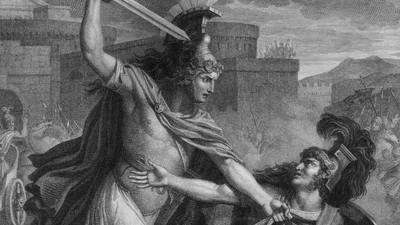
The past week has brought us two similar ideas of masculinity, separated by 4,000 years. When Defense Secretary Pete Hegseth announced the initiation of testosterone screening in all U.S. servicemembers 30 and older under the title “The High T Department of War,” his vision was as clear as an IMAX projection of Odysseus: a warrior in his physical prime, lethal in battle, unquestionably ascendant in the home, anointed by god.
Both of these men, the classical hero and the optimized modern soldier, are fantasies. But I’m worried Hegseth’s vision is a tragedy in the making
The Greco-Roman ideal of masculinity was anchored in martial valor. The words for courage in both Greek and Latin share roots with “man” — “andros” and “vir,” respectively. To be a man was to be courageous: A coward was not a man. To die with courage, “with your shield or on it,” in the memorable words of the Spartans, was a man’s highest achievement. Your payment for a good death was “Kleos”: glory, renown, literally “that which is heard.” The tales of your achievements, your victories, your honor — they were your highest reward. And that reward required risking yourself. You could easily imagine a Greek hoplite looking at drone warfare with disdain.
Masculinity being defined by something invisible would be as alien to Agamemnon as an iPhone. Masculinity was something witnessed, performed.
And now, according to a vocal segment of Western society, it’s gone.
So can we pour masculinity back into men’s veins? Can we make perfect warriors with the prick of a needle?
As a urologist, I’ve witnessed the mythology around testosterone replacement therapy (TRT) growing for years. Some of it is warranted. TRT can genuinely help appropriately selected hypogonadal men — those with consistently low morning testosterone levels and signs or symptoms of testosterone deficiency, such as fatigue, erectile dysfunction, and low libido. It can improve sexual function. It can strengthen bone density. It can cure anemia and increase lean body mass.
But it can’t make them brave. Some studies show small, highly context-dependent effects of TRT on risk-taking and competitive behaviors. In many analyses it doesn’t change behavior meaningfully above baseline at all.
People treated with testosterone may show a preference toward status seeking, which could be beneficial in a hierarchical military context. It may increase amygdala activation, a part of the brain that processes intense emotions, such as fear and rage, and decrease communication between the amygdala and the prefrontal cortex, the neural seat of impulse regulation. If TRT does result in a slight increase in reactivity, a tendency toward higher threat recognition, and lower inhibition, I’m not sure it would be an improvement for our military, either on the battlefield or the base.
When we look back with nostalgia on the Spartans or even the boys who stormed Normandy, we have no way of knowing what their T levels were. Testosterone was first isolated in experiments in the 1930s and clinical use of serum testing wasn’t widespread until the 1970s. Many protein-powder-fueled think pieces have bemoaned the tanking T levels of our young men, but our earliest large cohort for historical comparisons are only a few decades old. The tests themselves have high inter-lab variability. It can be hard to compare cohorts between labs, let alone across time. There is genuine debate regarding the amplitude and significance of this apparent decline. We don’t know enough to draw conclusions.
While concerns regarding testosterone levels are new, anxiety about manliness is ancient, often rising with a society’s material comfort. As far back as the fifth century BCE, historians observed that “Soft lands breed soft men.” Texts in the 15th century lamented the erosion of chivalry and knightly honor. The Victorian era was awash in handwringing about the loss of male vigor (some of which was blamed on the unnatural intellectual pursuits of women). Teddy Roosevelt exhorted a nation of effeminate, civilized men to sally forth into the wild and reclaim their natural vitality. No moral panic is more unoriginal than the fear that contemporary men are no longer as manly as the heroes who preceded them.
It’s painful to watch the men of our culture mired in a hopelessness that they struggle to express. If we’re lucky, we only hear the reports of men with gambling and porn addictions, mired in apathy and Reddit misogyny. We read the op-eds, shake our heads with empathy, glance at our sons with concern. But if we’re unlucky, we’re looking them in the eyes. We’re holding their hands begging them to pull back from despair and build a life in the world.
Nearly half of young men report that they feel like failures. If they’re comparing themselves to the yardstick of Achilles, that’s true. There are fewer outlets to perform masculinity in ways that echo myths of glory.
But the glory is the actual fantasy. Most men in classical antiquity weren’t noble warriors. They were slaves, herdsmen, farmers too poor to own a sword. Your average 14th-century European male was more likely to be starving to death from a bad harvest or bleeding out from the plague than riding into battle in gleaming armor. They told tales of outsized heroes they could never equal, just like we do now. What was attainable was a family and a home. Those are the things that are slipping away, not lethality. Achilles was never real.
The crisis of masculinity in our culture isn’t rooted in a lab value. It’s a series of doors shutting. Stable work. Affordable homes. Education and connection.
And it’s not isolated to men. Surveys indicate that young women are experiencing their highest rates of hopelessness on record. The walls are collapsing around all of us.
The poet didn’t say “sing to me, Muse, of a man with optimized endocrine panels.” Humanity’s most enduring myth is the tale of a complex man, an intelligent man, a survivor: Odysseus, the strategist of Troy, not its strongest hero. In the “Odyssey,” the ghost of Achilles, the archetype for every warrior who followed, rejects Odysseus’ attempts to comfort him with flattery. Instead Achilles laments that he should never have chosen glory. “I’d rather serve as another man’s laborer, as a poor peasant without land, and be alive on Earth, than be lord of all the lifeless dead.”
He asked after his son, his father. He ached to rejoin the living. The answer to a crisis of masculinity won’t be found at the bottom of a vial. It’s in the everyday enacting of a meaningful life. Witnessed by those who rely on us. Performed for those we love.
Elizabeth Dray is a urologist practicing in Asheville, N.C., who writes about the friction between clinical medicine and the stories a culture tells itself.
STAT’s coverage of health challenges facing men and boys is supported by Rise Together, a donor advised fund sponsored and administered by National Philanthropic Trust and established by Richard Reeves, founding president of the American Institute for Boys and Men; and by the Boston Foundation. Our financial supporters are not involved in any decisions about our journalism.