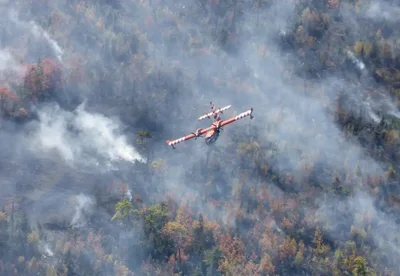
As New Brunswick sees an early start to its wildfire season by roughly a month, crews in Nova Scotia have already responded to more wildfires than they had by this point last year.
The Mooseland Road fire near Jacket Lake in the Halifax area continues to be held and is estimated to be 1,447 hectares as of Tuesday morning. The fire first became out of control last Thursday evening, with an evacuation order issued for about 100 homes, cottages and cabins in the rural area.
While that evacuation order was lifted as of Sunday, wildfire preparation is on the minds of many.
2:10
What the Maritime forecast holds for this wildfire season
Officials in both Maritime provinces say one of the simplest ways to prepare is having a 72-hour emergency kit ready.
Story continues below advertisement
“If they do have to evacuate, they have the basics for a couple of days in order to sustain themselves until everything is put together,” said Claude Chouinard, regional preparedness manager with New Brunswick Emergency Measures Organization.
Get daily National news
Get daily Canada news delivered to your inbox so you'll never miss the day's top stories.
“I would also say prior to going back, make sure all the important papers they have are with them.”
In Nova Scotia, officials say last year’s record wildfire season has changed how they prepare by planning for long-lasting and more intense fires.
While recent rain has helped, hot and windy weather could quickly change conditions to be favourable for a fire to spark.
“If you have a hot day with high winds and you haven’t had rain in a while and the relative humidity is very low, that’s all very bad for fires to start,” said Jim Rudderham, NS Fleet and Wildfire management director.
New Brunswick has responded to 317 wildland fires so far this season, burning about 452 hectares.
In Nova Scotia, 105 fires have been recorded — most of them relatively small.
Officials say areas that burned last year may be somewhat less susceptible this season because much of the heavier fuel has already burned, but under the right conditions, they can still ignite.
Story continues below advertisement
Saint John Deputy Fire Chief Ed Moyer says residents can minimize the threat around their own homes.
“Improve the safety around your yard, from keeping the grass cut to keeping mulch and any combustibles away from your house,” he advised.
Moyer says the department is working on additional training for crews and equipment purchase.
2:17
Saint John no longer considered a safe space from wildfires
Similarly, the Fredericton Fire Department tells Global News it has strengthened emergency planning to include expanded training as well as updated evacuation and shelter plans.
Meanwhile, Moncton firefighters say they’ve sent members to urban interface training, which focuses on the unique circumstances of fighting fires where woodland meets populated areas.
“It’s one thing to go to a wildland fire and it’s just all trees. It’s another thing like we’ve seen in the past number of years, in which it’s involving homes that border along trees,” said Moncton Fire Department Deputy Chief Keith Guptill, adding they are conducting a study to see where some of the “susceptible places” are in the city.
Story continues below advertisement
“A wildland fire isn’t something that’s necessarily going to start right in the middle of Moncton but of course it can be on the outskirts and impact us by coming in the direction of the city,” he said.
Emergency officials also stress that people should check daily burn restrictions and follow evacuation alerts if issued.
© 2026 Global News, a division of Corus Entertainment Inc.