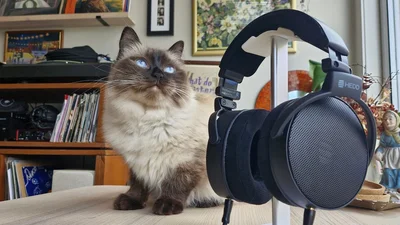
HEDD HEDDphone D1: Two-minute review
The HEDDphone D1 are a quite frankly astonishing pair of over-ear headphones, trucking in a new line of innovative thought from the Berlin brand that also brought AMT technology to the wearable market. They’re open-back and passive, with eyes locked both on the world of pro audio and at-home audiophile listening.
While most brands struggle to occupy both spaces in any meaningful way, it’s my view that the HEDDphone D1 are a rare and commendable success. They are full in heart and full in throat, with an expansive frequency range and a hugely expressive soundstage. Their Thin-Ply Carbon Diaphragm (TPCD) drivers make good on their claims of tonal balance and transient excellence, making these just as adept at clinical representation as they are at gratifying, fulsome home listening.
The specs are friendly to both camps too, starting with the works-with-anything 32-ohm impedance. Traditionally, I’m less fond of this in other devices, but here and with the D1’s rich sonic capacity across devices, it’s a boon. They’re comfortable to wear, innately and over long periods of time, and they never get fatiguing to listen through either.
Latest Videos From
I don’t like giving full marks to things. It makes me feel like I’ve failed; like I’ve missed something, somewhere, or that I’ve even dared to be a bit lazy. More’s my disappointment, then, that I can’t fault the HEDDphone D1 in any meaningful way.
Sure, the build quality might stoop a tad beneath the price in places, but then the pristine presence afforded by those unique dynamic drivers shoots well above. Likewise, a slight low-end boost might disincentivise some pro-audio folk from trusting them in their line of work, but that same lift allows these headphones to provide weight and context unlike any other set of open-backed headphones at this (or perhaps any) price. Every question an answer.
So, then, I resolve to put away my thoughts of laziness or journalistic inadequacy, instead settling with the thrilling and essential truth that must be my own final answer: these are the best headphones I’ve tried in my career thus far. And they get full marks. Among the best wired headphones on the market? Emphatically yes.
(Image credit: Future / James Grimshaw)
HEDD HEDDphone D1: Price and release date
- $799.99 / £599 / AU$999
- Launched on 6th November, 2025
When a pioneering set of headphones hails from a German brand literally called HEDD, it’s one’s duty to take notice. HEDD stands for Heinz ElectroDynamic Designs, and is the another in a series of major audio-tech gifts from Heinz Klaus — founder of ADAM audio, and key contributor to the development and improvement of AMT (Air Motion Transformer) transducers.
Sign up for breaking news, reviews, opinion, top tech deals, and more.
HEDD is a continuation of Klaus’ inventorial pursuits, first with a new suite of professional monitor speakers, then with bringing AMT and some clever material design to new territory: the world of head-fi. All lovingly designed and manufactured in Berlin.
The subjects of today’s scrutiny are the HEDDphone D1, the fourth set of over-ears to come from HEDD, following HEDDphones ONE, TWO and TWO GT respectively. Where prior cans focused on combining AMT drivers with over-ear headphones, the D1 are an exploration of dynamic drivers through the lens of Thin-Ply Carbon Diaphragm (TPCD).
The HEDDphone D1, then, purport to be every bit as stereotypically precise as one might expect from a pioneering German audio brand — with emphasis on the ‘stereo’, and with pun very much smugly intended. If Heinz can do it, so can I.
At £599 / $799.99 / AU$999, the HEDDphone D1 certainly aren’t cheap; they tickle the upper reaches of what might be considered ‘mid-range’ in a broad market, increasingly filled with audiophile-grade cans that ask for four-figure sums (including HEDD’s own flagship HEDDphone).
But the D1 pitches itself, sonically, as a pair of ‘phones that’ll go toe-to-toe with most when it comes to detail, tone and depth — to the point that they’re marketed quite keenly towards professional audio-folk and audiophiles alike. And, not to spoil you too soon, I think they more-than stick the landing.
(Image credit: Future / James Grimshaw)
HEDD HEDDphone D1 review: Specs
Swipe to scroll horizontally
HEDD HEDDphone D1 specs
| | |
| --- | --- |
| Type | Open-back |
| Drivers | Driver: 50mm dynamic, thin-ply carbon diaphragm (TPCD) |
| Impedance | 32 ohms |
| Weight | 350g |
| Connectivity | 2 x 3.5mm TS |
| Frequency range | Frequency range: 5 Hz - 40 kHz |
| Extras | Moulded EVA case, dual-TS to 3.5mm TRS cable, screw-on 3.5mm-6.35mm TRS adapter, drawstring velour cable bag |
HEDD HEDDphone D1 review: Features
- 50mm Thin-Ply Carbon Diaphragm (TPCD) dynamic drivers
- 5Hz-40kHz frequency range
- 32-ohm impedance
The HEDDphone D1 are a pair of open-back over-ear headphones, designed as a mid-weight contender for pristine professional audiophile listening. They’re a passive, wired affair, and about as operationally simple as headphones get.
The big sell here is HEDD’s Thin-Ply Carbon Diaphragm (TPCD): a diaphragm constructed with an advanced carbon fibre composite that maintains rigidity in spite of its thin, low-mass design. The result is a responsive dynamic driver that doesn’t need to trade its proverbial lightness-of-foot for distortion or tonal imbalance, and doesn’t need conventional diaphragm-level dampening to maintain clarity either.
The HEDDphone D1 is outfitted with two 50mm TPCD-constructed dynamic drivers, which extend up to 40kHz and down to 5Hz — a remarkable range, with a remarkably steady response curve where it counts.
These drivers field an impedance of 32 ohms, making the HEDDphone D1 a suitable candidate for practically any sound source. I usually prefer my monitor headphones to have a little more fight in them than this, but on this occasion, I certainly don’t mind the results.
(Image credit: Future / James Grimshaw)
HEDD HEDDphone D1 review: Sound quality
- Incredible clarity across frequency spectrum
- Deep, full and spacious low-end
- Expansive soundstage
Being someone who encounters and experiences new audio tech as a matter of course, I’m rarely in a position to be surprised by something. I usually have some vague idea of what to expect, and my expectations are usually somewhat in line with what I ultimately hear. Here, though: wow.
Having had plentiful experience with professional monitor headphones before, I thought I knew what I was in for with the HEDDphone D1. I didn’t. These ground-up Berlin-designed drivers are a marvel — and, perhaps, a rare instance of experimental reality actually informing PR copy. The D1’s got everything: depth, width, height; microscopic detail and macroscopic grandeur; pro-grade clinical clarity and gratifying, grin-worthy weight. They are full-range and balanced enough to work well as monitor headphones, but not clinically transparent to the point of flatness. It’s a delicate balancing act that pays off.
There’s a lot to get into here, but let’s start with the bass. Though impressively even with respect to frequency response, there is a slightly pronounced push in the low end — the quality of which is, quite simply, astonishing. There is a bulging fullness, of the same heft that makes closed-back headphones so gratifying, but also a depth-of-field that only open-backs can achieve. It’s the platonic ideal for low-end presence; the best of both worlds.
First impressions of this were achieved through digital streaming, listening to hi-res audio streamed from Qobuz. Pile’s All Fiction is a maximalist flood of roomy orchestrations, reverb-drowned voices breaking like waves, and huge blooms of messy low-end energy. It should not be an easy-to-parse record, but the D1 handle the heft of Loops and Poisons handily.
That deeply-impressive low-end control isn’t all that’s happening here. It serves to support an incredibly detailed upper register, too; things sail above it with ease. Mitskis’ Cats, from early-2026 heartbreaker Nothing’s About To Happen To Me, is a supremely balanced slug of sad-folky Americana, carried on a wave of deep bassy richness and carrying a full, clear, near-sailing Mitski vocal. In fact, those vocals are a revelation of their own, every fathom and every miniscule wave rendered in the same amazing definition.
Definition, ultimately, is the word. The transients are, to my immense gratitude, tight and immediate without overextension or insistence. Mitski’s I’ll Change For You demonstrates this capably, through dead-on kick-drums, rich clatter-y rim shots and the most tactile shakers you’ve ever heard hidden in a ballad. The light plosives in Mitski’s voice are discernable, to great humanising effect.
To figure out some more of that definitional excellence, I turned to PJ Harvey’s Stories From The City, Stories From The Sea. Harvey’s vocals are an immediate, forthright affair, and pop into being with a refreshing urgency. Again, there’s some excellent separation between voice and instruments, even as things spiral away beneath as in Big Exit, Kamikaze and This Wicked Tongue. Across the album, dry drums, harsh leads and percussive acoustic guitars build a clear and crisp picture of the D1’s composure.
(Image credit: Future / James Grimshaw)
Over on vinyl, things are just as impressive. Queens Of The Stone Age’s …Like Clockwork demonstrates the D1’s soundstage admirably, as well as their gutsy, gratifying treatment of distorted guitars. I Sat By The Ocean is cleverly rendered in space; My God Is The Sun is addictively propulsive, from its growling plinth of glistening bass to its tight trio of ever-climbing riffy guitars. Homme’s voice is, as ever, a mile-long track of croon-y honey.
Between PJ Harvey, Mitski and QOTSA, the D1’s aptitude for rock instrumentation — much like my personal proclivities for the same — have been summarily proven. To change tack, and to make a small case for my actually-quite-eclectic-I-promise taste, I threw on my vinyl copy of jazz drummer Roy Haynes’ 1963 album Cymbalism.
It’s a rich and free-wheeling collection of quartet-arranged brilliance, opened up with fast-paced flute-led swinger Modette. Haynes’ ‘snap-crackle’ drums shine immediately, and Frank Strozier’s flute, that threatens to be unlistenably harsh, comes in bright, beautiful and searingly insistent. The double-bass is a subtle, hollow, plucky affair, held up well somewhere between kick and snare; the piano is unobtrusively clear, even sharp.
In Lonnie Liston Smith And The Cosmic Echoes’ sprawling 1973 spiritual-jazz missive Astral Traveling, I found the D1’s tonal strengths on full display. In Search Of Truth’s a slow, sure-footed hike, its footsteps a consistent bass riff over which a spaced-out, upward-spiralling piano, disparate, immaculately-preserved percussive elements and a steady harmonium drone reach towards a mountain’s peak — a full-throated, ensemble-derived answer to the call, and a truly expansive experience in these headphones.
It’s clear to me how the HEDDphone D1 can be marketed simultaneously as a powerful home-listening audiophile product and a pro-grade monitoring headphone. The soundstage is broad and deep across the frequency spectrum; instruments and elements have their space, to be appreciated or scrutinised accordingly. That broad low-end lift could be argued as a platform by which to better examine low-end information, but really, it’s a little gift for you and me.
- Sound quality score: 5 / 5
(Image credit: Future / James Grimshaw)
HEDD HEDDphone D1 review: Design
- Unusual — yet welcome — grip on head
- Incomparably comfortable for long
- Slightly underwhelming material choices in places
The HEDDphone D1 are some seriously comfortable headphones — and not in the conventional way, either. Most headphones aiming for comfort have a light touch; they’re trying to be light, airy, and leave little evidence of presence on your head. The HEDDphone D1 are gloriously opposed to this approach.
Instead of a feather-light balancing act, the D1 goes hard, gripping your head with a deep and encouraging firmness. Some super-soft ear cup cushions eat up a lot of that inward force, and a firm foam cushion beneath the headband provides supple support from above. It’s a tight hug in headphone form, and all the better for it. They melt into your head, and, thanks to their open-back breathability, never get old.
Materials-wise, the HEDDphone D1 doesn’t quite have the same quality of build as other headphones at this price point — with a firm and reverential gaze levelled at the likes of Meze Audio. Besides the metal grilles protecting the diaphragm, and the spine of the headband, everything visible is plastic, foam and variably-breathable fabrics.
This is to say that the money’s been spent elsewhere; within. And given the incredible quality displayed within, I’m actually not all that fussed by the less-rarefied material design here. Besides, things work where it counts. The headband adjustment feels firm and reassuring, and the foam used for the cushions couldn’t be better-suited.
There is some semi-significant sound leakage out into the world, as is to be expected from anything open-back; that said, the same can’t quite be said for the inverse — at least, when music’s playing. It’s hard to be distracted when wearing these things.
HEDD HEDDphone D1 review: Value
- An undeniably upper mid-range price point
- Sonic performance that outstrips pricier cans
- Unignorably high bang-for-buck
Value’s always the hardest thing for me to pin down in a piece of tech. Circumstances differ, but MSRPs above a certain point are almost always a big ask. And I think it’s fair to call $799.99 / £599 / AU$999 a big ask. But in comparing that to the value of other headphones on the market, something emerges. At least, to me. The HEDDphone D1 pretty much clears them all for sonic characteristics.
Reservations may rightly be held for the plasticky nature of the chassis in places, but I think the D1’s built well enough to see off any assertions of poor value for money, particularly when they sound as good as they do. As far as fidelity is concerned, this could well be the absolute best bang-per-buck on the market.
Let me couch that in something a little more tangible. I’ve reviewed audiophile-grade over-ear headphones worth upwards of $2,000 / £1,899 / AU$3,550; I’ve even loved them. But not as much as these. And that’s irrespective of price. If the HEDDphone D1 can outperform something three times their price (and something I’ve deemed more-or-less worthy of that price, too), then they are stunningly under-valued.
Yes, $799.99 / £599 / AU$999 is a big ask for a lot of things, headphones included. But if you care about sonic fidelity personally or professionally, and when you’re getting four-figure sound quality at a mid-budget price point, it’s hard to call this anything but a steal.
(Image credit: Future / James Grimshaw)
HEDD HEDDphone D1: Should you buy them?
Swipe to scroll horizontally
| Attributes | Notes | Rating |
| --- | --- | --- |
| Features | Passive, open-backed over-ear headphones furnished with some top-flight 50mm TPCD dynamic drivers. They boast a 5Hz-40kHz frequency range — and a 32-ohm impedance guarantees they play well with pretty much any source. | 5 / 5 |
| Sound quality | An absolute delight to listen through, from a well-constructed and surprisingly robust low end to crystal clear highs, bywhy of excellent tonal control and some uniquely tactile transients. | 5 / 5 |
| Design | They look great, but they feel even better when worn. HEDD D1 aren’t fatiguing in the slightest, whether sonically or physically. A small shame that some parts feel cheaper than others. | 5 / 5 |
| Value | In spite of a slightly disappointing chassis, the HEDDphone D1 is incredible value for money. Its transient and tonal clarity reach far above its price point, giving many other more expensive audiophile- grade cans a run for their money. | 5 / 5 |
(Image credit: Future / James Grimshaw)
Buy them if...
Don't buy them if...
HEDD HEDDphone D1: Also consider
Swipe to scroll horizontally
| | | | |
| --- | --- | --- | --- |
| Row 0 - Cell 0 | HEDDphone D1 | Meze Audio 105 Silva | Grado Signature |
| Open-back or closed- | Open-back | Open-back | Open-back |
| Driver | 50mm dynamic, thin-ply carbon diaphragm (TPCD) | 50mm dynamic; bio-cellulose, titanium-coated semicrystalline polymer | 50mm dynamic |
| Frequency range | 5 Hz - 40 kHz | 5 Hz - 30 kHz | 6 Hz - 46 kHz |
| Impedance | 32 ohms | 42 ohms | 38 ohms |
| Connector | 2 x 3.5mm TS | 2 x 3.5mm TS | 4pin Mini XLR |
| Weight | 350g | 354g | 460g |
| Extras | Moulded EVA case, dual-TS to 3.5mm TRS cable, screw-on 3.5mm-6.35mm TRS adapter, drawstring velour cable bag | Carry case, soft pouch for cables, 3.5mm TRS to dual 3.5mm TS cable, 3.5mm TRS to USB-C adapter w/ integrated DAC, 3.5mm TRS to 6.35mm TRS adapter | Source connection 6.3mm; Signature Gold 12-conductor 6ft detachable cable; new B Cushion ear pads supplied |
HEDD HEDDphone D1 review: How I tested
- Tested for 5 weeks
- Used as primary home listening headphones, for streaming and vinyl
- Predominantly tested using Qobuz on a Windows laptop, connected to a UAD Volt 4 audio interface
- Also tested on a Vestax turntable setup with an Audio-Technica VM-95EN cart
I spent a month with the HEDDphone D1 headphones, wherein they were used as my primary home listening headphones. They split their time between my attic office space and my living room hi-fi stack.
In the attic, the HEDDphone D1 were used to listen to hi-res audio on the streaming service Qobuz, as well as lossless audio in my digital music library, through the headphone output of my trusty Universal Audio Volt 4 audio interface.
In the living room, they were used to listen to vinyl records played on a Vestax PDX-D3 turntable, outfitted with an Audio-Technica VM-95EN cartridge, via the headphone output of my Vestax PCV-275 mixer.