Argentina had won its previous three major tournaments — two Copa Americas on either side of the 2022 FIFA World Cup. It had not lost a knockout duel since the 2019 Copa America. It had made fighting back from the brink look like clockwork. It had Lionel Messi, the greatest player of this generation and arguably of all time, in its midst.
France had finished runner-up in the previous World Cup, and roared with unbridled joy in the edition prior to that. It had the most dazzling array of attacking players in Kylian Mbappe, Michael Olise and Ousmane Dembele.
Yet, when they met Spain at the business end of the just-concluded quadrennial spectacle in the United States, Canada and Mexico, neither seemed to turn up. Or more accurately, they were not allowed to turn up.
ALSO READ: FIFA World Cup 2026: A grand spectacle despite its share of controversies
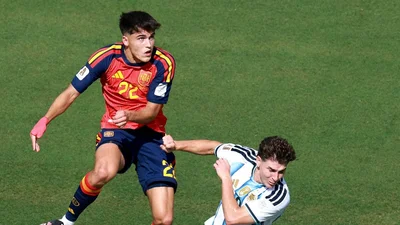
Such was the dominance of the Spaniards in North America as they capped off a near-flawless campaign — remarkably, the goalless draw against Cape Verde in their opener was the only stutter in the entire tournament — with a 1-0 win over Argentina in the final to lift their second World Cup.
Much like the incandescent march to the title by an elite group of players in 2010, many of whom were in the stands at the New York New Jersey Stadium on Sunday afternoon to watch their countrymen thoroughly outclass Messi’s troops, the Iberian nation’s latest conquest on the grand stage is not merely a victory on the field of play. It is also a renewed vindication of an idea and identity that is rooted in a deep affiliation for keeping the ball.
Portugal's Cristiano Ronald, bottom, tries to get the ball from Spain's Xavi Hernandez, left, Sergio Busquets, right, and Andres Iniesta, during the World Cup round of 16 football match between Spain and Portugal at the Green Point stadium in Cape Town, South Africa, Tuesday, June 29, 2010.
\| Photo Credit:
FILE PHOTO
The genesis of it in the Spanish set-up dates back to Luis Aragones’ time as head coach in the mid-2000s. Having overseen Spain’s round-of-16 exit to France at the 2006 World Cup in Germany, the bespectacled tactician paved the way for a course-correction by trading La Furia Roja — a more direct, physical approach — for a possession-based game.
That he had midfielders of the ilk of Xavi and Andres Iniesta, who had been schooled in this philosophy at La Masia — Barcelona’s renowned youth academy — and were beginning to come into their own, facilitated a smooth-sailing transition. As intended, Spain found long-awaited success at the 2008 European Championship.
For the idea to become the envy of the footballing world, the entry of Pep Guardiola as Barcelona manager in the summer of 2008 was even more significant. With Messi, Xavi, Iniesta and Sergio Busquets among his core contingent, Guardiola elevated that style, modelled on intricate passing, playing out from the back and retaining possession, to another degree. Tiki-taka would become an integral part of the sport’s lexicon and embody the beautiful game in all its glory.
At the international level, Vicente del Bosque, who took over from Aragones as Spain coach after Euro 2008, knew better than to veer away from these tried-and-tested tactics. More success inevitably came Spain’s way at the 2010 World Cup and Euro 2012.
Ever since, the importance of keeping the ball has been drilled into Spain’s footballers across all levels from a very early age. Pressing opponents high up the pitch as soon as they lose possession is another ingredient fundamental to this playbook. In a nutshell, no team retains possession better than Spain, and nobody recovers the ball as quickly. That is a surefire way of winning football matches, isn’t it?
Even so, Spain stagnated and fell into a rut where it didn’t win a lot of World Cup games between 2012 and 2024. In the carnival in Brazil in 2014, the defending champion was jolted by a shock group-stage exit.
In 2018 and 2022, it couldn’t advance past the round of 16. In Qatar four years ago, Spain’s manner of defeat to Morocco was particularly jarring, for its ouster via a penalty shootout after a drab 120 minutes was marked by a distinct absence of penetration in the final third. Pass after pass was played without an end product. Spain’s obsession with possession, perhaps rightly, was labelled by its critics as dour and devoid of imagination.
Luis de la Fuente, head coach of Spain, poses for a portrait with the FIFA World Cup trophy.
\| Photo Credit:
Getty Images
Few would have anticipated, then, that Luis de la Fuente would be the man to engineer a turnaround. Appointed in December 2022 in the immediate aftermath of a disastrous World Cup that Luis Enrique paid the price for, de la Fuente, 61 then, was barely known beyond his country’s borders.
Much to the credit of the federation, what he did have in spades was an intimate understanding of the players he was going to work with. He had played a pivotal part in the development of many of them in his capacity as coach of Spain’s junior teams, winning the U-19 European Championship in 2015 and the U-21 equivalent in 2019. He knew the buttons to press to get the best out of these players.
Instead of throwing the baby out with the bathwater, de la Fuente shrewdly stuck to the principal identity of Spanish football in the 21st century and embellished it with his own beliefs. Instead of the slow, sometimes monotonous build-up that involved a sequence of short passes in search for the perfect goal, de la Fuente would set up his team to be more fluid in its use of a large share of possession. The former full-back employed greater attacking width, and desired the ball circulating more quickly through the middle of the park.
Back to being the best
The results have been resounding. Having won every game on the way to claiming a record fourth European title in 2024, the Spanish juggernaut stitched together an unbeaten run at this World Cup too.
In Sunday’s final, Messi and Co. were a distant second. As is its wont, Spain had 60 percent of possession, and 20 attempts in comparison to Argentina’s two. The Albiceleste’s first shot came during the second half of extra time. Not one was on target.
Such supremacy wouldn’t have been possible without the calming, all-encompassing influence of Rodri. Blessed with the passing range of a playmaker and the physicality of a centre-back, the 6’3” defensive midfielder combines the dual responsibility of orchestrating Spain’s attacks and suppressing the rival’s threats with aplomb. As per Opta, the 30-year-old delivered 122 line-breaking passes at this World Cup, the most in a single edition since compatriot Xabi Alonso’s 126 in 2010.
To be presented the Golden Ball at the end of Sunday’s final — awarded to the best player of the tournament — was a fitting recognition of his contribution over the past month. If he has a robust beginning to the club season with Manchester City, a second Ballon d’Or could be another feather in an ornate cap by the end of the year.
ALSO READ: Football is simple for complete midfielder Rodri
Defensive solidity
That Spain conceded just a solitary goal in the tournament — against Belgium in the quarterfinals — was also down to goalkeeper Unai Simon and a well-drilled defensive unit. While Simon wasn’t really required to make desperate saves worthy of making the highlight packages, his inclination to step up as a sweeper, a la Germany’s Manuel Neuer from recent memory, enabled Spain’s defence to hold a high line. There were instances in both the semifinal and final when the French and Argentine forwards successfully beat the offside trap and ran behind the defence, but Simon was ever so swift to charge out of the box and clear the danger.
In keeping a clean sheet in seven out of eight matches, the precocious Pau Cubarsi also played a sparkling part. All of 19, the centre-back’s positional awareness and reading of the game were well beyond his tender age. It meant that he was one of only two outfield players, the other being left-back Marc Cucurella, to play every minute of the competition for Spain.
With such a tightly-knit defensive unit working in tandem, Spain’s forwards were never encumbered with having to chase a game. Not once, in fact, did the European giant trail in its quest for the holy grail, a first in 23 editions cutting across 96 years. The attack wasn’t free-flowing to start with, struggling to get past the gutsy Vozinha in the Cape Verde goal despite enjoying a plethora of possession. It may have invited some doubts about Spain retreating to a turgid style.
But once de la Fuente brought a fit-again Lamine Yamal and Dani Olmo into the mix from the get-go in the second game against Saudi Arabia, the dynamism in Spain’s attacking play returned and it romped to a 4-0 win. While Olmo’s foremost strength is his ability to receive the ball on the half-turn and dribble his way through congested spaces, Yamal’s trickery on the right wing is a sight for sore eyes.
Lionel Messi of Argentina controls the ball against Lamine Yamal of Spain during the FIFA World Cup 2026 final.
\| Photo Credit:
GETTY IMAGES
The wunderkind sparkled in spurts without quite seizing the spotlight as a teenaged Pele did in 1958 or Mbappe in 2018. A torn left hamstring at the back end of a hectic season with Barcelona may have been a factor, but it is instructive of the high regard he is held in that opponents yet felt the need to often double up against the 19-year-old.
Yamal’s scope for growing into a great of the game applies to many of the other members too. Sample the case of Nico Williams. The 24-year-old has pace to burn on the left wing, but circumstances curtailed his impact at this event. One of the breakthrough stars of the Euros two summers ago, Williams came into this year’s marquee competition with a hamstring injury.
To compound matters, he suffered a right adductor muscle injury in the final group encounter against Uruguay. Still, he came off the bench and provided the assist for Ferran Torres’ 106th-minute winner in the summit clash.
The conclusion of a World Cup, regardless of the outcome, usually marks the end of a cycle. With so many in this champion outfit yet to hit their prime, however, this feels like just the start of a very special era. After winning the World Cup in 2010, the men in bright red had to wait 16 years for a second star to be emblazoned above their crest. The third is likely to come far sooner.