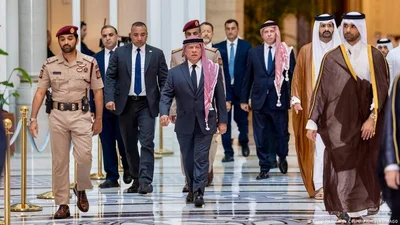
Air raid sirens again sounded in parts of Jordan early Tuesday as Iranian missiles targeted the kingdom.
"The air defense system intercepted and downed tonight three missiles coming from Iranian territory that entered Jordanian airspace and targeted the kingdom's territory," the army said in a statement.
No injuries were reported, but the latest strikes follow a series of attacks that have raised the stakes for one of the United States' closest Arab allies in the past days: Two US service members were killed and around 30 others injured by an Iranian missile strike on a US base in Jordan last week.
Jordan is one of the eight Arab countries that host permanent US military facilities. Some of the other host countries — particularly the Gulf states — have been the targets of Iranian attacks since the United States and Israel launched joint attacks on Iran in late February.
Though Iran launched missiles toward Jordan shortly thereafter, there has since been a lull in direct attacks on the kingdom, which has helped to intercept Iranian missiles launched toward Israel, arguing that it is acting in defense of its own airspace.
"Iran has reserved itself the right to return fire on any state in the region that hosts US military assets or bases, and Jordan is one of them," Erwin van Veen, a senior research fellow at the Clingendael Institute in The Hague, told DW. "Only the options of Jordan's King Abdullah II are quite limited as Jordan is in a very precarious balance with respect to military and economic dependence on the Americans."
On Sunday, in a first diplomatic escalation, Jordan summoned Iran's top diplomat in Amman to demand an immediate end to what the foreign ministry called "unjustified and blatant Iranian attacks."
Jordan's political and economic tightrope walk
The US is Jordan's largest single foreign supporter. Under a seven-year Memorandum of Understanding signed in 2022, Washington agreed to provide $1.45 billion (€1.27bn) annually in economic and military assistance. In 2025, Congress increased this to $1.65 billion, which was triple the amount from 2010.
Furthermore, a Defense Cooperation Agreement signed in January 2021 grants US forces formalized access to Jordanian military facilities. According to a recent report, there are currently 4,000 US troops, more than in previous years, stationed in Jordan.
In March, however, Jordanian Foreign Minister Ayman Safadi insisted that there were no foreign military bases in the country. Kelly Petillo, program manager for Middle East and North Africa at the European Council on Foreign Relations, said one reason for downplaying foreign military presence in Jordan could be anti-US sentiment.
"Despite Jordan's efforts to remain neutral in this war, existing alliances such as the one with the US not only affect Jordan's fragile security but also cause public discontent," she told DW.
She speculated that Jordan, like its Gulf allies in the region, might be beginning to question whether its alliance with the US was beneficial to the country's stability or actually a cause of instability.
A 2026 poll by Arab Barometer, a nonpartisan public opinion research network, concluded that only 12% of Jordanians view US President Donald Trump's foreign policy favorably.
For Jordan's King Abdullah II and Queen Rania the Palestinian issue is of particular importance Image: Paul Ellis/AFP/Getty Images
Jordan-Israel ties
"The other risk for Amman is that Iran's attacks could also place it in the same camp as Israel," Petillo warned. "This impression could cause further discontent among the wider public, creating space for protests as they were already seen during the war in Gaza, when people called for an end to the Israel-Jordan 1994 peace treaty."
In the past three years, relations between Israel and Jordan have become increasingly strained. In November 2023, the two countries recalled their ambassadors after Jordan's condemnation of Israel's conduct during the early days of its war in Gaza, which was unleashed after the Hamas attack on Israel on October 7, 2023. Hamas is considered a terrorist organization by the US, the EU and others.
Jordan has been at the forefront of efforts to push for a two-state solution, which would grant Palestinians their own state alongside Israel.
The Palestinian issue is of particular importance for Jordanian citizens as more than half of the population, including Queen Rania, has Palestinian roots. Around 2.4 million Palestinian refugees live in Jordan, according to the United Nations Relief and Works Agency for Palestine Refugees in the Near East (UNRWA).
But Jordan has repeatedly rejected any more displacement of Palestinians into the kingdom, particularly considering the high cost of hosting refugees whose return is anything but guaranteed.
"Jordan has been faced with a massive decline in USAID funding and the US pullback from UNRWA," Petillo said.
This comes as Jordan continues to struggle with high public debt and unemployment.
Aid organizations warn that increasing settler violence has forced more than 1,000 children from their homes in 2026Image: Leo Correa/AP Photo/picture alliance
Popular anger related to Israel has recently been exacerbated by the expansion of settlements in the occupied West Bank, which the United Nations and rights groups say has accelerated since 2023. Increased settler violence has made life even worse for Palestinians in the West Bank.
According to the aid organization Save the Children, more than 1,000 Palestinian children were displaced by a surge in settler violence in the West Bank in the first six months of 2026. This was half the total number of children forced from their homes by settler violence over the entire previous three-year period.
"As the current Israeli coalition wrote in its own coalition agreement at the start of its tenure in 2022, it ultimately intends to annex the West Bank," Erwin van Veen said.
"Jordan is, in many ways, between a rock and a hard place, as it has little room for manoeuvre — neither toward Israel, Iran nor Washington," he added.
The West Bank, a landlocked territory of about 5,655 square kilometers (2,183 square miles), lies between Israel and Jordan. Israel took control of it from Jordan in the 1967 Six-Day War. According to the United Nations Security Council, "Israel's establishment of settlements in Palestinian territory occupied since 1967, including East Jerusalem, had no legal validity."
Children injured in Gaza arrive in Jordan for treatment
[](https://hlsvod.dw.com/i/dwtv_video/flv/je/je20250307_KIDSDAY_,AVC_480x270,AVC_512x288,AVC_640x360,AVC_960x540,AVC_1280x720,AVC_1920x1080,.mp4.csmil/master.m3u8)
Edited by: Anne Thomas, Carla Bleiker