David Clement, Policy Director at the Consumer Choice Center, says Canada's trade relationship with the U.S. is too strong to unravel, but shifting tariff policies are discouraging business investment.
NEWYou can now listen to Fox News articles!
President Donald Trump is opening a new chapter in his playbook by invoking a tariff authority that no previous president has ever used — a move that could reshape future trade wars.
Trump used a little-known provision of the 1930 Tariff Act to impose 50% tariffs on a range of Canadian goods.
Known as Section 338, the nearly century-old law gives the president broad authority to impose duties on imports from countries deemed to discriminate against U.S. commerce. Its first-ever use by a U.S. president could establish a new legal blueprint for future trade disputes.
Canada, one of America's top trading partners, is the first country targeted under the long-dormant authority, with 50% tariffs covering exports ranging from wine and hockey sticks to cement, dairy products and furniture.
TRUMP BET TARIFFS WOULD BRING BACK AMERICAN FACTORY JOBS. NEW REPORT SAYS IT DIDN'T WORK
The latest tariffs add another point of friction in the already strained trade relationship between Trump and Canadian Prime Minister Mark Carney. (Jim Watson/Getty Images)
In a statement, Canadian Prime Minister Mark Carney criticized the tariffs as the latest in a series of U.S. trade actions he said violate the U.S.-Mexico-Canada Agreement while reaffirming Canada's commitment to negotiations.
The new duties are expected to take effect in the next 30 days.
"The significant thing is Trump uncorked a new tariff statute that has never been used and is pretty wide open in terms of the president's supposed power to impose tariffs," Scott Lincicome, vice president of general economics at the Cato Institute, told Fox News Digital.
"It's a lot more about what could be coming and the new uncertainty that just got injected into a multi-trillion-dollar trading environment."
The law has taken on added significance since the Supreme Court ruled against the administration's use of emergency powers for Trump's "Liberation Day" tariffs, prompting new interest in alternative legal authorities.
Against that backdrop, Lincicome said Section 338 could provide a broader legal avenue for imposing tariffs than authorities that have faced legal challenges or carry greater procedural constraints.
Tariffs are taxes on imported goods that U.S. importers generally pay upfront. Businesses can absorb the costs or pass them on to wholesalers, retailers and consumers through higher prices.
TRUMP DEFENDS TARIFFS, SAYS US HAS BEEN ‘THE KING OF BEING SCREWED’ BY TRADE IMBALANCE
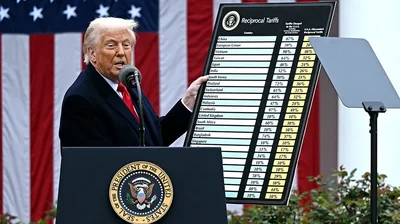
Trump's "Liberation Day" tariffs, announced in April 2025, imposed broad new import duties on dozens of countries. (Photo by Brendan Smialowski/AFP/Getty Images)
Lincicome said the limited scope of the tariffs may reflect political realities ahead of the midterms.
"The president knows that the midterms are just a couple months away and that Americans generally don't like tariffs because they associate them with affordability issues," Lincicome said.
David Clement, policy director at the Consumer Choice Center, argued the administration's latest move appears designed to preserve Trump's broader tariff agenda despite recent legal setbacks while increasing uncertainty for businesses.
"I would actually view this as almost like a last-ditch effort to try and keep some tariffs on the table," Clement told Fox News Digital. "All this means is that for roughly $20 billion in imports, they're just going to pay more for them."
He said the bigger long-term risk is not the collapse of North American trade, but businesses delaying investment because of the uncertainty surrounding future tariff policy.
Monthly tariff collections have more than tripled since Trump returned to office, rising from roughly $9 billion to more than $30 billion. The government collected $30.4 billion in duties in January, a 275% increase from a year earlier, bringing fiscal-year collections to $254.8 billion.
CLICK HERE TO DOWNLOAD THE FOX NEWS APP
Tariffs have been a defining feature of both of Trump's presidencies, with the president arguing they protect American industries, boost domestic manufacturing and strengthen the U.S. economy.
But with affordability remaining a defining issue ahead of the midterms, any tariff policy that raises consumer prices is likely to face renewed political scrutiny.
Amanda Macias covers the intersection of business, economics and politics, with a focus on how policy decisions shape markets, businesses and American workers.