The mile has always been a mythical race. For years it was seen as the benchmark of human athletic achievement and breaking the four-minute barrier was considered attainable, but improbable.
In 1954, a young medical student named Roger Bannister dedicated himself to piercing that four-minute threshold despite scepticism that a human could push themselves that far.
On a mild, breezy afternoon, on 6 May that year, at Oxfordâs Iffley Road track, Bannister and his two training partners and pacemakers Chris Chataway and Chris Brasher executed their plan perfectly.
The pair of Chrises carried Bannister on schedule to the final lap, and he did the rest, crossing the line in 3:59.4 seconds.
Roger Bannister breaks the tape at the end of his record-breaking mile run at Iffley Road, Oxford. He was the first person to run the mile in under four minutes, in a time of 3 minutes 59.4 seconds. (Photo: Norman Potter / Central Press / Hulton Archive / Getty Images)
It became global news with the Daily Telegraph declaring Bannisterâs feat the equivalent of being the âEverestâ of sport.
The New York Times reported that Bannister had broken âone of manâs hitherto unattainable goalsâ.
Three weeks later, Australian John Landy took 1.5 seconds off Bannisterâs time, clocking 3:57.9 in Turku, Finland. Bannister broke the door down, and many others have come streaming through for 60 years.
Like scaling Mount Everest, once Edmund Hillary and Tensing Norgay reached its summit, thousands more have done it. Itâs the way with barriers.
Kerrâs moment
When Scotlandâs Josh Kerr broke the line in 3:42.66 at Londonâs Olympic Stadium on a hot Saturday afternoon last weekend, he continued a great British tradition in the mile.
Since Bannisterâs feat, the great British middle-distance trio of Sebastian Coe, Steve Ovett and Steve Cram each held the mile record at various stages from the late 1970s well into the 1980s.
Coe and Ovett broke the record three times in a 10-day spell in 1981.
British athlete Sebastian Coe competing in Stockholm, 1981. (Photo: Keystone / Hulton Archive / Getty Images)
Kerr became the seventh man from Britain to hold the world record, but more significantly, he broke Moroccan Hicham El Guerroujâs 27-year-old world record.
In 1999, El Guerrouj clocked 3:43.13, which sliced more than 1.2 seconds off the existing record at the time, held by Algeriaâs Noureddine Morceli.
It was a seismic shift forward that remained unchallenged for nearly three decades.
Brief timeline of British mile performers before and after Hicham El Guerroujâs 1999 world record. (Graphic: Daily Maverick)
Before Saturday, the mile had been one of athleticsâ longest-standing records, partly because itâs not raced as often any more and partly because El Guerroujâs previous mark was so outlandishly brilliant that it required single-minded dedication by a supremely talented athlete to even come close.
Kerr is that man.
His middle-distance pedigree is exceptional. He is a 1500m World Champion, won in 2023. He also won silver at the 2024 Olympics in the same event and is a two-time indoor world champion.
Kerr is also a showman and clearly not short on confidence â a vital trait for any elite sportsperson.
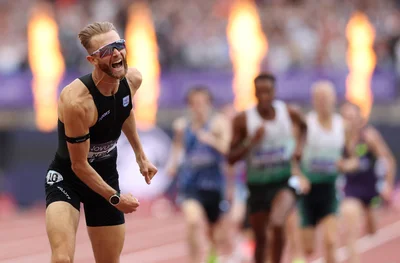
Britain's Josh Kerr celebrates after winning the menâs mile in London and setting a new world record. (Photo: Reuters / Matthew Childs)
Project 222
In March this year, Kerr declared that he was targeting the mile world record in London on 18 July. And to achieve the goal, he revealed his âProject 222â, representing the number of seconds it would take to break El Guerroujâs benchmark.
âGoing after records like that is not really anything about fitness, itâs about wrapping your mind around that time. Thatâs why this was called Project 222,â said Kerr.
In collaboration with running shoe sponsors Brooks, Kerr trained at altitude in Albuquerque while documenting the process on YouTube. Brooks designed custom spikes and a speed suit, and the buildup culminated in a 1200m time trial completed in 2:42.45 to confirm his fitness was on track.
Saying he would break the record and actually doing it were two different things, but with a near-perfect build-up, free of injury and illness and the ideal track conditions, Kerr was ready for the assault.
In many ways, that ramped up the pressure because he had no excuses â not that he sought any. Now it only came down to execution on the day, which is the true test of greatness.
To say he executed perfectly would be an understatement.
Hicham El Guerrouj of Morocco held the mile world record for 27 years. (Photo: Simon Bruty / Anychance / Getty Images)
Like Bannister 72 years earlier, training partners Brannon Kidder and Žan Rudolf paced Kerr through the first three laps of the four-lap event.
Kidder hit 400m on world record pace in 54.75, with Kerr a few strides back in third, hitting the mark in 55.3 seconds.
Kidder continued to lead through 800m, with Kerr timed at 1:51.1 â which was more than two seconds faster than the womenâs 800m world record held by Jarmila KratochvÃlová.
The pacemakers stepped aside, and Kerr took over, hitting the 1200m mark in 2:46.39.
Kerr then went through 1500m in 3:27.62 â faster than his own British record for the distance. The record was on, and with an astonishing display of stamina at such express pace, Kerr crossed the finish line in 3:42.66, taking 0.47 off El Guerroujâs record.
His final lap split was 54.87, nearly 0.3 seconds quicker than his first lap.
Josh Kerr celebrates his achievment. The mile world record has always been associated with British athletes. (Photo: Reuters / Isabel Infantes)
âI feel very lucky to push this forward and bring it back to the UK because I feel like thatâs where the mile belongs,â Kerr said after the race. Hopefully, it can stay for a while.
âI knew I had 3:42 in me. If Iâm going to leave my mark on this sport as a British athlete, I have to be able to do those performances. And those performances take every single part of you and every single part of your team. This feels incredible.â DM