NASA's Psyche mission is on its way to check out the asteroid 16 Psyche, a massive and metal-rich asteroid in the main asteroid belt. It was launched in October 2023 and will reach its target in August 2029.
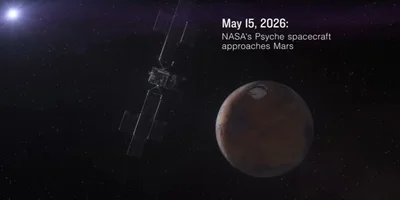
On its way, it used a gravity-assist maneuver at Mars to gain speed and give a slight change to its trajectory. The flyby brought it to within about 3500 km (2200 mi) of Mars, and provided an opportunity to test the spacecraft's science instruments. That was back in May, and it took months to download and analyze the data.
Psyche's instruments delivered observations of things we already know about Mars, so the results showed that the instruments are performing exactly as designed. Some of Psyche's data will also complement what we already know about the planet.
*Astronomers from MIT and other institutions used ALMA data to map Psyche's surface and came up with this image. We'll have to wait several years before we see the real thing in this much detail. The Psyche spacecraft's closest orbit will bring it to within 75 km of the asteroid. Image Credit: NASA*
âThe missionâs imager, magnetometer, and gamma-ray and neutron spectrometer teams worked overtime to make full use of this planetary encounter, and all instruments delivered great results,â said Lindy Elkins-Tanton, principal investigator for Psyche at the University of California, Berkeley. âWe didnât anticipate big discoveries, given how extensively the planet has been studied, but we did complement Mars science with the data we collected through Psycheâs unique perspective.â
Psyche's magnetometer will play a leading role in its mission. Astronomers have thought that the object is the metal-rich, left over core of a protoplanet that had its outer layers removed by collision. This view is bolstered by the fact that it contains about 1% of the mass of the main asteroid belt.
But in recent years, new research has challenged that view. In any case, it is almost certainly a metallic asteroid, and Psyche's magnetometer will address this. By measuring 16 Psyche's magnetic field, it will confirm the asteroid's nature.
Magnetomers are rugged instruments widely used on missions. They employ coils that the spacecraft power source saturates magnetically. Then, when an external magnetic field changes the saturation of the coil, the difference between the two reveals the nature of the external magnetic field. They're almost the perfect instrument, because they use little power and are very robust.
Psyche's magnetometer is different from some others. It's actually a pair of sensors mounted on a 2.15 meter boom. This system is called a gradiometer, and it lets Psyche carefully separate its own small magnetic field from that of its target, because one sensor is closer to the spacecraft than the other.
*This schematic shows some of the components of the Psyche spacecraft, including its pair of magnetometer sensors. The spacecraft's magnetometer is a critical part of its payload, and will help the mission determine if asteroid 16 Psyche is the remnant metallic core of a protoplanet. Image Credit: Zuber et al. 2022. SSR*
Though the magnetometer has been measuring the solar wind during cruise, the Mars flyby was the first opportunity to test the magnetometer on an object.
"As the spacecraft passed close to Mars, the magnetometer saw an intense uptick in magnetic field corresponding to the bow shock region, where the solar wind slams into the planetâs magnetic field,â said Ben Weiss, Psycheâs deputy principal investigator and the magnetometry investigation lead at MIT. âThis flyby calibration effort validated the instrumentâs performance under dynamic conditions while also revealing the fascinating physics of planetary magnetism.â
It's critical that the magnetometer functions properly. Though 16 Psyche doesn't currently generate a magnetic field like Earth does, it may hold evidence of a remnant magnetic field frozen into its rock. That field will either confirm or deny that 16 Psyche was once the core of a protoplanet.
Like many spacecraft, Psyche also has a multispectral imager that captures images in different parts of the light spectrum. It will help differentiate between 16 Psyche's metallic and silicate components. During the flyby, it captured images of Mars showing craters, the southern polar ice cap, and other features.
*This image from Psyche's multispectral imager shows Huygens crater, a large double-ringed crater, the fifth largest impact crater on Mars. The different colours reveal different rock compositions. Image Credit: NASA/JPL-Caltech/ASU. PIA26775*
It's also possible that 16 Psyche has moonlets like some other asteroids, and the flyby was an opportunity to test the camera and how it can help search for any moonlets the asteroid may have.
âThe imager performed brilliantly, delivering some rarely seen views of the Red Planet,â said Jim Bell, the Psyche imager instrument lead at Arizona State University in Tempe. âBesides the obvious beauty of the photos, we were also able to fully test its calibration and sensitivity to scattered light, including picking out the Martian moons Phobos and Deimos from very far away as a part of a practice for the satellite search that weâll use at the asteroid Psyche to look for any moonlets there.â
NASA has released a timelapse flyby movie of its visit to the red planet made with the multispectral imager. The movie looks shockingly artful.
VIDEO
The Mars flyby was a critical maneuver, and the Psyche team prepared for it for years. The maneuver was executed perfectly, according to NASA, and now the spacecraft is on its way to rendezvous with 16 Psyche three years from now.
âThis gravity assist was years in the making, and the navigation team nailed it â Psyche flew by Mars on exactly the trajectory we needed to set us on a path to rendezvous with the asteroid in the summer of 2029,â said Bob Mase, Psycheâs project manager at NASAâs Jet Propulsion Laboratory. âThe spacecraft is in great shape, and weâre on schedule to resume sustained thrusting with the solar-electric propulsion system later this fall.â
VIDEO