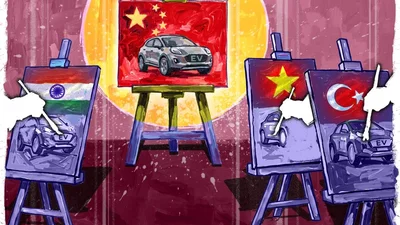
China’s electric vehicle (EV) industry sits at the centre of numerous economic and geopolitical trends: consumer spending, environmental protection, trade policy, high-end manufacturing, technology and more. In this short series, we assess the current state of the sector within these broader contexts. Here, Yeon Woo Lee asks whether Beijing has written a blueprint for developing countries to kick-start their own contenders in the field.
Emerging markets once seemed like also-rans in the global car industry. In the days when petrol vehicles predominated, manufacturers required vast supplier networks and hard-won expertise in engines, transmissions and other core power train technologies to compete – two advantages among many for established, wealthier players.
But with a global shift towards electric engines and China’s consequent rise from automotive latecomer to
, that calculus has changed.
Many emerging-market governments have taken cues from China’s state-led playbook, using incentives to create demand while pushing companies to localise production and supply chains.
As the thinking goes, electrification can accelerate industrial catch-up and help them build domestic champions before global EV markets become more firmly dominated by a handful of large firms from a few early adopter countries.
“China’s rapid rise in the EV sector demonstrates that disruptive innovation can
dismantle entrenched technology barriers
– such as internal combustion engine – and unlock viable pathways to industrial upgrading,” said Claire Yuan, director at S\&P Global Ratings. “Established international players could risk losing their competitiveness as local, state-backed national champions expand.”
Electrification has lowered some traditional barriers to entry by reducing the importance of engines and transmissions. At the same time, China’s vast EV supply chain has given aspiring carmakers a faster foothold by making key components easier to source.