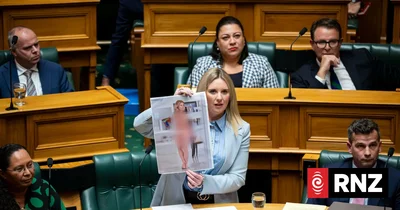
The ACT MP championing a crackdown on "deepfake" abuse has described her legislation as just the "first step", encouraging MPs to also consider a wider revamp of relevant laws, more education, and possible regulation of AI.
Laura McClure's member's bill - which passed its first reading in May unanimously - would expand the legal definition of an "intimate visual recording" to include images or videos manipulated by AI without consent.
Appearing before a parliamentary select committee on Wednesday, McClure said police found it challenging to prosecute the creation and sharing of explicit deepfakes under the existing law, as they were required to prove an intent to cause harm.
"It appears that police, certainly in some of the cases I'm aware of, don't tend to take this any further," she told MPs.
McClure acknowledged there had been a successful prosecution earlier in the year, but said it had required the victim's family to build an extensive case themselves.
She said AI technology had improved dramatically in recent years and was now being regularly used to create "highly realistic" images of "disgusting" acts that were then shared for "sadistic" purposes.
"This is not just what you'd call an old Photoshop-a-head-onto-someone-else's-body."
McClure accepted there would still be challenges in enforcing the law - including tracking down the original creator - but said an explicit ban would send a clear signal to offenders.
"I don't expect to see kids being locked up in jail for deepfaking," she said. "But what it will do is set the standard."
She stressed the need to also consider further action, outside the scope of her bill, and said the Harmful Digital Communications Act, passed in 2015, needed a full review.
"That's on notice to the next Parliament or the next minister in charge."
Asked about ways to hold online platforms accountable, McClure said a blanket ban on deepfake technology would be "a bit like playing whack-a-mole" given its proliferation.
But she said officials should be investigating the regulation of the AI landscape, noting risks and opportunities.
"What are we going to do in the future?" she said. "Is there going to be some sort of regulation of technology?
"There is going to need to be some kind of ethics with AI."
One option worth considering, she said, was a "national hashing register" to prevent particular images and footage from being repeatedly shared online.
McClure said deepfaking could also be used for "fraudulent" purposes beyond pornography, but described that as a "massive piece of work" for a future government to grapple with.