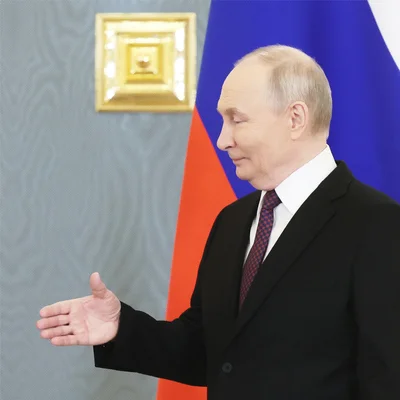
“Putin is now isolated from the world more than ever,” President Joe Biden proclaimed in his State of the Union address in March 2022. One week before, President Vladimir Putin of Russia had ordered his tanks into Ukraine, prompting Western nations to sever ties with Russia and throw their support behind Kyiv. The shock over Mr. Putin’s brazen land grab reverberated across the globe. Many expected Russia to turn into a bête noire.
But it soon dawned on Russia’s adversaries that the country wasn’t going anywhere. Forced to prepare for a long war, the Kremlin instructed its diplomats, intellectuals and operatives to secure support in the non-Western world. Many countries proved receptive to Russian overtures, refusing to be forced into a binary choice between Russia and the West. Russia soon became something curious: the most sanctioned country in the world, yet more than able to stay afloat. Estrangement from Europe was offset by ever closer relations with the global south.
To make sense of this turn of events, I set off on a journey around the globe. Traveling to over a dozen countries, I spoke with the politicians and people who support Russia, and I interviewed Russians who propel the Kremlin’s agenda from Moscow and those who operate on the periphery. The question was simple: How has Russia managed to weather its rejection by the West? What I found was testament to the country’s relentless adaptation. No matter what the West does, Russia will not yield.
In Dubai, the successes of Russia’s economic maneuvering were unmistakable. After the invasion, the United Arab Emirates became the epicenter of Russia’s wartime strategy: a haven for Russia’s rich relocating their businesses, a conduit for Russian traders importing Chinese goods and a hub for Russian banks settling nondollar payments. For Russia’s shadow tankers, ferrying Russian oil to willing buyers across Asia, the U.A.E. became a place to shapeshift and camouflage. In the netherworld of shell companies and obliging professionals, Russia was able to sidestep Western sanctions.
Other Russian schemes were more sinister. In the Alabuga Special Economic Zone, some 600 miles east of Moscow, sits a hub for the assembly of Iranian-origin drones used to pummel Ukraine. Central to the effort is a pseudovocational program that has targeted young African women to work there, with administrators making false promises of career advancement and a life filled with love and marriage. Sprawled across social media platforms, the recruitment spree represented just a tiny fragment of Moscow’s information campaigns in Africa, which scored points by framing Russia as an antidote to the “neocolonial” West.
In Vienna and New York, I witnessed the loftier forms of Russia’s power plays. At the United Nations, Russian diplomats worked hard to corral non-Western countries to support their positions, including on the war in Ukraine. Russian diplomats also used newer formats to woo friends. Chairing the BRICS alliance in 2024, the Kremlin impressed its partners with hundreds of events, among them a fashion show, a sports tournament and a grand summit in the city of Kazan. A formidable host, Russia made clear that it would not be isolated.
We are having trouble retrieving the article content.
Please enable JavaScript in your browser settings.
Thank you for your patience while we verify access. If you are in Reader mode please exit and log into your Times account, or subscribe for all of The Times.
Thank you for your patience while we verify access.
Already a subscriber? Log in.
Want all of The Times? Subscribe.