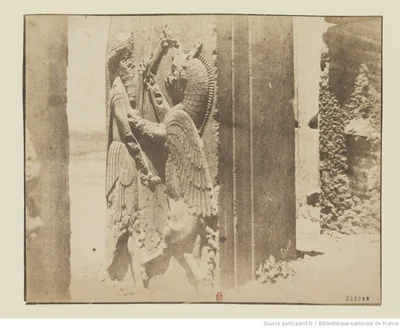
TEHRAN - The oldest known photographs of Persepolis, the ceremonial capital of the Achaemenid Empire and now a UNESCO World Heritage site, provide a rare visual record of the monument before modern archaeological excavations reshaped its appearance.
Captured in the second half of the 19th century by pioneering photographers and later complemented by archaeological documentation and aerial photography, the images chronicle both the site's condition and the evolution of archaeological research in Iran.
The earliest known photographs of Persepolis were taken in the autumn of 1857 by Luigi Pesce (1827–1864), an Italian military officer and photographer who had traveled to Iran as part of a military mission to help train the Qajar army. Carrying the cumbersome photographic equipment of the period across the Marvdasht Plain, Pesce produced what are widely regarded as the first surviving photographs of Persepolis.
The photographs reveal a markedly different landscape from the one familiar to modern visitors. Much of the ancient complex remained buried beneath centuries of accumulated soil and debris. Among the most notable differences, the eastern staircase of the Apadana Palace, today one of Persepolis' defining architectural features, had not yet been excavated and was therefore absent from Pesce's images.
Pesce is widely credited as the first photographer to systematically document several of Iran's most important archaeological sites, including Persepolis, Pasargadae, and Naqsh-e Rostam. On April 29, 1858, he presented an album of his photographs to Naser al-Din Shah Qajar. A second album was sent to King Wilhelm I of Prussia, and that collection later entered the holdings of New York's Metropolitan Museum of Art, where it remains an important record of early photography and nineteenth-century Iran. The museum notes that Pesce's album represents one of the earliest extensive photographic surveys of Persian antiquities and landscapes. His photographs were created using the wet collodion process, a technically demanding method that required photographers to prepare, expose, and develop glass negatives while still wet, often under difficult field conditions.
Nearly three decades later, Antoin Sevruguin, the Armenian-Iranian court photographer of the Qajar era, also documented Persepolis. Renowned for recording Iran's historical monuments, landscapes and people, Sevruguin visited the Marvdasht Plain several times around the turn of the twentieth century. A number of his photographs of Persepolis were taken between approximately 1898 and 1902, capturing additional details of the site before the beginning of large-scale archaeological excavations.
Sevruguin's photographs now preserved in major international collections, including the Smithsonian Institution's Archives of Asian Art and other museum archives, are regarded as valuable historical documents that record both Iran's cultural heritage and the appearance of monuments before extensive restoration efforts. His work forms one of the most comprehensive photographic records of late Qajar Iran.
Scientific documentation of Persepolis entered a new phase in the early twentieth century. In 1931, German archaeologist Ernst Herzfeld, representing the Oriental Institute of the University of Chicago, began the first systematic excavations at the site. Photographer Hans von Busse later joined Herzfeld's expedition to document the archaeological work.
Herzfeld's first major excavation focused on the Apadana Palace. Between 1931 and 1934, archaeologists uncovered much of the eastern staircase from beneath collapsed mudbrick debris. Although the rubble had concealed the reliefs for centuries, archaeologists have noted that it also acted as a protective layer, shielding many of the carvings from weathering and erosion.
Following Herzfeld's departure in 1934, archaeologist Erich F. Schmidt assumed leadership of the excavations and continued work until 1939. During two field seasons between 1935 and 1937, Schmidt used his own aircraft to produce an unprecedented series of aerial photographs of Persepolis and numerous other archaeological sites across Iran. The images offered researchers entirely new perspectives on the layout of ancient cities and monuments and were later published in his influential volume Flights over Ancient Cities of Iran.
Together, the work of Pesce, Sevruguin, Herzfeld, Schmidt and their collaborators provides an unparalleled visual chronology of Persepolis spanning more than eighty years. From the first cumbersome wet-plate photographs of a largely buried monument to systematic archaeological documentation and pioneering aerial surveys, these images remain indispensable historical records, illustrating how one of the world's greatest archaeological sites has been gradually revealed through exploration, excavation and photography.
The information in this article was compiled from museum archives, archaeological publications, and historical sources, including the UNESCO World Heritage Centre, the Metropolitan Museum of Art, the Smithsonian Institution, and the Oriental Institute of the University of Chicago.
AM