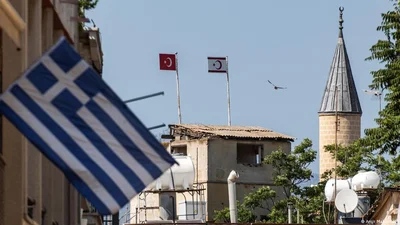
Monday marks the 52nd anniversary of Turkey's 1974 invasion of Cyprus, which led to the division of the island.
Five decades later, the Cyprus issue remains one of the world's longest-running unresolved disputes.
The United Nations announced last week that Antonio Guterres is due to visit Cyprus from July 27 to 29 — the first visit by a UN secretary-general in 16 years — in an effort to breathe new life into the stalled peace process.
A new UN push for progress
His visit marks the culmination of a renewed UN initiative that was launched after an informal enlarged meeting on Cyprus held in Geneva in March.
Since then, the UN secretary-general's personal envoy, Maria Angela Holguin, has held a series of consultations in Cyprus, Greece, Turkey, the United Kingdom and Brussels to assess whether the political conditions exist for meaningful negotiations to resume.
Antonio Guterres will visit Cyprus next week. It is the first visit to the island by a UN Secretary-General in 16 yearsImage: Jean Marc Ferré/MAXPPP/IMAGO
During his stay in Cyprus, Guterres will hold separate meetings with President of the Republic of Cyprus Nikos Christodoulides and Turkish Cypriot leader Tufan Erhurman.
On July 29, the two leaders are expected to meet jointly with the UN chief at the residence of the UN Special Representative in the UN-controlled buffer zone.
UN initiatives in the past 25 years
The last time a UN secretary-general visited Cyprus was in 2010, when Ban Ki-moon sought to inject political momentum into negotiations between then President of the Republic of Cyprus Demetris Christofias and Turkish Cypriot leader Mehmet Ali Talat.
Both leaders came from left-wing political parties that supported a bizonal, bicommunal federation and were widely seen as having the political will to pursue a comprehensive settlement.
That momentum, however, faded only months later after Talat lost the Turkish Cypriot leadership election to Dervis Eroglu, while major disagreements over the core chapters of the negotiations remained unresolved.
Ban's efforts were preceded by the intensive engagement of Kofi Annan between 2002 and 2004, when the UN undertook its most ambitious effort to broker a comprehensive settlement of the Cyprus issue.
Former UN Secretary-General Ban Ki-moon (center) sought to inject some momentum into negotiations between the two sides in 2010. He is pictured here with President of the Republic of Cyprus Demetris Christofias (left) and Turkish Cypriot leader Dervis Eroglu Image: Katia Christodoulou/dpa/picture alliance
Annan became personally involved in the negotiations, presenting a series of revised versions of what became known as the Annan Plan.
The initiative culminated in simultaneous referendums in April 2004. The proposal was approved by a majority of Turkish Cypriot voters but rejected by 75.8% of Greek Cypriot voters.
Reports in the British media
Guterres' visit comes amid reports that the UN is exploring a possible new framework for resolving the Cyprus issue.
The discussion gained momentum after Britain's The Independent reported on July 12 that Holguin is working on a revised settlement proposal.
According to the newspaper, the framework would retain the agreed model of a bizonal, bicommunal federation, as set out in relevant UN Security Council resolutions, while granting significantly greater autonomy to the two constituent states and limiting the powers of the federal government.
The report also claims that, in exchange for this broader autonomy, the Turkish Cypriot side would be expected to accept territorial adjustments, including the return of the fenced-off city of Varosha and the town of Morphou.
British newspaper 'The Independent' reported on July 12 that the UN secretary-general's personal envoy, Maria Angela Holguin (pictured here), is working on a revised settlement proposal for CyprusImage: Kostas Pikoulas/IMAGO
It also suggests that new security arrangements are being considered that would allow Greek and Turkish troops to remain on the island under NATO command.
According to The Independent, the proposal seeks to bridge the gap between the Greek Cypriot commitment to a federal settlement and Turkey's long-standing support for a two-state solution.
The UN has neither confirmed nor denied the report.
Asked about it, President Christodoulides said that "not everything reported by the newspaper is accurate," adding that he expects further developments in the coming period.
What next?
Despite the expectations surrounding Guterres' visit, diplomats say the UN chief's immediate objective is not to discuss a draft settlement plan.
Diplomatic sources who spoke to DW believe the most likely outcome of the meetings next week will be the announcement of a new informal expanded meeting bringing together the leaders of Cyprus' two communities, representatives of Greece, Turkey and the UK — the island's three guarantor powers under the 1960 treaties — and the UN.
According to the same sources, such a meeting could take place in late August or early September. Unlike previous informal gatherings, however, the UN is said to be seeking a more structured process this time, with a clearer sequence of steps and a defined timeframe.
Why now?
Although Guterres' renewed engagement is inevitably linked to the final months of his second term, which ends in December, diplomatic sources believe the latest initiative is driven by more than his limited remaining time in office.
For the first time in years, they believe conditions for a renewed political dialogue may be emerging.
A key factor has been the election of Tufan Erhurman as Turkish Cypriot leader last October. Unlike his predecessor, Ersin Tatar, who advocated a two-state solution, Erhurman has said he is prepared to resume negotiations on the basis of a bizonal, bicommunal federation.
That change does not represent a shift in Turkey's official policy, nor does it resolve longstanding disagreements over security, guarantees, political equality or the continued presence of Turkish troops on the island.
It has, however, created conditions that allow the UN to test whether a meaningful return to negotiations is now possible.
What is the role of the EU?
Cyprus government spokesperson Konstantinos Letymbiotis believes Guterres' visit should also be viewed in the context of a broader increase in international diplomatic activity on Cyprus.
Antonio Costa (left) and Ursula von der Leyen (right) of the EU recently met Turkish President Recep Tayyip Erdogan (center) in AnkaraImage: Turkish Presidency/Murat Cetinmuhurdar/Handout/Anadolu/picture alliance
"The secretary-general's initiative, the European Union's stronger engagement and the appointment of Executive Vice-President Raffaele Fitto as the EU's envoy on Cyprus are creating new momentum," he told DW.
On July 8, European Council President Antonio Costa and European Commission President Ursula von der Leyen discussed the UN initiative with Turkish President Recep Tayyip Erdogan, urging Ankara to make use of the renewed diplomatic momentum on Cyprus.
A few days later, the Commission appointed Raffaele Fitto as its special representative for the Cyprus issue.
The move was widely interpreted as a sign that Brussels intends to play a more substantive role in the process, while underlining that any future settlement must be fully compatible with EU law.
The EU's increased involvement is also closely linked to the broader trajectory of EU-Turkey relations.
From Brussels' perspective, progress on the Cyprus issue could facilitate movement on several key areas of cooperation with Ankara.
Conversely, the absence of progress continues to be one of the main obstacles preventing any meaningful upgrade in relations between the EU and Turkey.
Edited by: Aingeal Flanagan