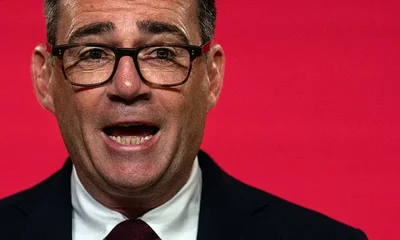
In his speech on Friday formally accepting his dramatic elevation to the Labour leadership, Andy Burnham told the assembled delegates: ‘This is a proud moment you have given me and my family today, and an emotional one. But it is one for which I am ready. I am ready, ready to lead.’
The triple use of the word ‘ready’ was his own, which he had scribbled into the text just before he spoke.
It was aimed at reassuring his watching party. But also, I suspect, a subconscious attempt to reassure himself.
The reality is Burnham is not yet ready to be Prime Minister. And his team is not yet ready to govern the nation.
‘It’s all come more quickly than we would have liked,’ one aide admitted to me yesterday. ‘We wanted a longer transition. But we’ll make it work.’
Since Keir Starmer’s announcement four weeks ago that he was standing down, Burnham and his allies have been engaged in a race against time to prepare for the transition of power. And they have lost it.
Their initial plan involved an extended handover, one in which Starmer would remain until just before the Labour Party conference at the end of September. But Sir Keir was having none of it.
‘They didn’t seriously think he was going to spend the summer acting as Burnham’s house-sitter, did they?’ one Starmer supporter caustically observed.
Andy Burnham is not yet ready to be Prime Minister and his team is not yet ready to govern the nation, writes Dan Hodges
The result is that when Burnham steps into Downing Street today he will do so with less preparation than any other prime minister in modern British political history.
The evidence of this is everywhere. Friday’s ‘special conference’ to formally announce his accession was poorly managed. His speech had no framing, was backward looking and directed solely at his party.
As one Cabinet minister observed: ‘It led every major news bulletin. And for a lot of people, that was basically their first introduction to Andy. But he wasn’t speaking to them. He was basically speaking to Neil Kinnock.’
Then there is the confusion – which has now morphed into outright chaos – over his Cabinet planning. Allies of Burnham spent last week insisting no final decisions had been made. In the past 48 hours they have suddenly pivoted back, briefing that everything has been locked down for days.
Whatever the truth, the impression was given that a number of major Cabinet positions – most notably Chancellor – were still up for grabs. This in turn sparked a damaging and unedifying briefing war, as Shabana Mahmood, Ed Miliband and others tried to bounce Burnham into handing them the role.
Similar turmoil has surrounded his policy agenda. Burnham and his allies have spent the past two days insisting ‘there is a plan’. But that claim has been undermined by increasingly inchoate and random briefings on everything from ID cards and North Sea oil development to overseas aid.
And again, none of these disparate policy initiatives has been accompanied by any form of coherent narrative framing or messaging. ‘It’s like they’re just chucking stuff out to convince people they actually have a policy agenda,’ was how one worried MP put it.
These problems are being exacerbated by an increasingly acute staffing crisis within his team. The speed of the transition means there has simply not been time to fill many of the posts required to support his plan for a dual No 10 of the North and No 10 of the South.
Indeed, there is currently no coherent staffing diagram at all. Nor is there a settled 100-day strategy. Or even a basic grid of activity for Burnham’s first month in office. As one ally admitted: ‘The grid? We haven’t got one. We haven’t even got anyone to fill it in yet.’
Ed Miliband, Shabana Mahmood and others are all in the frame for the role of Chancellor
Some of Burnham’s internal opponents are already gleefully pointing at this dysfunctionality, predicting it presages disaster. ‘It’s all going to fall apart very quickly,’ one Starmer supporter told me. ‘It won’t be long before everyone’s saying, “Oh God! What have we done?”’
Such talk may simply prove to be wishful, if malign, thinking. First, the fact that Burnham is taking over at the start of the summer recess gives him and his embattled team a little leeway.
Without the pressures of daily parliamentary scrutiny, his new Cabinet will have some space to read into, and get to grips with, their briefs.
Our new Prime Minister also has one advantage over his predecessor. While he does not yet have a clearly defined policy agenda, he does have a vision of where he wants to take the country.
The ‘Makerfield Test’ – in which he insists any initiative must be of direct benefit to the working people of his constituency – provides a template to build upon. Keir Starmer, as we have seen, did not even have that basic framework.
Another positive is that Burnham is someone who knows how to build a team. As an ally recently pointed out, ‘when he was mayor [of Manchester] he gave portfolios to opponents from across the political spectrum. The Tories and the Lib Dems. His strength is pulling people together.’
In time, such strengths may well come to the fore. But there is no avoiding the fact that the premiership has come too soon for a man who was not even an MP at the start of June. And that means that in the first weeks and months of his term of office mistakes are inevitable.
Not least because no-one taking the most demanding job in the land has had so little time to brace themselves mentally for the enormity of what lies ahead.
A couple of months ago I bumped into Andy Burnham in the street. He was off to the pub with friends. He taunted me over the latest Liverpool result, I swore at him, and we said our goodbyes.
That life has now ended. He will never walk alone in the street again. In the wake of his Makerfield by-election win, a close ally explained how he was going to try to carve out some serious time for Burnham to go away with his family and process what was coming. But in the end, it couldn’t be found.
I’m told that over the weeks ahead Burnham is going to deploy a new phrase. He wants, he will say, to give the British people ‘space to breathe’. Some respite from the cost of living crisis, concerns over their jobs and the economy, worries about crime.
It’s to be hoped that at some point over the summer our new Prime Minister can also find some space to breathe himself. Because if he can’t, Britain may be facing a long, cold winter.