Thousands of Kidnapped Africans Died on an Island in the Atlantic After Being Rescued From Slave Ships. Evidence in Their Teeth Traces Their Journeys
Remains in the graves of St. Helena, where the British military housed “liberated” enslaved Africans, contain isotopes from inland Angola and Zimbabwe
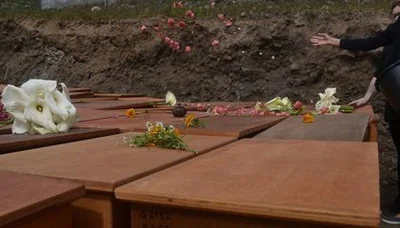
The exumed remains were reburied in caskets in 2022.
St. Helena Trans-Atlantic Slave Memorial
The British Royal Navy spent the better part of the 19th century patrolling the Atlantic, intercepting ships full of captured Africans. Great Britain had outlawed the slave trade in 1807, but there was the issue of compliance among its colonies. As a result, naval enforcers seized around 1,600 vessels, liberating some 150,000 people.
The British brought about 450 of these ships to the island of St. Helena, in the middle of the Atlantic, where the Navy had set up a Vice-Admiralty court. There, some 27,000 liberated Africans were housed in a settlement called Rupert’s Valley. Some of these people stayed on the island and raised families. Most voyaged back to the African continent. And about a third of them died in the settlement soon after they arrived, of horrifically common slave-ship maladies like scurvy, dysentery and dehydration.
In 2008, archaeologists investigated the settlement, which a missionary once called a “valley of dry bones.” They found the remains of 325 skeletons, most buried haphazardly and without coffins, some in shared graves.
“It became clear pretty quickly these were the remains of liberated Africans,” Hannes Schroeder, a geneticist at the University of Copenhagen, tells Science magazine’s Andrew Curry. “The question came up, where did they come from? And if these people were liberated captives brought to St. Helena, should they be repatriated to wherever they came from in Africa?”
St. Helena island is located about 1,200 miles from the coast of Africa.
St. Helena National Trust
Schroeder co-authored a study recently published in the journal Science, in which researchers attempted to answer those questions by analyzing the deceased’s teeth. The researchers identified strontium isotopes in the tooth enamel of 152 skeletons from Rupert’s Valley. They found that most of the individuals grew up near the West African coast—while some of them traveled from further inland when they were children.
Strontium isotopes are specific to types of water and plants, and they embed in kids’ tooth enamel as it forms. That means the isotopes “reflect where they were at that specific time in their lives,” study co-author Vicky Oelze, a geochemist at the University of California Santa Cruz, tells Science. “Even if they were displaced, the signature of where they grew up is locked in their teeth for eternity.”
The dwellings of Rupert’s Valley
St. Helena National Trust
By analyzing the teeth, researchers discovered that some of the people originated further east than expected. According to the study, one young man buried at Rupert’s Valley likely traveled between the ages of 7 and 9 from inland Angola to a “coastal region near the likely port of embarkation.”
It’s “possible that their displacement during childhood was connected with their enslavement,” Schroeder tells Live Science’s Owen Jarus. Several individuals likely traveled great distances as children—from the interiors of Angola, Zimbabwe or elsewhere in southern Africa.
“It makes sense that slave traders wanted younger people, with the potential for many years as laborers,” says David Head, a historian at the University of Central Florida who wasn’t involved in the research, to Live Science. “But to have [this] reinforced through their [teeth] reveals the tragedy of enslaved children.”
Did you know? Mapping Africa
Researchers previously used related methods to produce a map of predicted strontium isotope ratios across Sub-Saharan Africa that is intended to enable study of how people and wildlife have moved across the globe and “to contribute to the restoration of the identities, cultures, and lives of individuals and communities whose rights and lives were stripped away during the colonial period,” said Xueye Wang, lead author of both that research and the new research in Science, in a statement. Wang is a research associate at Sichuan University, China.
The identified regions line up with previous findings: A 2023 analysis of DNA from 20 skeletons from St. Helena linked them to the region between Gabon and northern Angola. Researchers of the new paper write that their results match testimonies of Royal Navy personnel, “who reported multiple languages among the captives, including Congo and Benguela dialects.”
The researchers’ methods to determine birthplaces mark “a first for the study of the transatlantic slave trade,” Clement Bataille, a isotope geochemist at Purdue University who wasn’t involved in the study, tells Science.
How the settlement looks today
St. Helena National Trust
St. Helena remains a British territory, with a modern population of about 4,400 people. In 2022, the St. Helena National Trust reburied the skeletons unearthed at Rupert’s Valley. Each was placed in a handmade wooden casket.
“We are a migration island, formed by settlers, sailors, soldiers and slaves,” study co-author Helena Bennett, head of the St. Helena National Trust, tells Science. “Liberated Africans are accepted as part of our identity and history—we are connected to their story, because they shaped our story.”