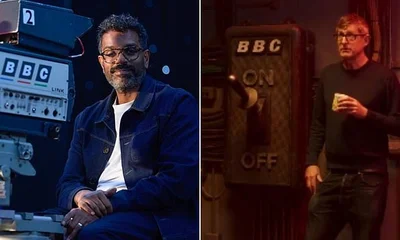
The big-budget BBC advert campaigning for the £180-a-year licence fee and lecturing viewers to pay it during the World Cup final has been branded 'nauseating' and 'shameless self-promotion'.
Amid criticism over its content and timing, Romesh Ranganathan has today said he felt 'honoured to be asked to front it' days after it was revealed the corporation lost half a million licence fee payers in a year of scandals.
The four-minute campaign film, titled What Has The BBC Ever Done For Me?, aired for the first time last night during the football, featuring almost 100 famous faces. It comes ahead of crucial talks over the Royal Charter and future financing.
Amid a backlash, Romesh said: 'I strongly, strongly believe that the BBC should exist. I hope it gets over the message that whatever you're into, the BBC provides something for you. And I think to lose that would be catastrophic.'
Critics called the four-minute film a 'nauseating' and 'toe-curling' attempt to convince Britons it is still worth paying for.
This included Louis Theroux appearing beside a giant on-off power switch and warning: 'None of this exists if we don't want it to.'
Ranganathan is then handed figures claiming the BBC generates more than £6.5 billion for the UK economy, and Pudsey Bear appears to remind viewers of the corporation's charity work.
One viewer said: 'Didn't think I would get threatened by Romesh and Louis Theroux to pay my TV licence, all I wanted was to watch a game of football.'
Another wrote on social media: 'This desperate BBC ad is beyond nauseating'. A third added: 'What did I just witness? BBC spending our money to tell us they're wonderful and we're ungrateful?' Someone else said: 'How do they get away with such shameless self-promotion?'
But Romesh said today he was 'really proud' of the advert and said he did it to ensure the BBC continues to 'exist'.
Defending his involvement, Romesh said: 'Making the film was an amazing experience and I couldn't help but feel honoured to be asked to front it.
'Look, don't get me wrong, I don't think [the BBC] is without its flaws. There have definitely been times and issues where I wished it could have dealt with things differently, but I feel incredibly passionate about the fact that we should have it and it adds so much to our lives. And I'm really proud of it.'
Romesh has also written a longer piece entitled: Why I had to make the case for our BBC.
Romesh Ranganathan has said he is really proud of an advert called What Has The BBC Ever Done For Me?, which has divided viewers
Louis Theroux appears beside a giant on-off power switch and warns: 'None of this exists if we don't want it to'
Coldplay's Chris Martin sits at the piano playing a tune as part of the BBC's campaign video
Ministers are set to consider how the corporation should be funded beyond 2027 as scrutiny grows over whether the BBC's current model, including the £180 fee, can survive.
Such is the reliance on the levy that World Cup viewers have been bombarded during games with on-screen QR codes and reminders to pay the charge.
Romesh said: 'I was very surprised that they'd chosen me and very honoured but I thought it was a no-brainer, really. I really do feel strongly that we should have a BBC and I think that there is nothing else that does what the BBC does.
'I grew up watching children's television and one of my earliest memories is probably Newsround with John Craven. I watched Blue Peter and we always had the BBC on in my house.'
The advertisement kicks off inside EastEnders' Queen Vic pub, where he picks up a newspaper splashed with the question: 'Is the BBC really worth it?'
Turning to barmaid Tracey, played by Jane Slaughter, he says: 'You've got to ask – what has the BBC ever done for me?'
The stars of the advert seen in EastEnders' Queen Vic pub include, from left, Adam Woodyatt, Jane Slaughter, Nick Grimshaw, Trevor Nelson, Rudolph Walker, Greg James, Anita Rani, Louise Minchin, Dr Xand van Tulleken, Diane Parish, Paul Merton, Katie Thistleton, Stacey Solomon and Sir David Jason
The advert sees Romesh head to EastEnders' Albert Square, where he breaks into a musical number
The BBC campaign ends with the comic on Strictly Come Dancing, surrounded by dancers
The campaign is a reworking of the BBC's 1986 advert starring John Cleese, which became one of the corporation's most memorable pieces of self-promotion.
From there, Ranganathan embarks on a whistle-stop tour through the BBC's most recognisable programmes, studios and personalities.
Coldplay frontman Chris Martin plays the piano, Claudia Winkleman pulls pints and stars from programmes such as Casualty and Strictly make the case for the broadcaster.
The likes of Mary Berry, Louis Theroux, Alan Carr, Graham Norton, Ruth Jones and even Doctor Who's Daleks make an appearance.
But nearly 40 years on from Cleese's campaign, the latest ad arrives at a far more difficult moment for the broadcaster as it faces mounting pressure over its future, and growing resistance to the licence fee.
Many households have increasingly questioned the compulsory charge, while the BBC has faced a series of bruising controversies in recent years, including rows over impartiality, high-profile presenter scandals, editorial decisions, criticism over staff salaries and falling audiences for some flagship programmes.
According to the BBC's annual report last week, 500,000 fewer people paid the licence fee in the past year – the biggest annual drop since the pandemic.
It has also warned its finances are under growing pressure, reporting a £121 million operating deficit while planning up to 2,000 job cuts. And it is battling changing viewing habits as audiences move towards streaming giants such as Netflix and Disney+.
Whether the campaign wins over viewers remains to be seen.
Claudia Winkleman is seen pouring a pint of beer from a pump with a Traitors-branded beer clip
Ruth Jones, creator and star of the beloved comedy show Gavin and Stacey, promotes the corporation's Welsh language radio station BBC Radio Cymru
Social media users have already questioned why the BBC did not feature ordinary licence-fee payers explaining what the broadcaster means to them, rather than relying on a parade of celebrities.
Some critics slammed the advert as 'dreadful'.
But the BBC said it was designed to ensure it gets credit not only for 'the things it makes' but for its wider impact on society.
Chief Customer Officer Kerris Bright said today: 'In 1986, there were two national television channels. Today there are eight. There were four national radio stations; today there are ten, alongside national services for Scotland, Wales and Northern Ireland and 39 local radio stations across England.
'We have created services that simply did not exist when John Cleese walked into that pub: iPlayer, Sounds, Bitesize, CBeebies, the BBC website and a range of digital services that reach audiences around the world.'
In an interview with The Sunday Times, chairman Samir Shah warned changes to the licence fee were needed ahead of next year's Royal Charter. He went on to suggest TV remotes should come with a specific iPlayer button, like they have for Netflix and Amazon, which pay for them.