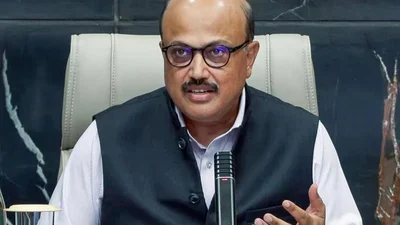
New Delhi, Jul 14 (ANI): Union Commerce Secretary Rajesh Agrawal speaks during a Press conference on India-UK FTA coming into force on July 15, in New Delhi on Tuesday. (ANI Video Grab)
\| Photo Credit: ANI
India on Monday (July 20, 2026) announced it had joined the WTO’s agreement on fisheries subsidies, which prohibits government support to illegal fishing activities and over-exploitation of stocks.
*Also read \| WTO’s fisheries pact: India for 25 year transition period, stronger disciplines on distant-water industrial fishing*
The agreement focuses on subsidies related to marine wild-capture fishing and fishing-related activities at sea. However, aquaculture and inland fisheries remain outside the scope of this pact, which came into force on September 15, 2025. It was adopted by consensus at the 12th WTO Ministerial Conference in Geneva in June 2022 and is the first multilateral WTO agreement with an environmental sustainability objective.
“India deposited its Instrument of Acceptance of the WTO Agreement on Fisheries Subsidies (AFS) on 20th July 2026, thereby becoming a Party to the Agreement,” the Commerce Ministry said in a statement.
The formal acceptance was handed over by the Commerce Secretary Rajesh Agrawal to the Director-General of the World Trade Organisation (WTO) Ngozi Okonjo-Iweala in Geneva.
Mr. Agarwal is in Geneva for an official visit.
The agreement, it said, protects the livelihoods of traditional and small-scale fishers by promoting sustainable fisheries.
It prohibits subsidies linked to illegal, unreported and unregulated (IUU) fishing and fishing of overfished stocks, as it aims to address unsustainable fishing practices that threaten marine resources.
The pact also creates a more equitable global fisheries regime by disciplining harmful subsidies that support large, heavily subsidised industrial fishing fleets being operated by distant water fishing nations.
“This benefits countries like India, where fisheries are predominantly small-scale and which are not major participants in industrial fishing,” it said, adding that the predominance of aquaculture-based shrimp in India’s seafood exports, which fall outside the scope of the agreement, ensures the continued resilience and competitiveness of the country’s seafood export sector.
The pact also seeks to promote the conservation and sustainable use of marine fisheries resources while providing appropriate flexibilities for developing and least-developed country members.
It added that India’s domestic fisheries management framework is in alignment with the agreement and safeguards the interests of traditional and small-scale fishers.
The agreement entered into force only after two-thirds of WTO members (166 at present) deposited their instruments of acceptance.
Once that threshold was reached, the pact became legally effective for those countries that had accepted it.
Published - July 20, 2026 10:46 pm IST