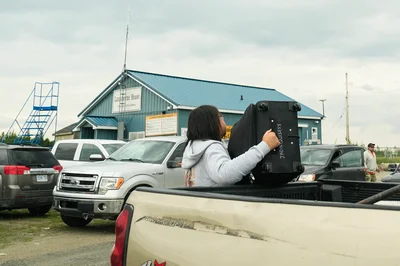

An evacuee from Neskantaga First Nation prepares to board a flight at Lansdowne House on Monday.Chris Young/The Canadian Press
While wildfires continue to move rapidly across northern Ontario, Premier Doug Ford says he plans to discuss the need for a national fire strategy with his fellow premiers and Prime Minister Mark Carney when they meet in Prince Edward Island later this week.
At an update Monday at the Provincial Emergency Operations Centre in Toronto, Mr. Ford also took aim at U.S. President Donald Trump for not doing enough to help Canada battle the fires, which he said on Monday have grown from 650,000 hectares to 735,000 hectares since the weekend.
He said there are currently 190 wildland fires and 56 are out of control.
Mr. Ford said there are 155 fire crews and approximately 80 water bombers and helicopters currently deployed and 40 aircraft ready to assist. Mr. Ford said 13 communities have been evacuated, with 1,800 evacuees sent to cities including Thunder Bay, Sudbury, Niagara Falls and Toronto.
Hydro crews worked to restore power to the Lac des Milles Lac area where a wildfire remained active, destroying camps and homes, Ministry of Natural Resources sergeant conservation officer Davis Viehbeck said Sunday at a roadblock into the evacuated area.
“It’s unprecedented,” he said, about the wildfire activity in the region and subsequent damage.
The ministry has put up roadblocks, including at Lac des Milles Lac Road off of the Trans-Canada Highway just west of Upsala, where residents have been on evacuation alert since last week.
The Upsala Fire Department told residents in a social media post Monday morning that while the threat of wildfire has started to subside with recent rain and changing fire behaviour, they are not out of the woods yet.
That’s not likely to happen “until either we get deluged with rain or MNR finally frees up enough manpower and equipment to come put this fire out,” said fire chief Doug Kiezebrink in the post.
Mr. Ford said one of the topics to be discussed at this week’s Council of the Federation meeting in Charlottetown will be a national fire strategy.
“We need the support from the federal government. They’ve been very good,” Mr. Ford said, adding that Ottawa has given the province two Dash 8 planes to spray fire retardant.
“But we need a large national fire strategy. We seem to be going through this every single year.”

Ontario Premier Doug Ford was in Thunder Bay on Saturday, where he held a news conference to address the government's wildfire response, which has been under criticism.COLE BURSTON/The New York Times
The premiers are also gathering for their annual summer meeting this week in Charlottetown, with Mr. Carney expected to join at the tail end.
Canada does not have a national firefighting strategy, despite long-standing calls to create a federal agency responsible for fire management and emergency co-ordination. While some say that existing agencies know their turf best but must be better resourced, there is also a growing consensus that the frequency of large, multijurisdictional fires demands a national response led by a single federal agency with shared firefighting resources.
Over the past week, Mr. Ford’s government has faced sharp criticism over its handling of the blazes, which threatened and destroyed northern First Nations communities and sent a thick haze of smoke through many North American centres, triggering a threat from Mr. Trump to increase tariffs on Canada.
Mr. Trump and Mr. Carney sat together during the World Cup final on Sunday. The U.S. President said he again told the Prime Minister that smoke from Canada is poisoning U.S. air, and that maybe Canada should pay damages, or the U.S. should impose tariffs.
On Monday, the Premier called Mr. Trump’s threats “disappointing to say the least.”
Mr. Ford said one of the largest fires to hit the U.S. this year started in Minnesota, adding that he’s discussed the issue with that state’s governor, Tim Walz, with whom he has an “incredible relationship.”
“Maybe President Trump would offer his closest allies and friends some support rather than sit there and threaten tariffs,” he said.
He said when Hurricane Helene ripped through the southeastern U.S. two years ago, Ontario sent resources to help.
“So you know something? Rather than criticize and threaten Canada, your closest friends, maybe one day you’re going to need our help,” he said. “I get frustrated just listening to these – bunch of rubbish.”
He added that Mr. Trump is “sitting there complaining.”
“Why don’t you send up some water bombers? Why don’t you start helping us, like we would help you in a heartbeat?”
The Premier also addressed criticisms that his government is understaffing firefighters, saying they’ve filled nearly 170 permanent positions over the past two years. He said the province plans to train and deploy firefighters from Toronto, the GTA and Ottawa.
“We’re in the midst of training our local firefighters to be able to go up into the wildland fires,” he said.
“There’s no other government in the history of Ontario that has supported firefighters like our government has.”
But union representatives have said the province could allocate up to 190 crews, calling the current allocation a “substantial operational gap.”
“It means fewer crews are available to respond quickly to new fires, less capacity to deal with several new fires at once, less ability to rotate and relieve exhausted personnel, and greater reliance on moving resources from one part of the province to another,” said Jeremy Rouse, chair of the Ontario Public Service Employees Union ministry employee relations committee for the Ministry of Natural Resources, in an e-mail statement.
Natural Resources Minister Mike Harris said 155 crews equals more than 700 people.
“It’s a pretty substantial number when you actually look at it,” he told reporters Monday.
With a report from Patrick White in Toronto