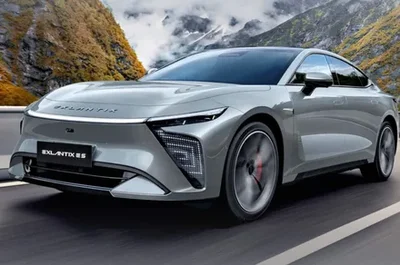
Chery’s premium arm just dropped a sedan that makes you wonder why American EVs cost twice as much for half the tech.
Exeed’s 2027 Exlantix ES ships with a driver-assist system called Falcon 700. It is built around an Nvidia Orin-Y chip and a genuinely stacked sensor suite.
So what makes Falcon 700 worth paying attention to?
I’m talking about 11 cameras, 12 ultrasonic radars, one LiDAR unit, and three millimeter-wave radars. All of these work together to enable full Navigate on Autopilot for both city streets and highways.
Pair that with a Qualcomm Snapdragon 8295P cockpit chip running Chery’s Carmind AI model, and the cabin’s voice assistant should feel noticeably more responsive than what you’d find in most cars at this price point.
Pricing runs from 179,900 to 209,900 yuan, or roughly $26,500 to $30,900. That buys you a choice between extended-range EREV and pure BEV setups. For context, Tesla’s cheapest Model 3 in the U.S. starts at around $39,000 before incentives.
What do you actually get for under $31,000?
The EREV Max makes 305 horsepower and provides a 188-mile all-electric range, while the AWD EREV Ultra jumps to 463 horsepower. The BEV Max, on the other hand, pushes 534 miles of range off a 100.2 kWh battery.
Combined with the gas engine, EREV models stretch total range past 994 miles. Design-wise, the fastback silhouette and frameless doors carry over, now joined by two new paint options and an optional Shadow sport kit with interactive headlights and an electric spoiler.
There’s no word yet on whether the Exlantix ES badge makes it to markets outside China anytime soon, but if it does, I’m sure the US buyers would definitely want to their hands on it.
What stands out here isn’t the spec sheet alone. It’s that Chery is shipping this sensor suite as standard across an entire lineup rather than gating it behind a premium trim. That approach, common among Chinese automakers primarily competing on value, keeps piling pressure on legacy brands.