Listen to this article
Estimated 3 minutes
The audio version of this article is generated by AI-based technology. Mispronunciations can occur. We are working with our partners to continually review and improve the results.
The McMichael Canadian Art Collection announced it will temporarily close to the public on the evening of July 26 to begin a landmark redevelopment of its building and grounds.
The art gallery — located in Kleinburg, Ont. — is the largest Canadian museum dedicated exclusively to Canadian and Indigenous art. Construction is expected to begin in fall 2026 and be completed in 2029.
Canadian firm Hariri Pontarini Architects leads the redevelopment, which marks the first major investment in the McMichael site in more than 40 years.
On its official website, the gallery describes "a transformative redevelopment — one that will enhance how we care for the collection, expand our exhibitions and programs, and improve the experience for every visitor who walks through our doors."
According to a news release, the project will add 60 per cent more space for exhibitions, education, conservation and public programming while modernizing outdated building systems and facilities.
It will also add state-of-the-art classrooms and studios, along with purpose-built spaces for events, concerts, lectures, conferences and dining.
The revitalization was announced in 2025 when the Ontario government pledged up to $50 million over three years to the project. The federal government committed an additional $25 million through its Green and Inclusive Community Buildings program.
The total cost of the project is estimated at $150 million and includes private donations.
During the construction period, much of the McMichael’s landmark collection will remain accessible through touring exhibitions of Canadian art across the country and abroad.
The permanent collection consists of almost 8,000 artworks, including masterworks by Tom Thomson, the Group of Seven and their contemporaries, as well as generations of Indigenous artists who have shaped and expanded the story of art in Canada, including Norval Morrisseau, Kent Monkman, Daphne Odjig and Jut-Ke-Nay Hazel Wilson.
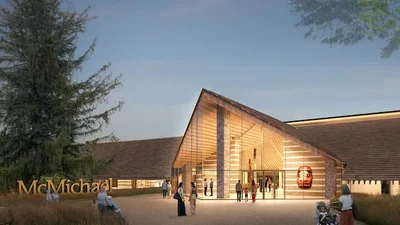
A conceptual rendering of the lobby. (Hariri Pontarini Architects)
In a statement, the collection's chief curator Sarah Milroy said, "We are delighted to be embarking on this exciting voyage forward, giving Canadians the world-class museum that our rich culture deserves, from coast to coast to coast, and from past to present. The McMichael is the place where it all comes together."
The gallery, located on 40 hectares of wooded conservation land overlooking the East Humber River Valley, was once the private home of art collectors Robert and Signe McMichael.
In 1965, the McMichaels offered to donate their collection — as well as their home and land — to the Province of Ontario. On July 8, 1966, the "McMichael Conservation Collection of Art" officially opened to the public.
The McMichael cemetery is the final resting place for six members of the Group of Seven and the gallery's founders, Robert and Signe McMichael. (mcmichael.com)
The land also includes a small cemetery in a small patch of land bordered by trees and marked not by traditional gravestones, but large chunks of the Canadian Shield.
It is the final resting place for six members of the Group of Seven (Arthur Lismer, Frederick Varley, Lawren Harris, Frank Johnston, A.J. Casson and Jackson), four of the artists' spouses (Esther Lismer, Bess Harris, Margaret Petry and Florence Johnston) and the gallery's founders, Robert and Signe McMichael.