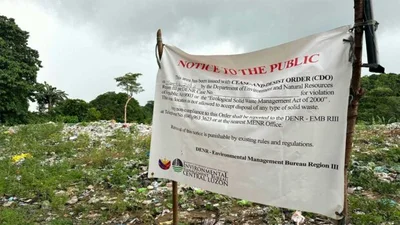
CLOSED A cease-and-desist order from the DENR-Environmental Management Bureau is displayed at the entrance of the open dump at Barangay Naugsol in Subic, Zambales. The site, located within an Aeta ancestral domain, was ordered closed for violating the Ecological Solid Waste Management Act. —Joanna Rose Aglibot
SUBIC, ZAMBALES, Philippines — Aeta leaders in this town said the decision to allow a portion of their ancestral domain to be used as a temporary garbage disposal site was made with the tribe’s consent at the height of the COVID-19 pandemic, when lockdowns disrupted the transport of waste to accredited sanitary landfills outside the province.
In an interview on Sunday, Aeta Ambala Chieftain Francis Santos said he was familiar with the discussions held in 2020, having served on the tribal council before assuming the post of chieftain in April this year.
Santos said the Subic municipal government sought the community’s approval after explaining that travel restrictions had prevented garbage from being transported to an accredited sanitary landfill outside Zambales.
Article continues after this advertisement
READ: Subic Aetas seek accountability over open dump in ancestral domain
He said municipal officials first consulted the non-Indigenous family occupying the 5-hectare (ha) property under a Department of Environment and Natural Resources (DENR)-issued Certificate of Improvement before meeting with Aeta elders and leaders because the site forms part of the tribe’s ancestral domain.
“They explained to us that the garbage would only be placed there temporarily because it was during the pandemic and the local government could no longer transport the waste,” Santos said.
‘Collective decision’
He stressed that the decision was made collectively by the tribe and was not authorized solely by the chieftain.
READ: Senate inquiry sought over illegal dump in Aeta ancestral domain
Article continues after this advertisement
Barangay Captain Jonel Serrano confirmed the account, saying the municipal government asked local officials early in the pandemic to identify a temporary disposal site after restrictions prevented waste from being hauled to sanitary landfills in Pampanga or Bataan.
Serrano said he directed municipal officials to the occupant of the 5-ha property and advised them to obtain the consent of the Aeta community because the land is part of an ancestral domain.
Article continues after this advertisement
He said the temporary use of the site began in March 2020.
According to the Subic Municipal Environment and Natural Resources Office, the municipality previously transported its garbage to the Floridablanca Enviro Park Project in Barangay Pabanlag, Floridablanca, Pampanga, a sanitary landfill operated by Floridablanca Enviro Corporation.
Santos said the tribe agreed to the temporary arrangement because it understood the difficulties faced by the municipal government during the pandemic.
“We agreed because we didn’t want the garbage to pile up and rot in Subic. We understood the situation at the time because it was during the pandemic,” he said.
He added that the area had long been occupied by non-Indigenous families even before the Aeta Ambala community was issued a Certificate of Ancestral Domain Title on Jan. 12, 2016. Portions of the 1,302-ha ancestral domain in Barangay Naugsol remain occupied by non-Indigenous residents.
Under the Indigenous Peoples’ Rights Act, activities affecting ancestral domains generally require consultation with and the participation of the Indigenous community. A Certificate of Improvement recognizes improvements introduced on public land but does not establish ownership.
The Inquirer sought confirmation from the DENR on whether a Certificate of Improvement had been issued for the property but had yet to receive a response.
Rehabilitation
The municipal government has since stopped using the site and is hauling out the waste as part of a rehabilitation program ordered by the DENR after the Environmental Management Bureau (EMB) found the operation violated Republic Act No. 9003 or the Ecological Solid Waste Management Act.
The issue gained national attention after Indigenous leaders and environmental advocates questioned the use of part of the ancestral domain in Sitio Tibag as a garbage dump. They also questioned why the EMB reportedly discovered the operation in 2022 but ordered its closure only in 2025 and called for administrative and criminal accountability, compensation for affected Indigenous communities and an independent assessment of the environmental damage.
In previous interviews with the Inquirer, Aeta leaders opposing the dump said the operation had contaminated their water source and forced some families to stop farming portions of their ancestral land.
On Monday, environmental nongovernment group Mother Earth Foundation (MEF) said the open dump should never have existed, calling it a clear case of “environmental injustice” and a violation of indigenous rights.
In a statement, MEF, which has promoted ecological solid waste management systems for over 25 years, expressed support for the Aeta community’s calls for accountability.
“The controversial dump in the ancestral domain of the Aeta Community is not an isolated incident; it reflects a persistent pattern of environmental injustices,” said the MEF
Your subscription could not be saved. Please try again.
Your subscription has been successful.
Last week, Sen. Robinhood Padilla filed Senate Resolution No. 513 seeking an inquiry into the operation of the garbage dump, including possible accountability, rehabilitation measures and legislative reforms to strengthen the protection of Indigenous peoples and their ancestral lands. /cb