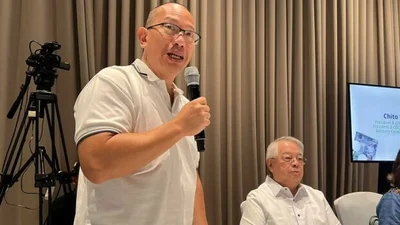
‘BIG DECISIONS’ Phinma Education president and CEO Chito Salazar (standing) and Phinma Corp. chair and CEO Ramon del Rosario Jr. explain the issues affecting Philippine education in a press conference on Monday. —Logan Kalel M. Zapanta
MANILA, Philippines — If President Marcos wants to address the country’s persistent learning gaps, he must start long before children enter school by prioritizing early childhood development.
Private school network Phinma Education made that appeal in a media briefing on Monday, with its president and CEO, Chito Salazar, saying the government should devote more resources to children’s nutrition and early learning.
“The solution to Philippine education … must begin in early childhood,” he said when asked what he wanted Mr. Marcos to address in his penultimate State of the Nation Address (Sona) on July 27. “That’s where the investment needs to be.”
Article continues after this advertisement
Salazar, who also serves as president of Philippine Business for Education, said intervention in kindergarten may already be too late for many Filipino children.
READ: The Early Childhood Care and Development Law
“What I would like the government to do is bite the bullet and say, ‘We’re making this decision, not for political reasons, but for evidence-based reasons: that investments should focus on early childhood,’” he said.
Work with private sector
“Fix the systems in early childhood so as many of our kids as possible are properly nourished,” he added. “If they’re properly nourished and they can read at Grade 1 or kindergarten, a lot of the solutions will have solved themselves already.”
READ: Study: 1 in 4 Filipino kids under age 5 stunted
Article continues after this advertisement
Phinma Education, a unit of listed conglomerate Phinma Corp., said its data show that shortcomings in basic education continue to affect students long after they reach college, particularly those from low-income families.
Based on its assessment, 99 percent of its students were not ready for college upon enrollment, while about 65 percent of incoming freshmen had reading competency at Grade 5 level or below.
Article continues after this advertisement
Around 71 percent of its students come from low- to lower-middle income households, while 69 percent are the first members of their families to attend college. Even if they reach college, about 30 percent of low-income students drop out during their first semester.
For Phinma Corp. chair and CEO Ramon del Rosario Jr., addressing those challenges also requires the government to work more closely with businesses and private schools instead of relying primarily on the expansion of state-run institutions.
“A policy of complementarity might work better, rather than trying to have government schools proliferate, increase in number and focus on the idea that all of the education that the public sector will support must be government schools,” Del Rosario said.
He also backed wider use of education vouchers, saying these would allow disadvantaged students to enroll in qualified private schools that would otherwise be beyond their families’ means.
Education goals on track
Asked what he wanted Mr. Marcos to discuss from a business standpoint in his Sona, Del Rosario said he hoped the President would “continue the process of making the national budget more transparent and more responsive to what the public is looking for.”
“Hopefully, it will become a budget that will be more responsive to the needs of the people, rather than being padded with all kinds of secret funds for personal pockets,” he said.
Salazar still noted that the Marcos administration has made “major moves” in education, including increasing the education budget, accelerating classroom construction and appointing “really good” officials to key agencies.
“I think they’re on the right track, except there are some big decisions that need to be made,” he said.
Besides early childhood development, he cited the need for greater accountability among the local governments, considering their crucial role in delivering services to children before they enter school.
Phinma Education serves nearly 180,000 students across the Philippines and Indonesia. Since its founding in 2004, it has produced 104,669 college graduates and 48,327 licensed professionals.
‘Simple Sona’
Meanwhile, Palace press officer Claire Castro said the President’s fifth Sona would be “simple yet dignified.”
At a briefing on Monday, Castro said there would be no “celebrity directors” or “big A-listers who will perform.”
The President, however, has picked someone who would sing the national anthem, Castro said, adding that she cannot yet disclose the performer’s name.
She also reacted to Bayan president Renato Reyes’ call for accountability, as he questioned Marcos’ anticorruption efforts after his Sona last year, which tackled massive corruption in flood control projects.
Your subscription could not be saved. Please try again.
Your subscription has been successful.
“Have you seen everything the President has done and accomplished for the country?” Castro said. “We should broaden our thinking, open our eyes, and open our ears—what has the President actually accomplished?” —WITH A REPORT FROM LUISA CABATO