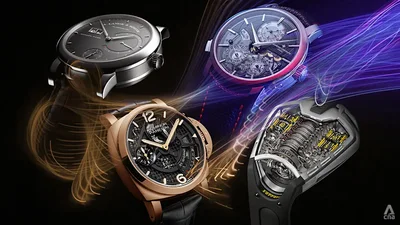
So far, the solutions have involved either storing more energy or consuming it more slowly. Parmigiani Fleurier, however, had another idea. In 2016, working with retired physicist and aerospace engineer Pierre Genequand and Swiss research organisation CSEM, it unveiled the Senfine concept. Instead of a conventional regulating organ, the movement used a blade-like silicon oscillator that flexed rather than pivoted, dramatically reducing friction.
The concept paired a blistering 16Hz frequency with a projected 70-day power reserve. Reality, however, proved less accommodating. The mechanism remained vulnerable to shocks and temperature changes and was extremely difficult to adjust or repair, leaving the Senfine a brilliant one-off rather than a production watch.
For now, at least. The Senfine wasn’t so much a dead end as it was a glimpse into a future that got here too quickly. It owed its existence to advances in aerospace engineering, silicon technology and micro-machining, so who knows what the next generation of manufacturing will unlock. The question probably is not whether a mechanical watch can run reliably for months – or even years – but when.
Panerai has spent seven years developing a month-long movement that can be wound through an ordinary crown, while Vacheron Constantin has persuaded a calibre just 6mm thick to keep running for 70 days. That future may not be so far away.