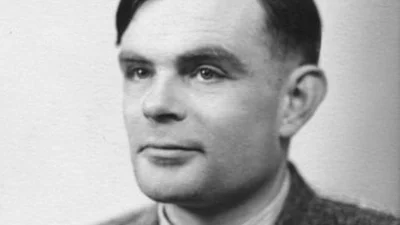
Alan Turing is widely revered as one of the most important scientific and technological figures in modern history. Following his work on cracking the Enigma Machine during the Second World War, Turing published his thoughts on the future of machine intelligence – and specifically on the pathway that we can one day take to achieve proficient AI.
"We may hope that machines will eventually compete with men in all purely intellectual fields. But which are the best ones to start with?... We can only see a short distance ahead, but we can see plenty there that needs to be done."
—Alan Turing, October 1950
Eating machines
Turing concluded his seminal 1950 study 'Computing Machinery and Intelligence' with musings on how to fulfill what he saw as achieving the great promise of machine intelligence in the future.
Quote of the day
This article is part of TechRadar Pro's QOTD project to provide an insight into the minds of the brightest and most recognized figures in the technology industry today and in years gone by. Read the full series here.
The pioneering mathematician and computer scientist suggested, in his concluding passage, that even though you may hold some vision for the future, or long-term ambitions, it's key to solve the immediate challenges you face now. True progress isn't achieved in one leap, but through a series of smaller and seemingly less significant steps.
Latest Videos From
In the context of his paper, Turing suggested that scientists in the future need not strive to achieve human-like intelligence in machines, but build the very first iterations of what he described as "thinking machines" so that this work can be iterated on in the future.
Beyond the Turing Test
When the study was published, the term "artificial intelligence" was not in widespread use, with scientists instead opting for terms like cybernetics or machine intelligence.
What followed over the next decades was a cascading series of breakthroughs – including the birth of neural networks in the 80s and the transformer architecture in 2017 – that have led to today's widely used large language models and generative AI services.
Although true human-like intelligence is still some distance away, we've advanced to such an extent that many have even claimed the Turing Test – where somebody cannot tell the difference between interacting with a human and AI – has already been beaten.
Sign up to the TechRadar Pro newsletter to get all the top news, opinion, features and guidance your business needs to succeed!