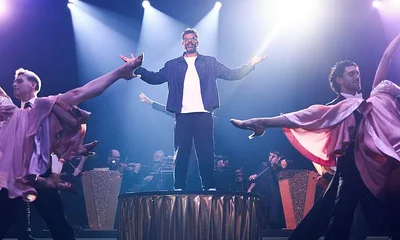
What has the BBC ever done for Romesh Ranganathan? Apart from endlessly plastering his face across our screens, that is?
The ubiquitous comedian popped up at half time in the World Cup final on Sunday night, joined by nearly 100 celebrities, in a three-and-a-half minute advert aimed at convincing us the Beeb is worth every penny.
Every penny, that is, of the £180 licence fee imposed on any British household that ever switches on live television... regardless of how much they watch, or how much they earn.
The ad, which took six days to shoot, is a musical spectacular, opened by Coldplay’s Chris Martin on piano and climaxing with a Strictly dance routine.
Along the way, Romesh asks variations on that question, ‘What has the BBC ever etc,’ seven times. It might seem overly literal to point out that it has handed him the chance to present more of its shows, across a wider range of genres, than almost any other celebrity in its 103-year history.
Romesh has fronted travel series such as Asian Provocateur and The Misadventures Of…; topical chat show The Ranganation; his own sitcom Avoidance, and a long-running quiz game The Weakest Link. There have been panel shows, celebrity specials, stand-up routines and awards nights. And he’s just finished filming The Celebrity Traitors.
In fairness, the ad does make a jokey reference to this, as DJ Sara Cox calls out to him, ‘Oi, you’ve got a show on Radio 2 as well,’ before comic Chris McCausland adds: ‘And a hip-hop podcast on Sounds.’
The ubiquitous comedian popped up at half time in the World Cup final on Sunday night, joined by nearly 100 celebrities, in a three-and-a-half minute advert
Hardly surprising Romesh said yesterday it was ‘a no-brainer’ when he was asked to star in the ad. ‘I strongly believe that the BBC should exist,’ he declared. ‘We need to make sure it’s around for… future generations.’
Especially since, as the Daily Mail has revealed, he was paid for the job – though the BBC has refused to clarify how much that was.
Regardless of the amount Romesh was given to laud the national importance of his biggest benefactor, the cost of creating this ad will have been colossal.
While the Corporation was at pains to point out ‘the majority of people gave their time for free’ (lucky us!) some of its biggest earners, including Graham Norton, Claudia Winkleman, Clive Myrie, Clare Balding and Anita Rani, all put in an appearance. Of these, only Myrie’s BBC salary is published in the annual accounts (he earns between £320,000 and £324,999 a year), since the others are paid through independent production companies or the corporation’s commercial arm, BBC Studios.
Simply getting those five together to shoot their cameos must have been a logistical headache. Add the opening scene in the Queen Vic, where teetotaller Romesh pointedly does not order a drink from EastEnders barmaid Tracey (Jane Slaughter), and the headache swells to skull-busting proportions – you’ll spy Sir David Jason, Paul Merton, Sue Perkins, Adam Woodyatt, and more, before we exit the pub to find Alan Carr playing the soap’s doof-doof theme on a drumkit.
Small wonder that the ad’s credits list nine creative directors, three heads of planning, 13 producers and production managers or assistants, a brand manager and three marketing execs, among 77 off-screen staff.
All that, for 225 seconds of video – directed by Dougal Wilson, the 54-year-old who made his name with a series of Christmas ads for John Lewis in the 2010s.
The BBC’s new director-general, Matt Brittin, who arrived in May this year, must have hoped that such a big-budget production, aired in the middle of one of the showcase sporting events of the decade, would be met with unalloyed delight by viewers.
After all, it is based on a previous BBC advert from 1986, which starred John Cleese in a pub full of drinkers that included the Two Ronnies, David Attenborough, Sue Lawley, David Dimbleby, Alan Whicker and Esther Rantzen. The running joke, ‘What has the BBC ever done for me?’, was a play on one of Cleese’s most beloved one-liners from the film Life Of Brian (in which he was complaining not about the broadcaster but the Romans).
That original ad can still raise a smile. But as one of the comments beneath it on YouTube caustically remarked yesterday, by remaking this minor classic the BBC is simply underlining how much less relevant it is to the national conversation than it was 40 years ago. Certainly, the reaction from 15.8 million World Cup viewers on BBC1 and iPlayer was less than overjoyed.
‘Beyond nauseating’, ‘shameless self-promotion’ and ‘toe-curling’ were among the kinder reactions. Others cited the many scandals that have embroiled the BBC, most recently the sacking of its most highly paid star, ex-Radio 2 presenter Scott Mills, over allegations of sexual misconduct.
Few were bamboozled by the ad’s glitz and glamour. It was widely seen for what it was, a reminder to viewers that the law requires every household to pay a fee. This was emphasised by the stark caption at the end, in white lettering on an ominous black background: ‘There’s a BBC for each of us. Funded by all of us.’ Along with a QR code directing viewers to pay for a TV licence.
The subtext was unmistakable. We all have a legal responsibility to pay that annual £180 – a flat fee for a family of ten or a lone widow, a pensioner, a multi-millionaire or someone on benefits.
According to House of Commons figures, in 2025 there were 16,489 convictions for TV licence evasion. Of these, 12,080 or 73 per cent were women. Average fines were £150 to £180, though the maximum is £1,000.
Prosecutions have fallen dramatically since 2010, when nearly 150,000 people were convicted.
Last year, 539,000 households stopped paying, a steep increase of more than 75 per cent on the previous year’s 300,000 drop.
To lose funding at that rate is unsustainable, and no amount of all-singing, all-dancing adverts can mask this. Yet the Corporation has come up with no official proposals for ways to replace it.
The simple fact is this preening, smug, flaky, boastful exercise in self-aggrandisement has had exactly the opposite effect to what it was trying to achieve.
The 1986 ad ended with Cleese telling a chirpy Terry Wogan to ‘shut up’. This time, it is cheerful Strictly judge Anton Du Beke who pops up, only for Romesh to tell him to: ‘Bog off.’
The millions of football fans who had to sit through that thinly disguised demand for our cash will share a similar sentiment.