At the end of a dark corridor beneath Chester Crown Court, archaeologist Stewart Ainsworth raised his phone to illuminate a wall that should not have been there. The passage belonged to an 18th-century prison, but some of the stones emerging from the wall appeared to be much older.
For this discovery, there were no trenches, trowels, or freshly uncovered artifacts. Instead, Ainsworth’s chance observation revealed that part of Chester Castle’s medieval defenses had survived for centuries, hidden inside the newer construction.
“The walls of the prison and courts designed by Thomas Harrison are typical late 18th century masonry. It was dark at the end of that old corridor — but by the light of my phone I could immediately tell that a large section of wall in the gloom ahead was totally different. It turned a right angle and disappeared out of sight, leaving a very dark, narrow gap that I couldn’t squeeze into,” Ainsworth said in a press release.
Medieval Castle Wall Discovered Beneath Chester Crown Court
Ainsworth, a professor at the University of Chester, was exploring the remains of the prison beneath the court when he noticed the abrupt change in the surrounding masonry.
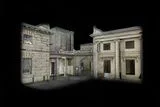
Remains of Chester Castle’s medieval bridge.
(Image Courtesy of the University of Chester)
After the find, he compared the newly revealed stonework with surviving Norman sections of Chester Castle and confirmed that the building materials and construction techniques dated to the medieval period rather than the 18th century.
The discovery challenges the long-held belief that architect Thomas Harrison demolished the medieval portion of the castle when constructing the prison and courthouse complex.
“The wall I discovered is massive — almost three metres high — so we now know that [Harrison] left a lot of the medieval stonework untouched. And I’m guessing much more may survive under the car park and castle complex,” explained Ainsworth.
Read More: Rare Camel Bones Found in Serbian Fortress Suggest Far-Reaching Medieval Trade Networks
Chester Castle’s Lost Medieval Bridge
High-resolution scans allowed researchers to establish the wall’s precise location. When they compared the results with historical plans and maps, they concluded that the masonry once supported a bridge crossing the deep defensive ditch around the castle’s inner ward.
Builders likely constructed the bridge between the 1260s and 1280s while adding a heavily fortified gateway to replace an earlier entrance. Its design appears similar to a surviving bridge at Beeston Castle, where visitors can still see the remains of a crossing leading toward a twin-towered, 13th-century gatehouse.
At Beeston, defenders could raise a drawbridge to block enemies from reaching the gate. According to the research team, Chester Castle may once have relied on a comparable system, turning the newly identified wall into a surviving piece of the fortress’s medieval security network.
Digital Scanning Helps Protect Historic Sites
The investigation became part of Digital Dimensions, a collaborative project involving the University of Chester, SCCS North, Cheshire Constabulary, English Heritage, Historic England, and the Hartree National Centre for Digital Innovation.
Researchers digitally scanned the underground wall and other sections of the castle to produce detailed 3D models. These virtual records can reveal overlooked archaeological features while also helping authorities investigate and discourage graffiti, stone theft, and other heritage crimes.
Earlier this year, 72 police officers from North West England and North Wales attended heritage-crime training at Chester Castle. Sessions explored how law enforcement and heritage specialists can work together to protect culturally important sites.
“I think it is amazing that by doing proactive surveys and recording of historic buildings, we are able to discover unknown archaeology. This just shows we can now safeguard this bit of history so we can learn from it for future generations,” concluded Cheshire Constabulary’s PC Jonathan Lightfoot.
Read More: The "Dig of the Century" at Notre-Dame Is Revealing 2,000 Years of Parisian History
Article Sources
Our writers at Discovermagazine.com use peer-reviewed studies and high-quality sources for our articles, and our editors review for scientific accuracy and editorial standards. Review the sources used below for this article: