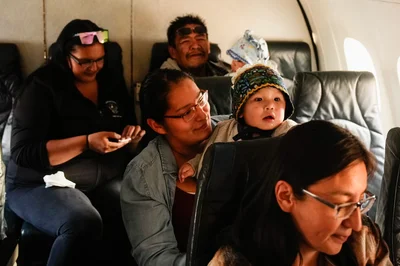

Families sit aboard a plane as they are evacuated from Neskantaga First Nation on Saturday. True North Aid closed a drive for donations after its drop-off locations rapidly filled with clothing, canes and walkers, hygiene products, diapers, baby items, blankets, pet supplies and other basic necessities for wildfire evacuees.Chris Young/The Canadian Press
As wildfires continue burning across northwestern Ontario, with some 1,800 evacuees sent to cities including Thunder Bay, Sudbury, Barrie, Niagara Falls and Toronto, organizers say they’ve been inundated with donations of clothing, food and other necessities. They’re now urging people to donate financially so they can more nimbly help evacuees with changing practical needs.
“Everybody wants to help; everybody wants to give something physical. But during times like this it’s important to wait to hear what’s needed. And to provide what’s needed, we can’t do that without funding,” said Lisa Mazzocato, executive director of True North Aid, an Oakville, Ont.-based charity offering humanitarian support to northern and remote Indigenous communities.
The organization closed a drive for donations on Saturday after its drop-off locations rapidly filled with clothing, canes and walkers, hygiene products, diapers, baby items, blankets, pet supplies and other basic necessities for wildfire evacuees.
“We were completely overwhelmed with donations. People really stepped up,” Mazzocato said. “The outpouring of support from communities has been tremendous, which is renewing faith in humanity and getting help to those who need it.”
The organization co-ordinated its collection drive with one of its projects, Moon Time Connections, which normally delivers menstrual products to high schools, shelters and community centers in remote areas across Canada.
From Oakville, Mazzocato helped fill a 25-foot U-Haul and drove it up to a donation depot set up in Holland Marsh, Ont. Volunteers spent hours sorting through and co-ordinating where supplies will go, supporting evacuees moved to cities including Toronto, Thunder Bay and those affected by wildfires in British Columbia in Chilliwack.
“We see this immediate need but there’s also going to be long-term need,” Mazzocato said. “Collins [First Nation] has lost their whole community. It’s going to go on far longer than the immediate need of clothing and gift cards. They’re going to have to rebuild. They’re going to need to furnish homes. We’re going to have to help with that too.”

Members of Namaygoosisagagun First Nations, also known as
Collins First Nations, evacuated from wildfires by boat outside of Armstrong, Ont on July 14. Lisa Mazzocato, executive director of True North Aid said that she knows the work of rebuilding will go on longer than donating clothing and gift cards. But she says they'll be there to help evacuees furnish homes too.Lyndon Paavola/Supplied
After receiving a sizable shipment of emergency food hampers, the Regional Food Distribution Association is now urging people to donate funds to the newly established Northwestern Ontario Wildfire Community Support Fund.
Set up on Friday, the joint effort from the United Way of Thunder Bay and the Thunder Bay Community Foundation will help front-line agencies distribute food and essential supplies, organize transportation, community outreach and mental health supports and plan for longer-term recovery. The aid will ultimately go to evacuees and their communities.
Since Friday, donations have been flowing in from all over Canada and around the world, from New South Wales, Australia to Tarpon Springs, Fla., said Albert Brulé, chief executive officer of the United Way in Thunder Bay. Some American donors wrote messages about wanting to pay it back after Canada was there for the United States through 9/11 and that country’s own wildfires.
“This is mind-blowing,” Brulé said. “It makes you appreciate that when people see a need, wherever it is, they want to help.”
Others are going beyond the basic provisions collected in a crisis situation.
Community organizer Quill Christie-Peters has been calling on local businesses to donate gift cards for coffee, sandwiches and family brunch to bring comfort to evacuees sent to Toronto. She’s also been asking for donations of day passes for activities catering to families and children who may have lost their homes and are now displaced in unfamiliar locations.

White Sand First Nation Deputy Chief Yvette Kwandibens among donations from local residents, in Thunder Bay, Ont., on Friday. Since then, donations have been flowing in from all over Canada and around the world as part of a joint effort from the United Way of Thunder Bay and the Thunder Bay Community Foundation.Chris Young/The Canadian Press
It’s a personal undertaking for Christie-Peters, who is from Lac des Mille Lacs, which was evacuated last week. On Sunday, Christie-Peters and fellow volunteers dropped off a bundle of donations at a Toronto hotel for evacuees. Many of the items were meant as distractions for children: “There are hundreds of kids, they have nothing to do and they’re in a hotel, so it was board games and pool stuff.”
Christie-Peters rattled off other creative donations streaming in her through her online callout: a vintage shop that invited people to pick some free clothes, salons offering free haircuts, music lessons for youth, even personal trainers giving out free sessions – anything to give fleeing evacuees some reprieve.
“We don’t know who, in a time of crisis, will take up these offers. But it’s nice to be able to tell the community that there are a bunch of options they can do for free, that there are people who want to help and take care of their needs.”
Beyond supporting evacuees streaming south to the cities, she and other organizers hope to push attention and donations back up north.
“We are encouraging people to keep donating to the communities that are directly impacted and will need to rebuild everything,” Christie-Peters said.
“Send your money up north. Pay attention to how communities are being treated up north, to why so many people are mobilizing and to why these kinds of care and services aren’t thought about for people in the north.”