Your car might be covering your balcony in toxic dust
Save
You have reached your maximum number of saved items.
Remove items from your saved list to add more.
AAA
A toxic chemical linked to mass salmon kills in the US has been found on balconies around Brisbane by researchers looking at the particle dust thrown into the air by tyres as they wear down.
University of Queensland PhD candidate Simran Kaur said a chemical called 6PPD-quinone was found on 23 of the 30 balconies tested around the city, and could have implications for human health.
Modern tyres are made of synthetic rubbers, as well as additives and fillers that slow wear and tear but do not break down in the environment.
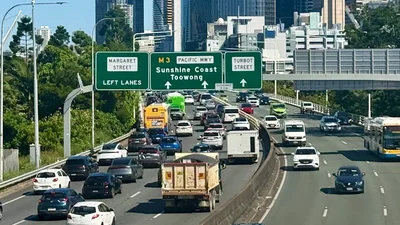
Tyres release particles every time they are driven on. Courtney Kruk
Six million tonnes of tyre-wear particles are estimated to be created each year, a major source of microplastics globally.
“Tyres are one of the most overlooked sources of microplastics,” Kaur said.
Working with the Queensland Alliance for Environment and Health Sciences, Kaur conducted tests between June 2024 and March 2025, finding potential particles from tyre additives on all but one of the balconies tested.
Inner-city balconies were more likely to be coated in the dangerous dust, with balconies within five kilometres having significantly more particles, the study found.
Wind speed played a role, with thicker dust typically found on balconies closer to the ground.
Kaur said 6PPD-quinone was by far the most worrying chemical they found, but further research would be required to fully understand the threats it might pose.
“Since this is very emerging research in Australia, we just wanted to initially find out if we [would] find these pollutants on our balconies, but there is definitely a need for more research to investigate any potential human and environmental impacts.”
The additive 6PPD reacts with the ozone once it has worn off, and becomes the dangerous toxin that can kill fish quickly when found in waterways, and has been linked to salmon kills in the US north-west.
Kaur and her fellow researcher, Dr Cassandra Rauert, believed the study was the first to look at the impact on urban homes.
Past research had looked at dust on roads, in water and sediments.
While not the expressed point of the study, Kaur said it was important to gain a better understanding of the threats posed by the dust as more electric vehicles became more common.
“EVs reduce exhaust emissions, which is great … [but] because EVs are often heavier due to their batteries, that might create more tyre wear,” she said.
Start the day with a summary of the day’s most important and interesting stories, analysis and insights. Sign up for our Morning Edition newsletter.
Save
You have reached your maximum number of saved items.
Remove items from your saved list to add more.