Pacgold has unearthed significant shallow oxide gold on the edge of the historical Vertigo open pit at its wholly owned White Dam project in South Australia, potentially putting the mine’s restart on the fast track.
The recently completed reverse circulation drilling began with an initial 178-hole campaign before a successful first phase prompted a further 102-hole infill and extension program. The latest round was designed to upgrade much of Vertigo’s inferred resource into the higher-confidence indicated category, strengthening pit design, reserve estimation and mine planning.
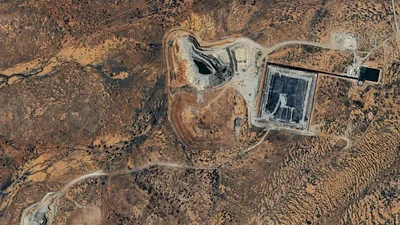
Aerial view showing the Vertigo deposit (bottom left), the Hannaford pit and existing heap-leach pad (upper centre), and the operating plant and SART facility (upper right) at Pacgold’s White Dam gold project in South Australia.
The program delivered some impressive shallow hits, with highlights including 4 metres grading 3.1 grams per tonne (g/t) gold from surface, including a 1m slice grading 7.2g/t gold.
Other notable results delivered 6m grading 2.2g/t gold from surface, 11m grading 1.2g/t gold also from surface, 17m grading 0.9g/t gold from 6m and 13m grading 1.3g/t gold from a depth of 14m.
‘The development from ore discovered north and east of the pit will drastically reduce pre-strip costs and bring forward gold production.’
Pacgold managing director Matthew Boyes
Beyond the headline intersections, the final assays also confirmed shallow northern and western extensions to the Vertigo deposit outside the existing resource model, pointing to further resource growth.
The results will now be incorporated into an updated resource estimate for Vertigo, currently being prepared by external consultants and slated for delivery early in the September quarter.
Prior to the update, the White Dam project hosted a global resource of 4.6 million tonnes grading 0.7g/t gold for 102,000 ounces across the Vertigo, Hannaford and White Dam North deposits. Vertigo is the first of White Dam’s four deposits targeted for restart, putting it at the front of the queue to bring White Dam back into production.
Management believes the shallow oxide mineralisation will improve both the economics and timing of bringing Vertigo back into production.
Pacgold managing director Matthew Boyes said: “These excellent shallow oxide intervals represent a very material win for Pacgold in respect to fast-tracking the restart of the Vertigo mine and getting shallow low-cost oxide dirt onto the old pad while extending the ore leaching capacity with the new pad expansion.”
The company is already pushing forward with a heap-leach pad expansion, with engineering nearing completion ahead of construction tenders. The bigger plant will allow for additional oxide ore to be processed as operations ramp up.
Since the mineralisation is shallow, oxidised and beside an existing pit, Pacgold believes it’s ideally suited for low-cost heap-leach processing, where a cyanide solution recovers gold without the expense of conventional milling. That winning combination could slash pre-strip waste removal, reduce working capital and bring forward the first new ounces of gold.
Management says the focus will shortly shift to pit optimisation, mine design and cashflow modelling once the new resource model is complete. The rig has now moved on from Vertigo, with drilling already underway at White Dam North ahead of a spell at the nearby Rolling and Hannaford deposits. All three are expected to provide additional resource growth and future ore sources for the planned restart.
The company is also preparing regional exploration drilling at the Wadnaminga, Wilkins, Green and Gold and Mary Mine prospects later this quarter as it hunts for additional ore sources within easy trucking distance of White Dam.
For a brownfield restart project such as White Dam, the gold’s proximity to the plant matters far more than the grades returned. Between 2010 and 2018, White Dam produced 180,000 ounces. It already has established open pits, a heap-leach facility, a processing plant and all the supporting infrastructure a new miner could want. Much of the operation was paid for by previous owners, allowing Pacgold to bring the project back into production far faster and cheaper than building a mine from scratch.
The company’s efforts to restart mining in South Australia seem well-timed. While gold prices may have pulled back to US$4000 (A$5700) per ounce from their historic highs of more than US$5500 (A$7800) per ounce earlier in the year, major institutions remain bullish. J.P. Morgan has forecast a rebound to an average of A$6,000 per ounce in the final quarter of this year. Finding a source of low-cost, quick-to-mine ore could leave White Dam well placed if bullion regains momentum later this year.
Against that backdrop, the White Dam story isn’t about chasing the next big discovery. It’s about systematically unlocking more ounces from an established mining operation and turning yesterday’s infrastructure into tomorrow’s cash flow.
The latest drilling has strengthened the investment case for Vertigo to become the first White Dam deposit back in production, while longer term, Pacgold sees White Dam evolving into a regional processing hub.
The next catalyst will be the updated resource model and mine plan, which could provide the blueprint for breathing new life into one of South Australia’s proven gold-producing operations.
Is your ASX-listed company doing something interesting? Contact: mattbirney@bullsnbears.com.au
Save
You have reached your maximum number of saved items.
Remove items from your saved list to add more.