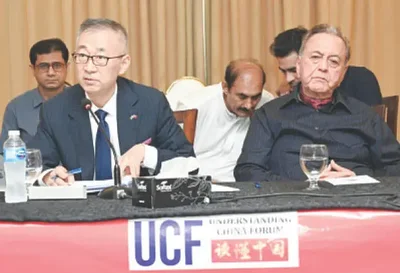
Chinese Consul General Sun Yan speaks at the forum.—Dawn LAHORE: Former foreign minister Khurshid Mahmud Kasuri has said peaceful co-existence between Pakistan, India and China is essential to unlocking regional connectivity, stabilising trade routes and fighting poverty in one of the world’s poorest regions. He was addressing a gathering to mark the 75th anniversary of diplomatic relations between Pakistan and China and the 105th anniversary of the founding of the Communist Party of China (CPC) here on Monday. The event brought together diplomats, scholars and policymakers, including Chinese Consul General Sun Yan, Understanding China Forum (UCF) founding president Zafaruddin Mahmood, and former ambassador and Director of the Beaconhouse National University Centre for Policy Research (BCPR) Mansoor Ahmad Khan. Kasuri, who is also chairman of the UCF, said Pakistan’s recent diplomatic and defence successes had placed the country in a position of confidence to pursue constructive engagement across South and Central Asia. Pakistan has realised less than 25pc of CPEC’s potential, says former principal secretary to premier Speaking about China’s development journey, Kasuri said the country’s progress had been built on a combination of visionary leadership, strategic planning and a sustained commitment to improving the lives of its people. He identified four key pillars behind China’s success. The first, he said, was people-centred governance, with policies focused on improving the quality of life through poverty alleviation, healthcare, education and infrastructure development. “The second pillar is theoretical innovation,” he said, describing it as the ability to adapt strategies to changing national and global circumstances while remaining committed to long-term development goals. He said leadership development had also been a defining strength, with the CPC placing emphasis on identifying and training capable cadres to ensure disciplined, effective and forward-looking governance. The fourth pillar, he added, was a commitment to peaceful development, with China promoting international stability, cooperation and a shared future for humanity while pursuing its own economic progress. Kasuri also offered a historical analysis of global revolutions, contrasting the Chinese Communist Revolution of 1949 with earlier European, American and Soviet milestones. He highlighted how Chairman Mao Zedong adapted Marxism from an urban-centred ideology to an agrarian-focused movement rooted in rural struggle and resilience, exemplified by the historic Long March. Tracing China’s post-Mao economic trajectory, Kasuri focused on Deng Xiaoping’s pivotal leadership in modernising the nation. He said Deng introduced two foundational maxims that redefined Chinese domestic policy and grand strategy under the concept of “Socialism with Chinese characteristics”, including the famous dictum: “It doesn’t matter if a cat is black or white, so long as it catches mice.” Transitioning to the present era under President Xi Jinping, Mr Kasuri said China no longer needed to hide its capabilities. “Having built a massive economic foundation, China under President Xi has moved towards proactive global engagement, driving high-quality development, technological self-reliance and mega-initiatives such as the Belt and Road Initiative (BRI) and the vision of a Community of Shared Future,” Kasuri said. He also extended his greetings to the Communist Party of China and congratulated the People’s Liberation Army on its 99th anniversary. Former principal secretary to the prime minister Fawad Hassan Fawad recalled that when the China-Pakistan Economic Corridor entered the implementation phase, it was hailed as a flagship project by virtually everyone across the government, bureaucracy and the media. “And yet, we have not been able to achieve even 25pc of the project’s true potential, and we have fallen behind in securing its promised gains,” he lamented. Former provincial finance minister Salman Shah, DWP Group CEO Farooq Naseem, UCF Director Syed Yawar Ali, former foreign secretary Shamshad Ahmed Khan, Civil Services Academy DG Farhan Aziz Khawaja and Lt-Gen Shafaatullah Shah also spoke. Published in Dawn, July 21st, 2026
Better ties vital for Pak-India-China prosperity: ex-FM Khurshid Mahmud Kasuri