-
Crypto and DeFi APIs for AI Bots In 2026, the development of AI agents and trading bots in the crypto and DeFi sectors has been significantly facilitated by the emergence of free, registration-free APIs that provide executable transaction data in a single request. Leading APIs like Swap API (swapapi.dev) support multi-chain operations across 46 EVM-compatible blockchains without requiring API keys or account creation, enabling seamless integration for autonomous agents and developers. These APIs simplify complex tasks such as token swaps, arbitrage, and portfolio management by returning ready-to-execute calldata, thus removing traditional barriers like smart contract ABIs and router management. This advancement is critical as AI-driven trading bots now represent a substantial portion of on-chain trading volume, with DeFi daily DEX volumes exceeding $13.5 billion. The availability of such agent-friendly APIs accelerates innovation and automation in crypto markets, making AI agents first-class participants in decentralized finance. research →

-
AI Agents in Crypto and Autonomous Commerce AI agents are increasingly transforming the cryptocurrency and financial sectors by autonomously executing trades, payments, and compliance tasks without human intervention. Innovations such as AI-driven arbitrage in prediction markets enable bots to exploit fleeting pricing inefficiencies at speeds unattainable by humans. New payment protocols like Lightning Network-based L402 and Coinbase’s x402 facilitate frictionless, autonomous micropayments between AI agents, signaling a shift toward a machine-driven economy. Meanwhile, challenges such as AI agent execution fragility, fraud detection gaps, and the need for robust compliance frameworks are being actively addressed through security layers, governance standards, and AI-enhanced auditing. These developments mark a significant evolution in how economic activity and financial services operate, with AI agents becoming autonomous economic actors in rapidly digitizing markets worldwide. research →

-
CrossCurve $3M Bridge Exploit On February 1, 2026, the CrossCurve bridge, formerly known as EYWA, suffered a significant security breach resulting in the loss of approximately $3 million across multiple blockchains including Arbitrum and Ethereum. The exploit was caused by a missing access control check in a publicly callable function, allowing attackers to forge cross-chain messages via Axelar's General Message Passing protocol. This vulnerability highlights a broader systemic issue in cross-chain bridge architecture, emphasizing the need for robust multi-layered defenses in decentralized finance protocols. The incident serves as a cautionary tale for auditors and developers, demonstrating how seemingly simple oversights can lead to major financial losses in the rapidly evolving DeFi ecosystem. research →
-
DeFi Exploits and Defenses 2026 In early 2026, decentralized finance (DeFi) protocols faced significant security challenges from both economic and technical attack vectors. Solana users lost up to $500 million to sophisticated sandwich bot attacks exploiting validator transaction ordering, while YieldBlox suffered a $10 million oracle poisoning attack due to illiquid markets skewing price feeds. Additionally, Aave experienced a $27.78 million liquidation cascade triggered by a faulty anti-manipulation oracle update, highlighting risks even in defense mechanisms. On the cryptographic front, zero-knowledge proof vulnerabilities led to over $200 million in losses, exposing the complexity and audit difficulties of ZK circuits. These incidents underscore the urgent need for improved protocol-level defenses, rigorous oracle design, and comprehensive auditing to safeguard DeFi ecosystems as they grow in scale and complexity. research →

-
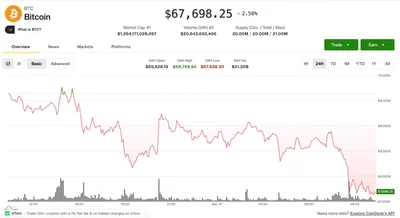
Bitcoin Price and Market Trends Bitcoin has experienced significant volatility in March 2026, with prices falling below key support levels such as $66,000 and $68,000 amid geopolitical tensions and macroeconomic pressures. The ongoing Iran war and disruptions in the Strait of Hormuz have driven oil prices above $100 per barrel, fueling fears of sticky inflation and prompting risk-off sentiment across markets, including cryptocurrencies. Institutional investors have shown caution, with Bitcoin ETFs breaking a four-week inflow streak and large weekly outflows signaling risk aversion. Despite price declines, long-term holders and whales have increased accumulation, suggesting confidence in Bitcoin's future value. Meanwhile, Bitcoin miners are pivoting towards AI infrastructure to offset rising production costs, highlighting structural shifts in the industry. research →

-
Stablecoins Business Payments Stablecoins are rapidly becoming a transformative innovation in business payments, marking what Ripple CEO Brad Garlinghouse calls crypto's 'ChatGPT moment' for enterprises. Companies from Fortune 500 to smaller firms are actively exploring stablecoin integration to enable faster, more efficient, and frictionless payments, especially as AI agents begin to autonomously execute financial transactions. Major players like Ripple have launched their own stablecoins (e.g., RLUSD), while Mastercard's $1.8 billion acquisition of BVNK underscores the urgent industry shift toward blockchain-based payment rails. This evolution is critical as traditional payment systems struggle with inefficiencies, and stablecoins promise to unlock new economic models where machines transact seamlessly without human intervention. research →

-
Wealth Management Growth in India India's wealth management sector is experiencing a significant growth phase driven by increased participation from investors in tier II, tier III, and smaller towns, collectively referred to as 'Bharat'. Enhanced digital penetration and evolving investor behavior in these regions are expanding the investor base from around 60 million to an anticipated 200 million over the next decade. This shift is prompting wealth management platforms to redesign products and educational initiatives tailored to this diverse demographic. The development of financial hubs like GIFT City is also facilitating easier cross-border investing for domestic and international investors by offering a streamlined regulatory and tax environment. These trends underscore a structural transformation in India's investment landscape, highlighting the importance of inclusive growth and technological integration in wealth management. research →

-
Ripple AI Security Upgrade Ripple has introduced a comprehensive AI-driven security strategy to enhance the XRP Ledger's robustness as institutional usage scales. The new approach integrates machine learning tools throughout the development lifecycle, including AI-assisted code scanning, automated adversarial testing, and a dedicated AI-assisted red team that simulates attacker behaviors to identify vulnerabilities proactively. This initiative marks a shift from reactive debugging to systematic vulnerability discovery, enabling Ripple to address security issues faster and with greater confidence. The XRP Ledger, operational since 2012 and handling billions of transactions, benefits from this advanced security framework amid growing complexity and demand. This development is significant as it demonstrates the increasing role of AI in securing critical blockchain infrastructure, potentially setting new standards for ledger security in the crypto industry. research →

-
CLARITY Act Developer Protections US Senator Cynthia Lummis has defended recent revisions to the Digital Asset Market Clarity Act (CLARITY Act), asserting that the bill now offers the strongest legal protections ever for decentralized finance (DeFi) developers. This statement comes amid criticism from crypto legal experts like Jake Chervinsky, who argue that certain provisions, especially Title 3, could impose onerous know-your-customer (KYC) obligations on non-custodial software developers, potentially undermining existing protections. Lummis emphasized bipartisan efforts to amend the draft and urged swift passage to secure these protections. The CLARITY Act's final changes have not yet been made public, but the debate highlights ongoing tensions between regulatory clarity and innovation in the crypto and DeFi sectors. research →

-
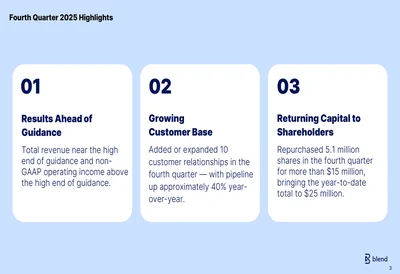
Blend Labs Q4 2025 Earnings Blend Labs Inc. reported its fourth quarter 2025 financial results, showing a mixed performance with revenue beating expectations while earnings per share (EPS) missed forecasts. The company achieved $32.4 million in revenue, marking a 7% year-over-year growth and exceeding analyst estimates by nearly 2%. Despite the EPS miss of $0 compared to the forecasted $0.0038, Blend Labs' stock surged almost 9% in after-hours trading, reflecting investor optimism about the company’s operational improvements and strategic initiatives, including the launch of its AI-driven Blend Autopilot. The company also highlighted a significant 48% year-over-year increase in non-GAAP operating income, signaling improved operational efficiency and a positive shift from a cash-burning model to generating free cash flow. Blend Labs’ strong cash position of $68.3 million with no debt further supports its growth trajectory amid ongoing profitability challenges. research →